
Unbiased headlines. Facts, not spin.
Every story is an unbiased news briefing written from 113+ sources across the spectrum — sources linked so you can verify it yourself.
 defense
Breaking / Critical (9/10)
Event date: September 22, 2026
defense
Breaking / Critical (9/10)
Event date: September 22, 2026
Xi Arrives for Trump Summit as Customs Data Show China Still Supplying Iran's Military
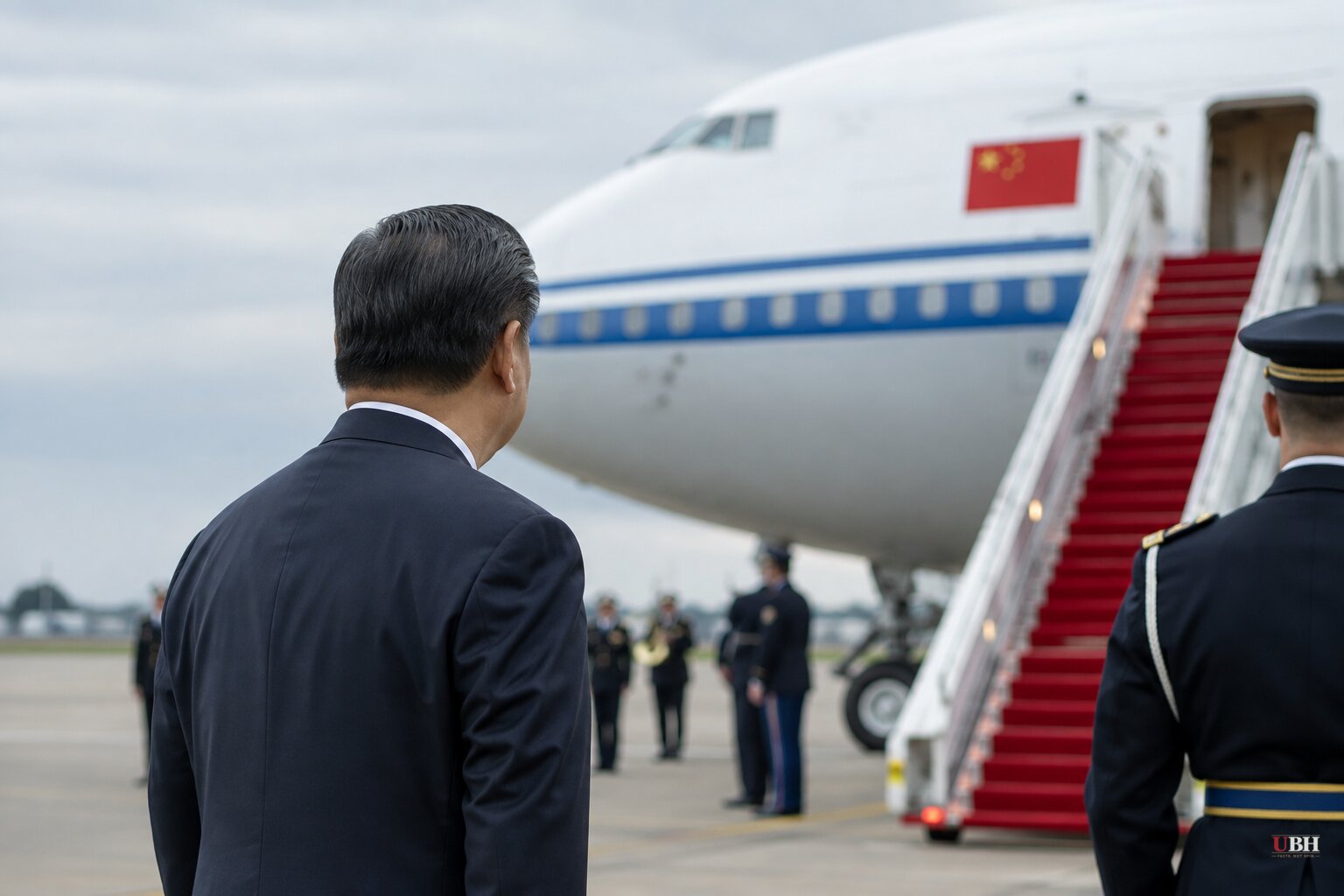
President Trump greeted Chinese President Xi Jinping on the tarmac at Joint Base Andrews on Wednesday evening, September 23, an unusual welcome ahead of their summit scheduled for Thursday, September 24, according to Breitbart. Trade, artificial intelligence and Taiwan top the official agenda. China's continuing support for Iran during its ongoing conflict with the United States and Israel is not on that list, but it hangs over the meeting anyway.
Iranian customs data analyzed by The Wall Street Journal shows around 1,300 shipments of "dual use" electronics components moved from China to Iran's Ministry of Defense through the end of June this year. One shipment landed in Tehran the same day Beijing was publicly touting its role in brokering a summer truce between Washington and Tehran. Two days later, more than a dozen additional shipments worth over $6 million arrived carrying parts usable in drone production, per the Journal's reporting.
The Journal also reported that satellite imagery obtained from Chinese entities has been linked by U.S. officials to an Iranian ballistic missile strike on the Muwaffaq Salti Air Base in Jordan on July 17, which killed three American service members and wounded four more, according to the Daily Wire. Chinese companies have also supplied chemical precursors used in the type of missile fired in that attack, per a document reviewed by the Journal.
U.S. officials have not accused the Chinese government itself of direct involvement in the strike. When American officials raised the imagery issue with their Chinese counterparts, those officials demanded proof, the Daily Wire reported. The Trump administration maintains that no foreign government's intelligence has meaningfully improved Iran's ability to hit U.S. assets, even as Tehran's strikes have grown more precise in recent months following earlier U.S. and Israeli hits on Iranian radar and intelligence sites.
Asked about the Chinese satellite-imagery link, Trump said "we spy on them" and China "spies on us," according to the Daily Wire. The Center for Strategic and International Studies notes that major Chinese companies are legally required to seat Communist Party members on their boards, giving Beijing potential leverage over decisions like imagery sales, though that structural fact doesn't by itself prove state direction of any single transaction.
The Oil and Money Pipeline
China has become the only major buyer of Iranian oil under U.S. sanctions, according to the Journal's reporting via LiveMint, funneling billions of dollars to Tehran this year through front companies and Chinese banks that route payments in yuan to dodge U.S. financial oversight. Commodities analytics firm Kpler puts China's share of Iran's seaborne oil exports above 80 percent, according to RFE/RL. Iran, meanwhile, accounts for barely 1 percent of China's total global trade, per Chinese government figures cited by RFE/RL. This asymmetry was acknowledged obliquely by Chinese Foreign Minister Wang Yi when he called the countries "comprehensive strategic partners" at a September 16 meeting with Iranian Foreign Minister Abbas Araghchi in Beijing, their fourth meeting in three months.
Wang urged "all parties" to reopen the Strait of Hormuz but offered no concrete mediation plan and stopped short of pressuring Iran directly, RFE/RL reported. "China isn't going to do the heavy lifting," Elizabeth Freund Larus of the Pacific Forum think tank told RFE/RL, arguing Beijing benefits geopolitically from a conflict that is draining U.S. military resources even as it raises China's own energy costs.
Those costs are real. Shanghai crude oil futures hit a record 929.4 yuan, or $137.80 a barrel, this month after Iranian-backed proxies struck Saudi Arabia's East-West pipeline, according to RFE/RL. China's strategic stockpiling, which the U.S. Energy Information Administration estimates added roughly 1.1 million barrels a day to reserves last year, has cushioned Beijing from the worst of the price shock.
On the U.S. side, the war has cost the Pentagon more than $38 billion through August 1, according to the Congressional Budget Office, and pulled enough military assets from the Pacific that the U.S. currently has no deployed aircraft carrier in the Western Pacific for the first time since World War II, RFE/RL reported.
Beijing's Defense, and What's Left Unresolved
China's government says it "consistently abides by international rules" and opposes "attempts to smear China by associating it with the conflict," per its statement to the Journal. Beijing has long maintained it strictly regulates dual-use exports and rejects unilateral U.S. sanctions as violations of international law, a position it has repeated for years regardless of the specific conflict. That is the strongest good-faith version of Beijing's case: dual-use goods have legitimate civilian applications, and Washington's sanctions regime is itself contested internationally, not universally recognized as legally binding.
The Arab Center Washington DC argues China's actual pattern in the Middle East is narrower than either full mediator or full spoiler. Beijing uses regional crises to gain leverage over Washington while working to insulate its own economy from the fallout, rather than resolving the underlying conflict. The Trump administration, for its part, has sanctioned several Chinese satellite-imagery firms tied to Iran but has not sanctioned major Chinese banks under its Treasury-led "Operation Economic Outcast" campaign, according to the Arab Center, a restraint that mirrors Trump's reluctance to let the Iran issue derail trade talks with Xi.
Whether Trump raises any of this directly with Xi at Thursday's summit remains an open question. Treasury Secretary Scott Bessent and U.S. Trade Representative Jamieson Greer have reported progress on trade terms ahead of the meeting, according to Breitbart, but left unresolved what any extension of the current arrangement would look like. No new sanctions on Chinese state banks or a broader rebuke of Beijing's Iran ties have been announced as of Wednesday, September 23.
Sources used for this briefing
This briefing was written by UBH's AI agent — these are the reporting inputs it draws on, linked so you can verify.


