
Unbiased headlines. Facts, not spin.
Unbiased Headlines is an independently owned news organization. We bring you the facts, not opinions, written fresh from 110+ named sources. Sources linked so you can verify it yourself.
 defense
Notable (6/10)
Lowy Institute: US Lead Over China in Asia Falls to Record Low, Authors Blame Iran War
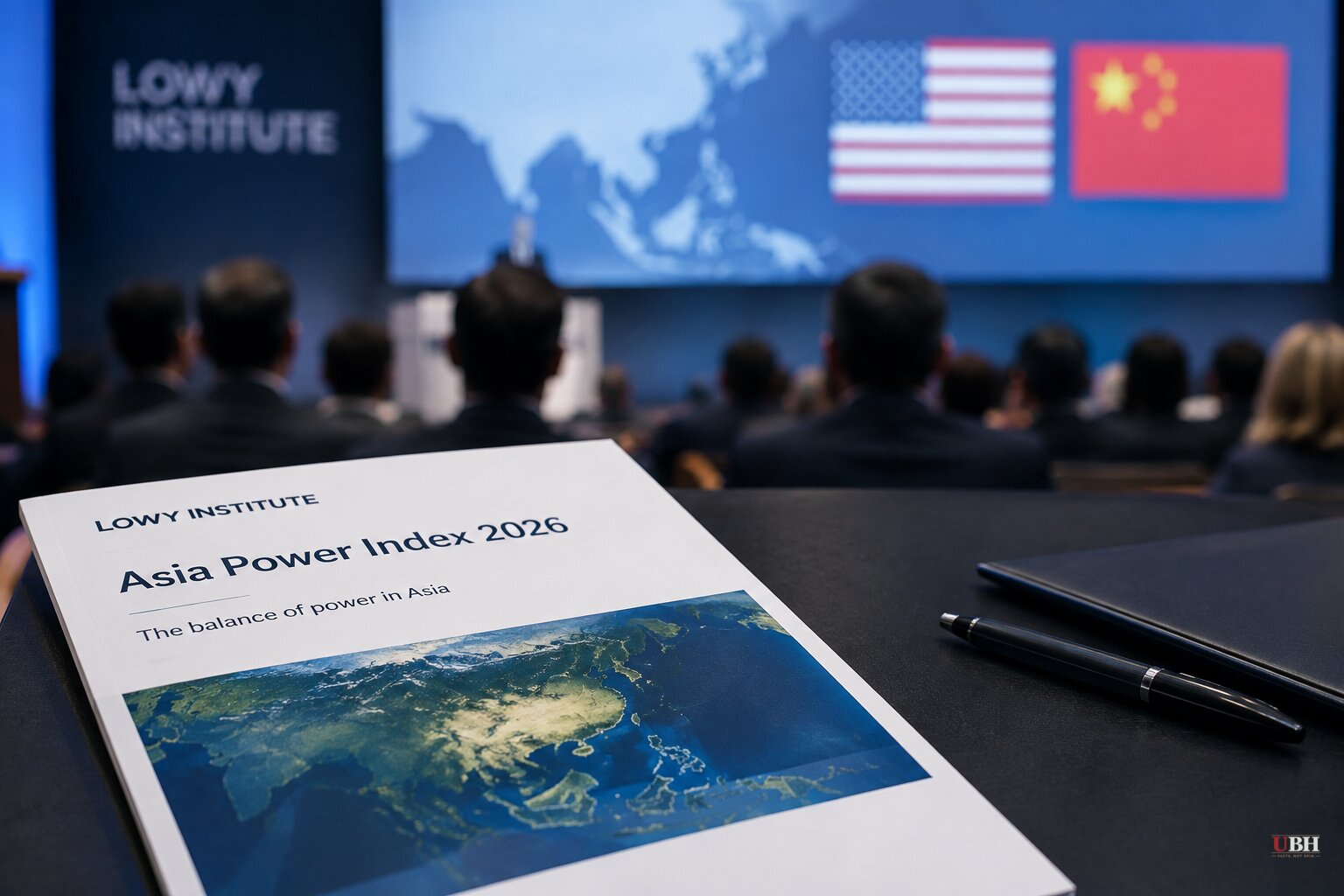
The gap between American and Chinese power in Asia is the smallest it has ever been, according to the Lowy Institute's latest Asia Power Index.
The US scored 78.9 out of 100 across 131 metrics covering military capability, economic strength and cultural influence. That is only 5.3 points ahead of China. The US advantage is the lowest since the annual survey started in 2018. The military capability gap between the two countries is the narrowest on record.
The index is published by a Sydney think tank. It is a scorecard, not a battlefield measurement. But the direction of travel is the point.
What the authors blame
Report authors Hunter Marston and Jack Sato argue the narrowing owes more to Washington's missteps than to any major advance by Beijing. They say the episode shows how quickly a superpower can erode its credibility.
Their chain of reasoning starts with the coordinated US and Israeli strikes on Iran in February. The authors say the conflict fueled perceptions that Washington has lost interest in Asia.
They point to three specifics. The Trump administration moved military resources from the Indo-Pacific to the Persian Gulf to support the war. US strikes on Iran depleted American missile stocks. And the US military held fewer joint exercises and defense dialogues over the past year with Australia, Japan and South Korea.
The authors do not let Beijing off. They credit Xi Jinping with continuing to expand China's maritime warfare capabilities. They write that China is increasingly willing to use naval power against the territorial claims of smaller countries such as the Philippines, testing whether Washington will honor its security commitments.
The Gulf bases question
The same war has opened an argument in Washington about the other end of the American footprint.
In a paper dated November 18, Brian Haggerty of Defense Priorities argues the US-Israeli war with Iran "shattered" the assumption that American forces in the Persian Gulf guarantee the security of Gulf Arab partners. He wants a significantly smaller footprint and a largely offshore posture. He says fears about a drawdown are overblown, and that a reset could also help nuclear talks with Iran.
The opposing view is well established. Reuel Marc Gerecht and Ray Takeyh made it in a June 4 Wall Street Journal op-ed titled "The U.S. Needs Its Mideast Bases." Haggerty summarizes what proponents of a permanent presence argue: without it, Gulf states would be attacked, destabilized, extorted or seduced by China, with a possible global energy crisis, an emboldened Iran or a foreign hegemon controlling Gulf oil as the result. The 2026 National Defense Strategy and CENTCOM's May 19 posture statement both cite Gulf security and deterring Iranian attacks.
The Lowy findings sit awkwardly beside that case. The Gulf mission is the stated reason forces moved out of Asia, and China is the competitor that gained ground.
Yemen and the limits of the US role
A TomDispatch essay, republished by Foreign Policy in Focus, argues the war's failure to meet its aims produced the most dramatic American retreat from a region since Vietnam in 1975. That is the essay's judgment, not an established finding, and it comes from a clearly anti-intervention vantage point.
The essay's facts are more concrete. It says fighting between Saudi Arabia and Yemen's Houthi-led Ansarullah government reignited in July 2026 when Saudi Arabia struck Sanaa International Airport. It says the Houthis briefly closed Saudi Arabia's own airport in October. It says Pakistan, Türkiye and Egypt have pledged to defend the kingdom, while President Trump has repeatedly declined to intervene on the Saudis' behalf.
The essay also argues the Iran war exposed Saudi vulnerability to Iranian drones and missiles. These are its claims, and they rest on a single account.
Harvard's Stephen Walt, a realist, makes a broader version of the argument in Foreign Policy. He writes that the Iran conflict is ending a century of great-power intervention in the Middle East, with regional actors deciding the region's fate more than outsiders do. His case rests on the record of the last two decades. The US failed to build a stable order in Iraq and Libya. Saudi Arabia failed to eliminate Ansar Allah in Yemen. Israel has not eradicated Hamas or Hezbollah.
The conservative defense argument
The case for rebuilding is also on the table. Rebeccah Heinrichs of the Hudson Institute, reviewing Roger Zakheim's new book Peace Through Strength in National Review, argues that America still relies on the military buildup Ronald Reagan pushed through, and that today's Republicans, Trump included, still claim Reagan's mantra. She calls for more Reaganesque statecraft.
She also notes a basic failure in Congress. Since 2018, she writes, it has been unable to pass the annual National Defense Authorization Act without a stopgap continuing resolution.
That is a taxpayer problem as much as a strategic one. Money spent on a Gulf war is money not spent keeping Taiwan Strait and South China Sea deterrence credible.
Diplomacy continues
The Lowy release follows a trilateral meeting among Trump, Xi and Russian President Vladimir Putin on the sidelines of the APEC summit in Shenzhen. Xi and Trump agreed at APEC that humans should always be involved in military decisions that use artificial intelligence.
Australia is trying to position itself. Prime Minister Anthony Albanese urged the three leaders to make sure AI is developed and deployed safely. Foreign Minister Penny Wong is expected to say Australia should have a role in forming AI safeguards, according to notes from her speech. She is also expected to say every advanced AI company operating in Australia will have to build in security and safety protections.
Solomon Islands Prime Minister Matthew Wale is set to visit Canberra to strike a comprehensive treaty with Australia. The Albanese government is using the deal to push back on China's growing influence in the Pacific. Whether a treaty can substitute for the American exercises and dialogues the Lowy authors say have thinned out is the open question.
Sources used for this briefing
6 links from 6 independent newsrooms (syndicated copies of the same report count once)
These are the sources it draws on, linked so you can verify.


