
Unbiased headlines. Facts, not spin.
Unbiased Headlines is an independently owned news organization. We bring you the facts, not opinions, written fresh from 110+ named sources. Sources linked so you can verify it yourself.
 defense
Major Story (7/10)
Event date: November 18, 2026 ·
IAEA Says North Korea Is Expanding Yongbyon Enrichment Plant as Trump Leaves Asia Without Meeting Kim
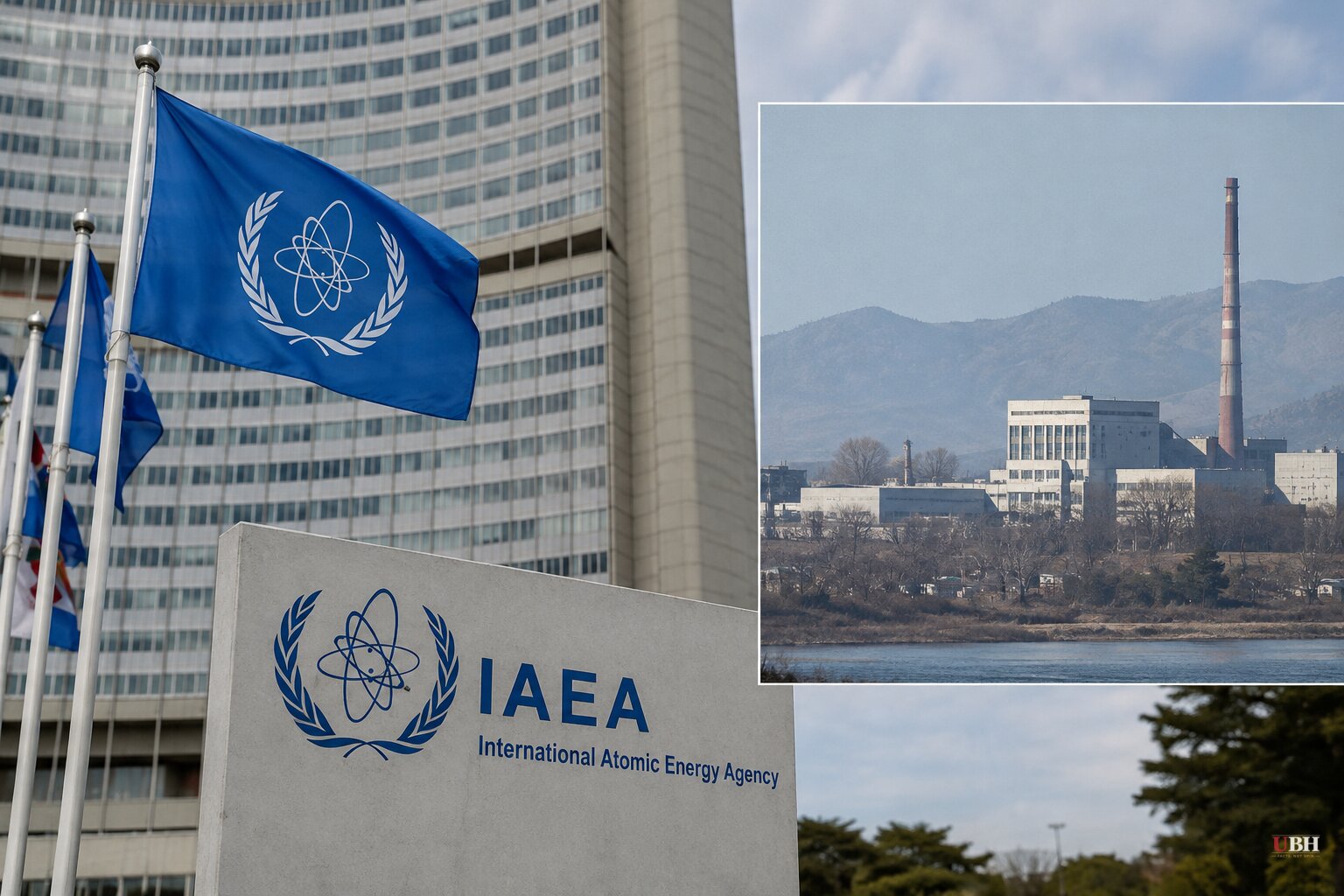
North Korea is adding capacity to make nuclear weapons material, and it did so while Washington was talking about talks.
IAEA Director General Rafael Grossi told the agency's board of governors in Vienna on Wednesday, Nov. 18, that "since mid-September 2026, a further extension to the original Yongbyon enrichment facility has been under construction with the new extension externally complete by late-October 2026." He called the ongoing expansion "a cause for serious concern."
The IAEA has had no inspectors in North Korea since Pyongyang expelled them in 2009. The agency tracks the program through satellite imagery and open-source information.
What Yongbyon means
North Korea calls Yongbyon "the heart" of its nuclear program. Nuclear weapons can be built from highly enriched uranium or weapons-grade plutonium, and the North has facilities for both at the complex.
Observers say the North has moved to build more enrichment capacity at Yongbyon and elsewhere since Kim's diplomacy with Trump collapsed in 2019. Last year, South Korean Unification Minister Chung Dong-young said the North was operating four enrichment facilities and running them every day.
The North has also enshrined its nuclear status in law and declared its arsenal permanent and irreversible.
Trump's Asia trip
Trump spent the week in Asia for the APEC summit in Shenzhen. He held a three-way meeting there with Chinese President Xi Jinping and Russian President Vladimir Putin, the first joint session of the three leaders, with nuclear weapons among the main topics.
Before leaving Washington, Trump said denuclearization would come up. "We're going to talk about denuclearization – tough subject, because it's very hard for any of us to say we'll get rid of our nukes," he said. On Kim joining, he said: "He may come. I don't know. That's up to President Xi."
Kim did not come. Trump left Asia late Thursday without meeting him and suggested he was too busy to fit it in. He said the two will meet at some point.
Secretary of State Marco Rubio said no meeting with Kim was scheduled for the China trip, but that the president is prepared to begin a new dialogue with Pyongyang.
Pyongyang has not responded to Trump's remarks. North Korean state media instead showed Kim touring a ski resort and Mount Paektu, then a naval university on Wednesday, where he stressed maritime defense. On Friday he inspected school equipment and teaching aids at factory sites, the Korean Central News Agency said Saturday. "Science and education are the clearest expression of our revolutionary outlook on the future generations," Kim said, according to the agency.
The joint declaration from the Trump-Xi-Putin meeting heralds a dialogue on reducing nuclear risks and preventing proliferation. According to analysis published by Tomorrow's Affairs, it does not mention North Korea.
Two readings of Kim's intentions
Rubio has argued that Kim is a different problem than Iran. Speaking at the Federalist Society's National Lawyers Convention in Washington last week, he said: "He just wants to survive in his regime, and I'm not excusing the terrible things that have happened there. I'm just saying. But he's not expansionist. He's not looking to, like, invade Japan and invade China, whatever."
Robert Carlin, a former State Department official with roughly 50 years of experience analyzing North Korea, sees something else. He told CBS News that Kim "is preparing something," and that the country has to "take seriously the possibility" that Kim is positioning himself to make "some sort of move against U.S. assets in the region."
Carlin points to a flurry of visible weapons tests, "pretty aggressive probing along the demarcation line" and threatening statements. Since the start of October, North Korea has test-fired more than a dozen missiles, the most concentrated series since 2023. Kim has watched some of the launches with his teenage daughter, Kim Ju Ae, who is widely viewed as a possible successor.
The weapons push sits alongside a diplomatic one. On Oct. 24, Kim made a surprise appearance at the official opening of the new Yalu River Bridge linking North Korea and China. The Chinese side was finished 12 years ago, and North Korea only recently completed its section.
Analysts say Pyongyang's closer ties with Beijing and Moscow reduce its incentive to deal with Washington. That complicates Trump's position after his party's midterm defeat.
The price of talks
Kim has said he could return to talks if the U.S. drops what he calls its "hostile policy" and respects the North's status as a nuclear state. In September 2025, he ruled out trading away his weapons for sanctions relief. Trump called North Korea a nuclear power on Inauguration Day in January 2025.
Experts say Pyongyang wants recognition as a nuclear state so it can demand an end to UN economic sanctions.
Tomorrow's Affairs argues that any deal has to separate three things: a ban on test explosions, a freeze on production of nuclear material, and a cap on warheads. A test ban alone, it says, would let the White House claim it halted the threat while enrichment continues. Neither side has publicly offered to stop testing in exchange for sanctions relief.
The new Yongbyon extension is already externally complete. Whether Washington would accept a test moratorium that leaves it running is the question any new dialogue would face first.
Sources used for this briefing
6 links from 6 independent newsrooms (syndicated copies of the same report count once)
These are the sources it draws on, linked so you can verify.


