
Unbiased headlines. Facts, not spin.
Unbiased Headlines is an independently owned news organization. We bring you the facts, not opinions, written fresh from 110+ named sources. Sources linked so you can verify it yourself.
 defense
Major Story (8/10)
Event date: November 19, 2026 ·
Poland Calls Russian Missile and Drone Landings on Its Soil an 'Intentional Provocation'
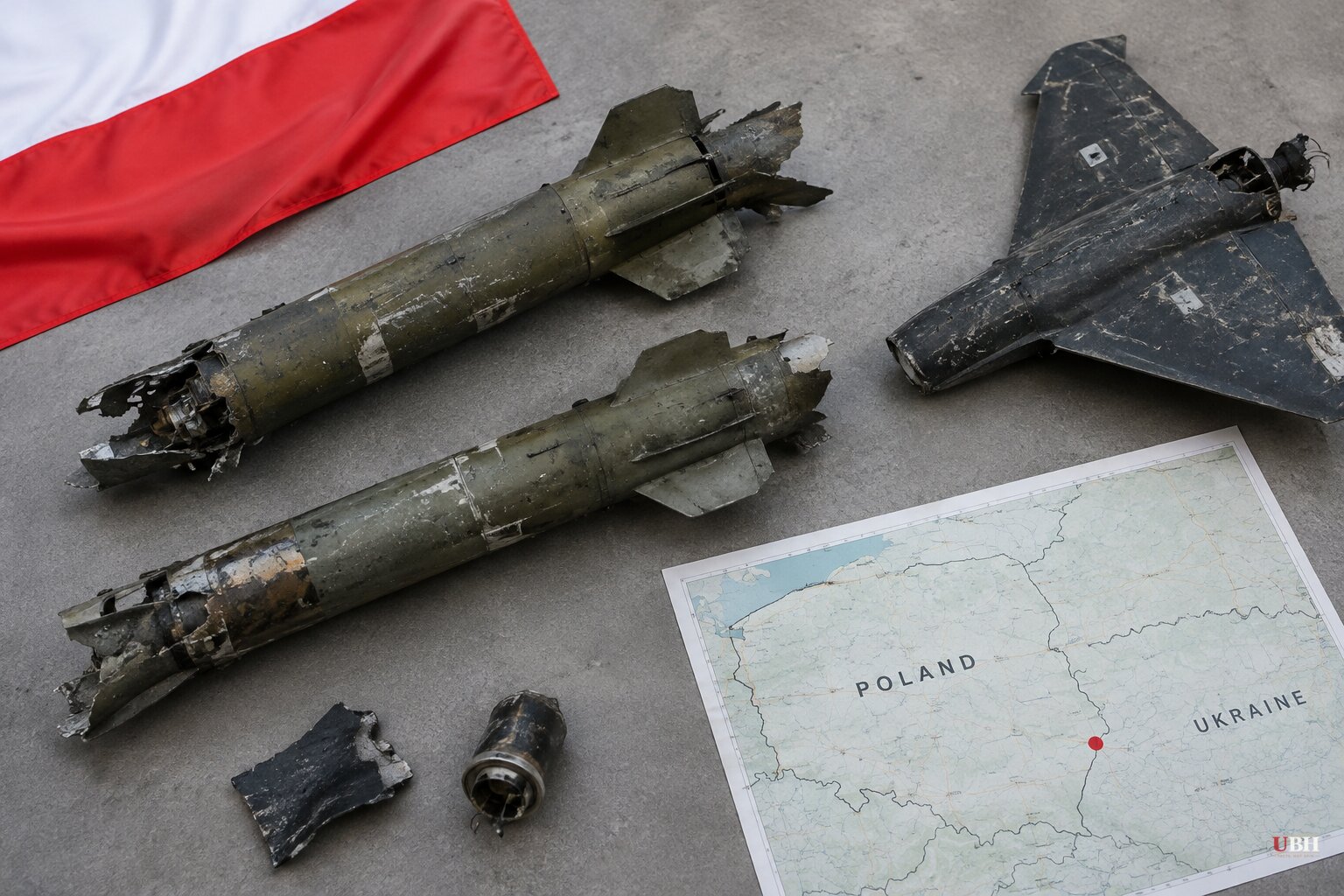
Two Russian missiles and a suspected drone came down in southeastern Poland on Friday, Nov. 20. Polish Prime Minister Donald Tusk says it looks deliberate.
"We know that what landed on Polish soil came from Russia," Tusk said. "It does not look like an accident. It appears that we are dealing with an intentional provocation." He said that assessment is shared by Poland's partners, including inside NATO.
No injuries or damage have been reported. Moscow had offered no immediate comment on the missiles, the drone or the exercises nearby.
What came down, and where
Poland's defense minister said three Russian weapons, believed to be two missiles and a drone, entered the airspace of southeastern Poland. Officials said a Kh-101 cruise missile fell roughly 50 kilometers (30 miles) from the Ukrainian border. What they believe was a jet-powered drone hit about 30 kilometers (20 miles) from the border.
One of the missiles is believed to have crashed about 35 kilometers (22 miles) from where military exercises were under way.
CCTV and phone images gathered by Poland's PAP news agency show a large, loud explosion and a bright flash, apparently in a wooded area.
Poland scrambled fighter jets and activated Patriot missile defenses in the southeast. Allied aircraft joined the response, including Swedish JAS 39 Gripens, a Dutch A330 tanker and Polish F-16s.
The timing
European troops are in the middle of a two-week exercise in southeastern Poland that began Nov. 9. They are rehearsing a possible postwar mission in Ukraine to help stabilize the country and rebuild its military. Tusk said the incident appeared timed to coincide with those drills.
The weapons came down during one of the largest Russian attacks of the war, according to Ukrainian President Volodymyr Zelenskyy. He said Russia fired more than 400 drones and 110 missiles overnight into Friday, including cluster munitions. Zelenskyy said at least eight people were killed.
Some Russian weapons hit the Austrian embassy in Kyiv and landed near the Netherlands embassy. France responded by calling for a UN Security Council meeting. "Russia will have to answer for this," French Foreign Minister Jean-Noel Barrot wrote.
The barrage came hours after Putin vowed to retaliate for Ukrainian strikes earlier in the week on the bridge linking occupied Crimea to the Russian mainland. That bridge is vital to Moscow's war effort.
NATO's response
NATO Secretary General Mark Rutte called it a "grave violation" of Polish airspace. "This incident is clearly dangerous, a consequence of Russia's ongoing war against Ukraine," he said. He added that NATO stands "in solidarity with Poland and will continue to strengthen our ability to deter and defend."
Article 5 of NATO's founding charter treats an attack on one of its 32 members as an attack on all. Drones have repeatedly strayed into Poland and other NATO airspace since the full-scale invasion began on Feb. 24, 2022, mostly near Ukraine but not exclusively.
What separates this from earlier incursions is the claim of intent. Tusk is saying Russia meant it. Moscow has offered no account, so whether the weapons were aimed, strayed or were diverted is a question only Russia can answer, and it hasn't.
Diplomacy runs on a separate track
The incident follows a Thursday summit in Shenzhen, China, where President Trump met Xi Jinping and Vladimir Putin. Trump's envoy Steve Witkoff said the war was discussed. Fox News Digital's live coverage carried Trump rating the summit "12 out of 10" and saying Putin wants a Ukraine deal. Trump said he would hold a "historic" press conference Friday.
Trump's other envoy, Jared Kushner, told European leaders the U.S. believes Russia is "comfortable" with NATO-like security guarantees for postwar Ukraine. That would be a possible step toward compromise.
Russia's own diplomats say otherwise. Deputy Foreign Minister Sergei Ryabkov said Friday that even quasi-membership in NATO for Ukraine would be unacceptable, according to Interfax. "We discuss security guarantees primarily in terms of ensuring the security of our own country," he said.
That is a direct contradiction of Kushner's read, within about a day of it being delivered. The postwar force now training in Poland is exactly the kind of guarantee Moscow says it will not accept.
Rhetoric from Moscow
Russian state TV has aired calls for escalation after the Crimea bridge strike. Retired Col. Mikhail Khodarenok, a military commentator, said on state TV that all bridges in Kyiv should be "razed to the ground" and that conventional operations should be accompanied by "demonstrative nuclear explosions." He is a TV commentator, not a government official. The Kremlin has not adopted that position in anything cited here.
A wider pattern across Europe
The Atlantic Council describes a surge of suspected Russian hybrid incidents in recent weeks. Those include bomb threats that disrupted airports in Rome, Copenhagen, Prague, Warsaw and Lisbon in early November, and cyberattacks on supermarket frozen-food operations. European security agencies are probing whether Russia is behind them, and none has been confirmed as Kremlin-directed. The Atlantic Council also points to an attempted bombing of Leipzig Airport in August 2026, which it says was widely read as a turning point.
Those incidents are separate from the missiles in Poland, where the origin is not in dispute. What is in dispute is intent, and whether the NATO allies who have promised to defend every inch of alliance territory will treat this as more than another statement-worthy incident.
The next concrete step is the UN Security Council meeting France has requested. Moscow, a permanent member with a veto, will have to answer there for what landed in Poland, or decline to.
Sources used for this briefing
6 links from 6 independent newsrooms (syndicated copies of the same report count once)
These are the sources it draws on, linked so you can verify.


