
Unbiased headlines. Facts, not spin.
Unbiased Headlines is an independently owned news organization. We bring you the facts, not opinions, written fresh from 110+ named sources. Sources linked so you can verify it yourself.
 defense
Major Story (7/10)
CBO Prices 15 Trump-Class Battleships at $275 Billion, $118 Billion Above Navy Estimate
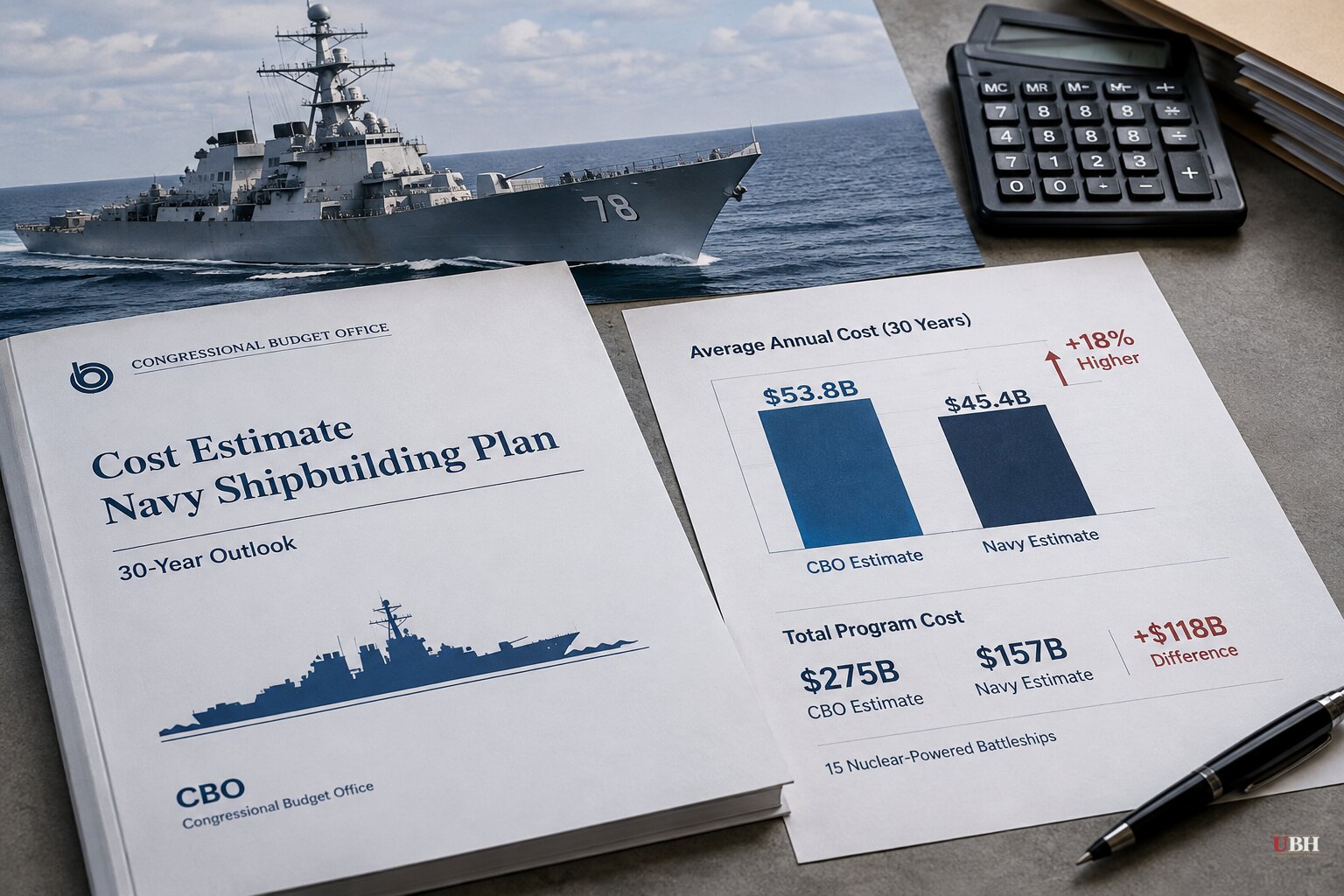
The Navy's plan to build 15 nuclear-powered Trump-class battleships would cost $275 billion, not the $157 billion the Navy projects, according to a Congressional Budget Office analysis released Thursday, Nov. 19.
That works out to about $18.3 billion per ship, compared with the Navy's estimate of $10.4 billion. The $118 billion gap between the two battleship figures shows the scale of the financial burden the program could place on the Navy's long-term shipbuilding budget.
The CBO numbers
The CBO's review covers the Navy's 2027 shipbuilding plan, which spans 2027 to 2056. Total shipbuilding costs would average $53.8 billion a year in 2026 dollars, the CBO found. That is about 18% above the Navy's own figure of $45.7 billion a year, and 41% above average annual appropriations over the past five years.
The CBO said the Navy's costs were also understated because some ship designs proved harder to build than expected, and "the estimated costs of some ships were unrealistically low in earlier shipbuilding plans."
To carry out the plan, the Navy's total budget would climb from about $310 billion today to roughly $415 billion in 2056. That figure includes operating ships, buying aircraft and weapons, and funding the Marine Corps.
The plan would grow the battle force from 286 ships to 398 by 2056. It calls for 371 new ships, including seven carriers, 38 Virginia-class submarines, 57 destroyers and 79 frigates.
The CBO also warned that the Navy's overall firepower could decline until 2035 as older missile-capable vessels are retired faster than new ones enter service.
A design that cuts against the Navy's own doctrine
The CBO flagged a contradiction. "Much of the additional costs in the 2027 plan stem from the navy's decision to purchase 15 large, heavily armed battleships, which would concentrate firepower in a few large ships and thus would be at odds with the navy's stated goal of distributing it among a greater number of ships or vessels," the report said.
Trump announced the program in December 2025 as part of his "Golden Fleet." He first called for two ships, then eight more, with as many as 20 or 25 possible. He said the ships would be "100 times more powerful than any battleship ever built" and would "inspire fear in America's enemies all over the world."
The administration's argument rests on China. Officials have warned the U.S. trails Beijing in shipbuilding capacity and output. Asked about that gap, Trump said: "We want respect, we're going to have it."
A fleet already stretched by the Iran war
The cost warning lands while the Navy is straining under the war with Iran. Acting Navy Secretary Hung Cao told a Senate confirmation hearing Wednesday, Nov. 18: "This war, again, I know it's a strain on our navy."
Deployments have stretched to 10 or 11 months, against a typical seven. Maintenance and repairs have been deferred to keep ships at sea. The USS Abraham Lincoln went 265 consecutive days without a port visit.
The Navy had no carrier in the Pacific for about three months, until the USS George Washington returned from the Middle East on Wednesday. Breitbart's UPI-sourced account says it was only the second such gap in two decades.
Kevin Rowlands, a naval analyst at the Royal United Services Institute, told the Guardian: "The real problems will arise further down the line if the war continues. Every long deployment will have a knock on effect for maintenance and people in future."
What the war has cost
Cao's term as acting secretary drew fire from Democrats. Sen. Richard Blumenthal told him: "The world is less safe as a result of the Iran war," and said the Navy has been "stretched beyond sustainable limits under your watch."
The war's price tag is itself in dispute. Pentagon official Arthur Miller told lawmakers the cost was an estimated $48 billion as of Nov. 13, covering munitions, equipment replacement and operations. That figure excludes repairs to Middle East installations damaged since February. Sen. Elissa Slotkin told the same committee the conflict has cost the U.S. an estimated $260 billion.
The two numbers differ by more than $200 billion.
What Congress does next
The CBO's number lands in the middle of the appropriations fight. Senate appropriators this week proposed cutting to zero the $1 billion the Navy requested in advance procurement for the Trump-class ships this fiscal year, according to the Guardian.
Whether the House follows, and whether the Navy revises its $10.4 billion per-ship figure, will decide if the program survives at the size Trump announced. Cao's confirmation vote is also still pending.
Sources used for this briefing
7 links from 7 independent newsrooms (syndicated copies of the same report count once)
These are the sources it draws on, linked so you can verify.


