
Unbiased headlines. Facts, not spin.
Unbiased Headlines is an independently owned news organization. We bring you the facts, not opinions, written fresh from 110+ named sources. Sources linked so you can verify it yourself.
 defense
Breaking / Critical (9/10)
Event date: November 20, 2026 ·
Iran Says It Struck Four US Bases in Bahrain, Bahrain Says It Intercepted Attacks, as Tanker Convoy Talk Builds
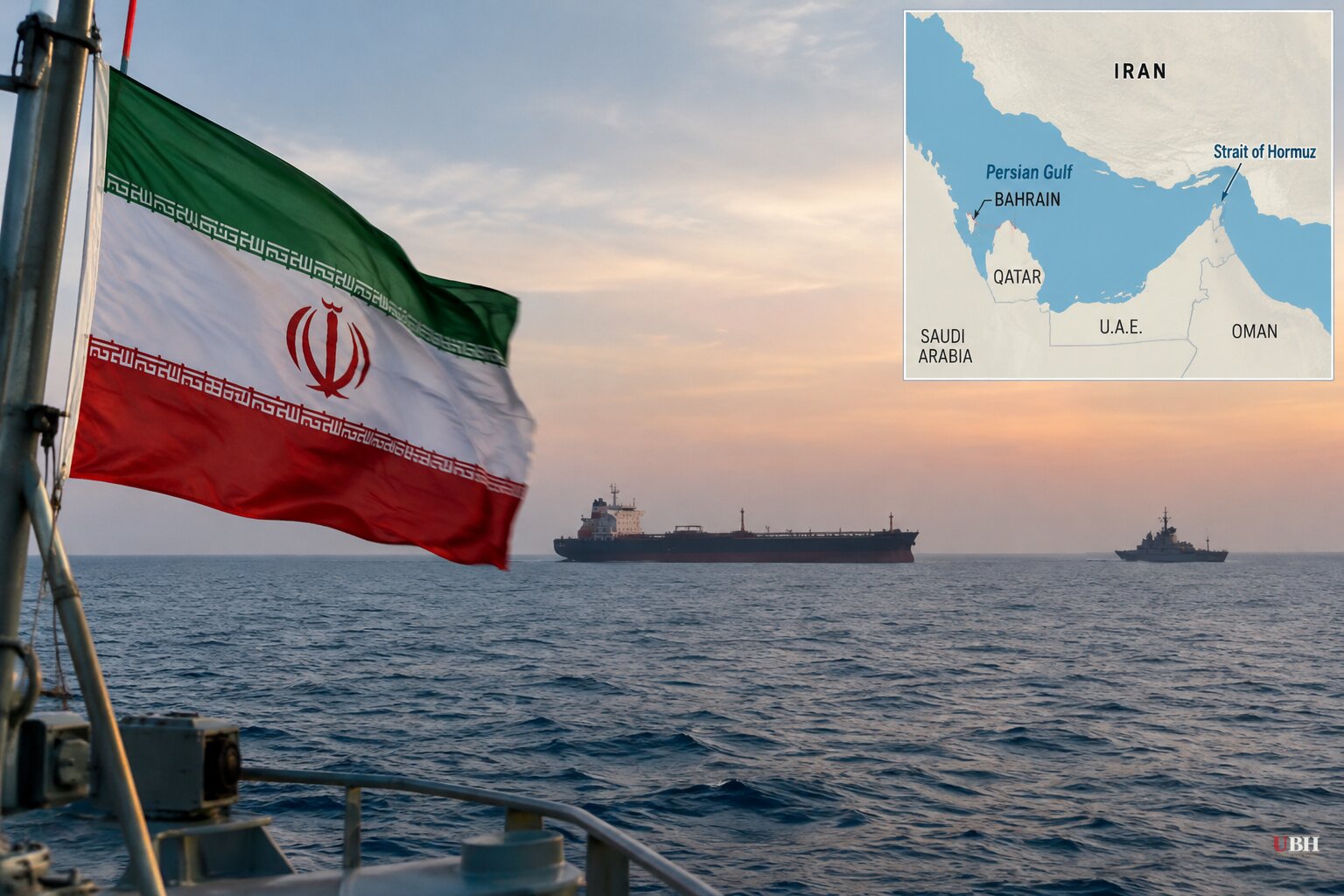
Since the war began Feb. 28, the "no war, no peace" phase of the US-Iran confrontation has repeatedly flared and settled. Saturday, Nov. 21, brought the sharpest flare-up yet in this latest round.
Two waves on Bahrain
Iran fired drones and ballistic missiles in two waves at four US bases in Bahrain, home of the Navy's 5th Fleet headquarters, according to Iran's semi-official Fars news agency and Bahrain's government. Fars named two of the targets: Sheikh Isa and Juffair.
Bahrain said its air defenses intercepted several of the attacks. The Interior Ministry said a fire broke out at a civilian industrial compound. No injuries were reported.
Explosions were reported in Sirik in southern Iran shortly after the Bahrain attack. No party has said who was responsible or what was hit.
Iranian army spokesman Brig. Gen. Mohammad Akraminia warned the US on Saturday that any attack on Iran would draw "a decisive and immediate response." He said Iran's defense "will not be limited to a specific geographical area."
Tankers hit near Hormuz
At least three oil tankers were attacked in or near the Strait of Hormuz on Saturday. The UK military's maritime security center, UKMTO, said two tankers leaving the Persian Gulf were struck separately by projectiles early in the day. No casualties were reported.
The Iranian navy said in a statement carried on state media that a tanker hit a naval mine east of the strait and caught fire. State media also said Iranian forces carried out their most "intense and varied" operations yet overnight to stop vessels.
Earlier Saturday, US Central Command denied Iran's claim that a surface-to-air missile damaged a US F-16 on Friday evening.
How the week got here
The Bahrain strikes follow a run of exchanges that ended a roughly two-month lull. Iran hit US facilities in Bahrain on Friday and Sunday of last week, then again Tuesday with drones aimed at a radar installation. Bahrain said it intercepted those drones, and the US military said they caused no damage or injuries.
A US fighter jet then struck a Revolutionary Guard missile launch site on Qeshm Island, a US official said, speaking anonymously. Iran responded Wednesday by targeting a US air base in Kuwait and hitting Bahrain again.
Iran has said its recent attacks were responses to US drone surveillance and an attack on Iranian communications towers.
The UAE's state oil company ADNOC said one crew member on its tanker was missing and 11 others were injured after a Tuesday attack in the strait.
The blockade and the convoy idea
The US naval blockade is the pressure point. RFE/RL reports Iran's crude and condensate export revenue is projected to hit zero by mid-December.
On Nov. 19, the IRGC-affiliated Fars published a column proposing that Iran send a group of tankers through the blockade. Iranian media call it the "Fereydun Plan." The column said any US move against the vessels should trigger strikes on oil facilities in Qatar, Saudi Arabia and the UAE. "We will not wait for America's permission," it said.
IRGC spokesman Hossein Mohebbi told a Tehran gathering the same day, "We will not allow the continued naval, land, and air blockade imposed on our country." Foreign Minister Abbas Araghchi said Friday that Iran would break the blockade, according to Iran International.
Parliament national security committee chairman Ebrahim Azizi posted that Iran "cannot be blockaded." Political analyst Mostafa Najafi, described in Iranian media as an adviser to Supreme National Security Council Secretary Mohsen Rezaei, wrote on X that Supreme Leader Mojtaba Khamenei ordered an end to the "neither war nor peace" situation some time ago. That is one analyst's claim, and no official has confirmed it.
No Iranian official body has formally announced a convoy. Reports say more than 14 Iranian-flagged tankers are gathering near Kharg Island, the departure point for roughly 85% to 90% of Iran's crude exports. That comes from satellite and vessel-tracking data plus Iranian media, and a Persian-language Euronews report called the information "unofficial." No independent confirmation has emerged that any convoy has left.
Samir Madani of TankerTrackers told Reuters on Thursday that a tanker was taking on Iranian crude from another vessel in the Gulf. If it clears the blockade area, he said, it would be "the first successful seaborne export of Iranian crude oil since mid-July." Asharq Bloomberg reported about 200,000 barrels moved between the tankers Olim and Hao Fan near Kharg with their trackers switched off.
Tehran's argument
Tehran argues the pressure cuts both ways. Deputy Foreign Minister Kazem Gharibabadi said Sunday, Nov. 15, that Iran remains "in a state of war" legally. He said sanctions affect Iranians' lives but the damage to "the global economy, global energy markets, financial markets and the US itself is far heavier."
Media analyst Alireza Shiva put it this way: "You cannot target Iran's oil exports while expecting the energy exports of others" to continue. That is the logic behind the threats against Gulf energy facilities.
What the US has signaled
President Donald Trump has sent mixed signals. He has said new strikes are highly unlikely, but he has also sent a third aircraft carrier and thousands more troops to the region. He reportedly told Vice President JD Vance talks aren't needed at this time. Qatari mediation continues but has not produced a deal.
Hamidreza Azizi of the International Crisis Group wrote that the accumulation of incidents across multiple fronts "increases the risk of miscalculation and escalation beyond what either side originally intended."
The open question is whether the Kharg tankers sail, and what Washington does if they do. US forces have retaliated for each recent Iranian strike. Brent crude was near $95.69 a barrel on Nov. 16 even as incidents mounted, so any attack on Gulf energy facilities would test that calm.
The mid-December revenue projection leaves Tehran a few weeks to decide.
Sources used for this briefing
7 links from 7 independent newsrooms (syndicated copies of the same report count once)
These are the sources it draws on, linked so you can verify.
More coverage: Iran


