
Unbiased headlines. Facts, not spin.
Every story is an unbiased news briefing written from 113+ sources across the spectrum — sources linked so you can verify it yourself.
 energy
Breaking / Critical (9/10)
September 21, 2026 at 06:10 PM
energy
Breaking / Critical (9/10)
September 21, 2026 at 06:10 PM
US Destroys One Iranian Tanker, Disables Two Others After IRGC Missile Attack on Navy Ships
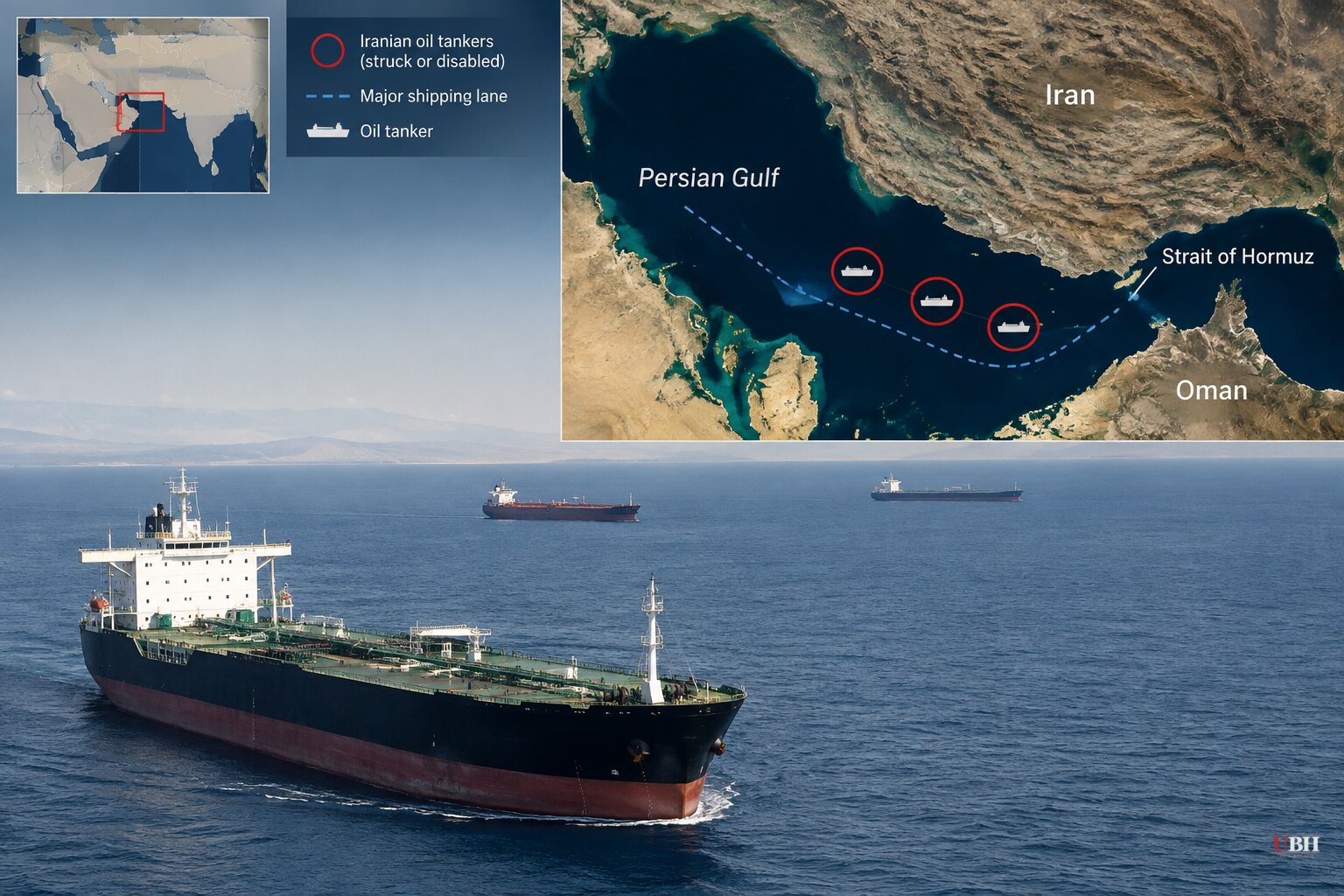
Since US forces struck three Iranian tankers on Saturday, September 19, the retaliation cycle between Washington and Tehran has moved into a new phase, one that now includes sanctions deadlines, an Iraqi flight ban and a fresh Houthi missile barrage on Riyadh.
Tanker for Tanker
A separate incident occurred when a tanker was hit by an unidentified projectile Monday while entering the Strait of Hormuz. The UK Maritime Trade Operations centre and the British military both reported the strike without assigning blame. Two crew members on that vessel suffered minor injuries, but it kept moving under its own power, according to the Las Vegas Review-Journal.
Saturday's strikes were different: deliberate, claimed, and offensive. US Central Command said the Islamic Revolutionary Guard Corps fired ballistic missiles at two US Navy warships, both of which evaded the attacks. In response, CENTCOM said US forces "permanently disabled" two IRGC-linked crude carriers, the M/T Downy off Kharg Island and the M/T Stark 1 near Jask, and "completely destroyed" a third, the unladen M/T Kylo, according to CNN.
Adm. Brad Cooper, the CENTCOM commander, framed it as a deterrence message: "If you shoot at two of our ships, we will impose an even higher economic cost, taking out three of yours." Defense Secretary Pete Hegseth put it more bluntly on X, writing that Iran's tanker fleet is "defenseless" since Iran has no navy or air force, and that the US could strike it in the Middle East or the Indo-Pacific.
Iran's foreign ministry called the strikes "illegal and aggressive" and a violation of the UN Charter, per CNN. Parliament Speaker Mohammed Bagher Ghalibaf warned any further US aggression would get "a faster, heavier, and more painful response." Iran's Khatam al-Anbia Central Headquarters told Iran's Tasnim news agency it has intelligence pointing to a new large-scale US strike in preparation, and that any regional country backing such a strike "will be treated as parties to the conflict." As of Monday, CNN reported no sign of a major Iranian counterstrike had materialized.
Mohsen Rezaei, secretary of Iran's Supreme National Security Council, told state media a restricted zone outside the Strait of Hormuz is coming in the next few days, according to Reuters.
Sanctions Squeeze Tightens
Treasury Secretary Scott Bessent told CNBC that Iranian airlines will effectively be locked out of global operations starting September 23. Any company that fuels an Iranian carrier, provides landing services, or sells tickets on one risks getting "knocked out of the dollar system," Bessent said.
Iraq is moving first. Two Iraqi government sources told AFP that Baghdad will enforce a ban on Iranian airline flights starting Tuesday at dawn, in line with the Treasury order, warning that countries that don't comply "risk sanctions," according to CBS News.
A Second Front in Yemen
The pressure campaign isn't confined to Iran and Hormuz. Iran-backed Houthi rebels claimed missile and drone attacks on Riyadh Saturday, triggering the Saudi capital's first air-raid alert since fighting escalated in July, according to CNBC Africa. Saudi-led coalition spokesman Maj. Gen. Turki al-Maliki said forces intercepted a ballistic missile with no casualties reported.
The underlying Yemen war between the Houthis and Saudi-backed government forces keeps grinding on independent of the Hormuz standoff. The World Health Organization said 164 people were killed and 516 injured in Yemen between September 13 and 18 alone, bringing total casualties since August 6 to 3,672, including 674 deaths, according to the Las Vegas Review-Journal. The International Organization for Migration says nearly 130,000 people have been displaced, with 11,352 of them fleeing in just three days starting September 18. Houthi leader Abdul Malik al-Houthi used the anniversary of his group's 2014 takeover of Sanaa to demand an end to the Saudi-led blockade, calling it a violation of "the legitimate rights of our people."
The Tuesday Decision
A meeting Trump has scheduled for Tuesday with leaders of six Gulf states—Saudi Arabia, the UAE, Qatar, Bahrain, Kuwait and Oman—comes on the sidelines of the UN General Assembly. Trump told Axios he is nearing a decision on whether to resume large-scale strikes, framing it as: "Do I want to go in and annihilate them or do I not?" Axios reported Trump held off on a bigger campaign in August after Saudi Arabia and Qatar warned Iran could retaliate against their own oil infrastructure, a concern that remains the strongest argument against escalation now that Riyadh has just taken a live missile attack.
The counterargument from Cooper and Hegseth is that limited, targeted strikes on Iran's shadow tanker fleet impose cost without opening a full new front. Iran's lack of a navy or air force limits its options for retaliating at sea. Whether that holds is untested. JPMorgan analysts told Investing Live this week they have no clear baseline view for where oil prices go next, and traders are treating the low-probability outcome—a genuine diplomatic breakthrough at Tuesday's sidelines meetings—as the wildcard nobody can price. Pakistan's interior minister, Mohsin Naqvi, met his Iranian counterpart Eskandar Momeni in Tehran Monday specifically to try to open that door, according to the Las Vegas Review-Journal.
Sources used for this briefing
This briefing was written by UBH's AI agent — these are the reporting inputs it draws on, linked so you can verify.


