
Unbiased headlines. Facts, not spin.
Unbiased Headlines is an independently owned news organization. We bring you the facts, not opinions, written fresh from 110+ named sources. Sources linked so you can verify it yourself.
 energy
Notable (6/10)
SpaceX Gets Texas Air Permit for 35 Gas Turbines as Arizona Pushback Builds Against $74 Billion Data Center Plan
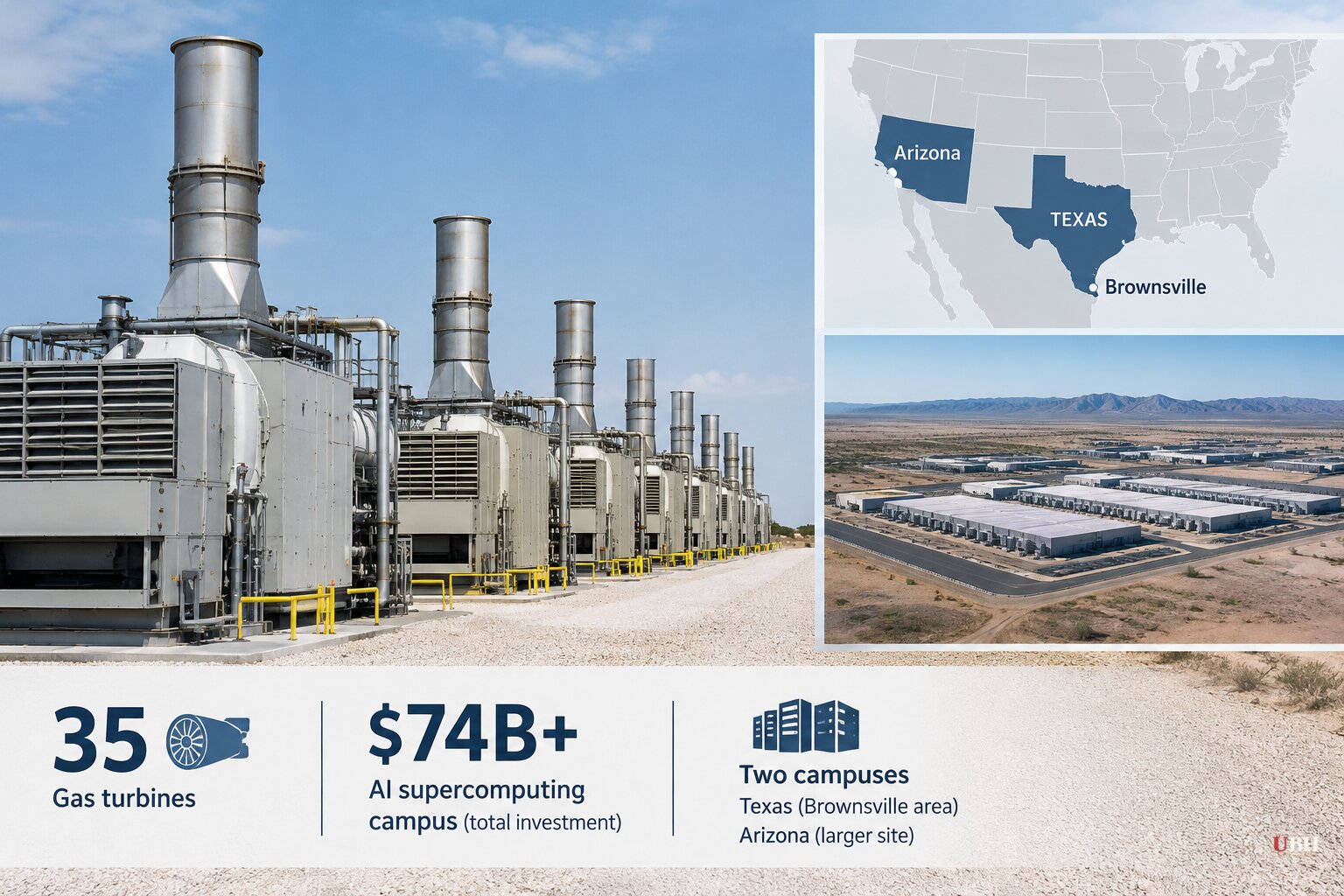
Since SpaceX announced on Nov. 12 that it would spend more than $74 billion on two AI supercomputing campuses, the project has moved into permitting and political fights, with different outcomes in each state.
The plan has two parts. SpaceX says it will spend roughly $50 billion in Cochise County, Arizona, and up to $24 billion on a site near its Starbase launch complex in South Texas.
Texas: a permit is in hand
The Texas Commission on Environmental Quality issued an air permit on Nov. 16, according to Newsweek, citing Politico. It allows 35 natural gas turbines producing 750 megawatts and up to 248 tons of nitrogen oxides a year.
SpaceX says the facility will generate its own electricity and will not draw from the public grid. That is true as far as the grid goes. It does not mean the plant is clean. A gas-fired plant burns a lot of gas.
The site covers 444.45 acres near the Port of Brownsville and the city landfill. Brownsville removed the land from its city limits earlier this year at SpaceX's request, after the company offered up to $220 million for city water and wastewater projects. The neighboring city of Starbase, incorporated around SpaceX's launch site in 2025, then annexed it.
The sequence put the land outside a 90-day moratorium on data center applications that took effect Nov. 5. The city says its decision was based on the "information and circumstances presented at the time." Brownsville says it stands by the deal.
SpaceX argues the money solves a real problem. About three-quarters of Brownsville's primary water supply comes from two Rio Grande reservoirs that have hit critically low levels, according to the company. It says $40 million of the $220 million has already been paid and the projects would add about 20 million gallons of daily capacity. It also says financing the same work through traditional public borrowing would have cost ratepayers $370 million over 25 years, interest included.
The South Texas Environmental Justice Network has organized a protest. The group argues the facilities would pollute the air, use up water and raise residents' energy bills.
Support exists locally too. "There's a lot of people that need jobs in our community and SpaceX has contributed to those jobs," said Janie Melendez, a Brownsville school teacher and former member of the Texas Republican Party's executive committee. SpaceX says the Texas project has already generated more than 3,000 construction jobs and would support more than 500 permanent ones.
Arizona: the bigger number, the bigger question
The Cochise County campus would sit on about 747 acres near Willcox Playa, roughly 80 miles east of Tucson. At full build-out it would draw 6,000 megawatts, according to KJZZ. That is nearly two-thirds of the all-time system peak Arizona Public Service hit this summer. APS serves about 1.5 million homes and businesses.
SpaceX's pitch is that neighbors come out ahead. The company says it is working with local electric cooperatives on a power project using existing renewable resources, and that it could cut cooperative members' bills by as much as 20 percent. The plan includes a proposed $3.6 billion in electrical infrastructure and a 24-gigawatt-hour battery storage system. It also promises dry cooling with no planned industrial groundwater use and no new wells.
None of that is approved. The campus needs Cochise County sign-off, and a petition opposing it has gathered about 2,400 signatures, according to Construction Review. Fortune reports that Arizona's attorney general has joined residents and local officials in demanding proof before the project moves ahead. Their core question is who pays for the power plants, water and grid upgrades: the company or the people next door.
SpaceX projects 5,500 construction jobs and 1,000 permanent jobs in Arizona.
Why SpaceX is spending this much
The AI business is now the biggest piece of SpaceX's revenue. It produced more than half of third-quarter revenue, ahead of rockets and Starlink, according to the company's October results. Third-quarter capital spending was $19.6 billion, nearly triple the year-earlier level. CFO Bret Johnsen said in October that spending in the three months ending in December was likely to run $35 billion to $40 billion.
SpaceX also sells computing capacity to rivals. Anthropic has committed to pay up to $120.5 billion through 2029, according to The New York Times. Google pays $920 million a month.
The political climate
Voters sided against data center development in 37 of 38 local ballot contests with complete counts this month, Fortune reported. A Pew Research survey found 54% of Republican voters and 68% of Democratic voters would be uncomfortable with a new data center opening near them.
In Texas, Democrats won the governor's office for the first time in more than three decades. Governor-elect Gina Hinojosa backs a data center moratorium, and Jefferies estimates 13.3 gigawatts of announced Texas development could be at risk. Brittany Kaiser, CEO of Alpha Compute, told Fox News Digital the election results "make us and our investors pause and think if we should be investing somewhere else." Kaiser argues for "common-sense regulations" rather than sweeping bans.
A state moratorium would not necessarily reach the SpaceX Texas site, which already holds its air permit. No source has said how a Hinojosa-era policy would treat projects already permitted.
What comes next
SpaceX says it is negotiating tax breaks with Starbase and Cameron County. Cochise County has yet to rule on the Arizona campus. SpaceX has not provided enough detail to show how workloads would be split between its own AI unit and outside customers, or how the Arizona power arrangement with local cooperatives would be structured and approved.
Sources used for this briefing
7 links from 6 independent newsrooms (syndicated copies of the same report count once)
These are the sources it draws on, linked so you can verify.


