
Unbiased headlines. Facts, not spin.
Unbiased Headlines is an independently owned news organization. We bring you the facts, not opinions, written fresh from 110+ named sources. Sources linked so you can verify it yourself.
 energy
Notable (5/10)
Event date: November 16, 2026 ·
Ember Model: Adding Wind to Solar and Batteries Cuts Cost of 90% Reliable Power 18% to $86/MWh
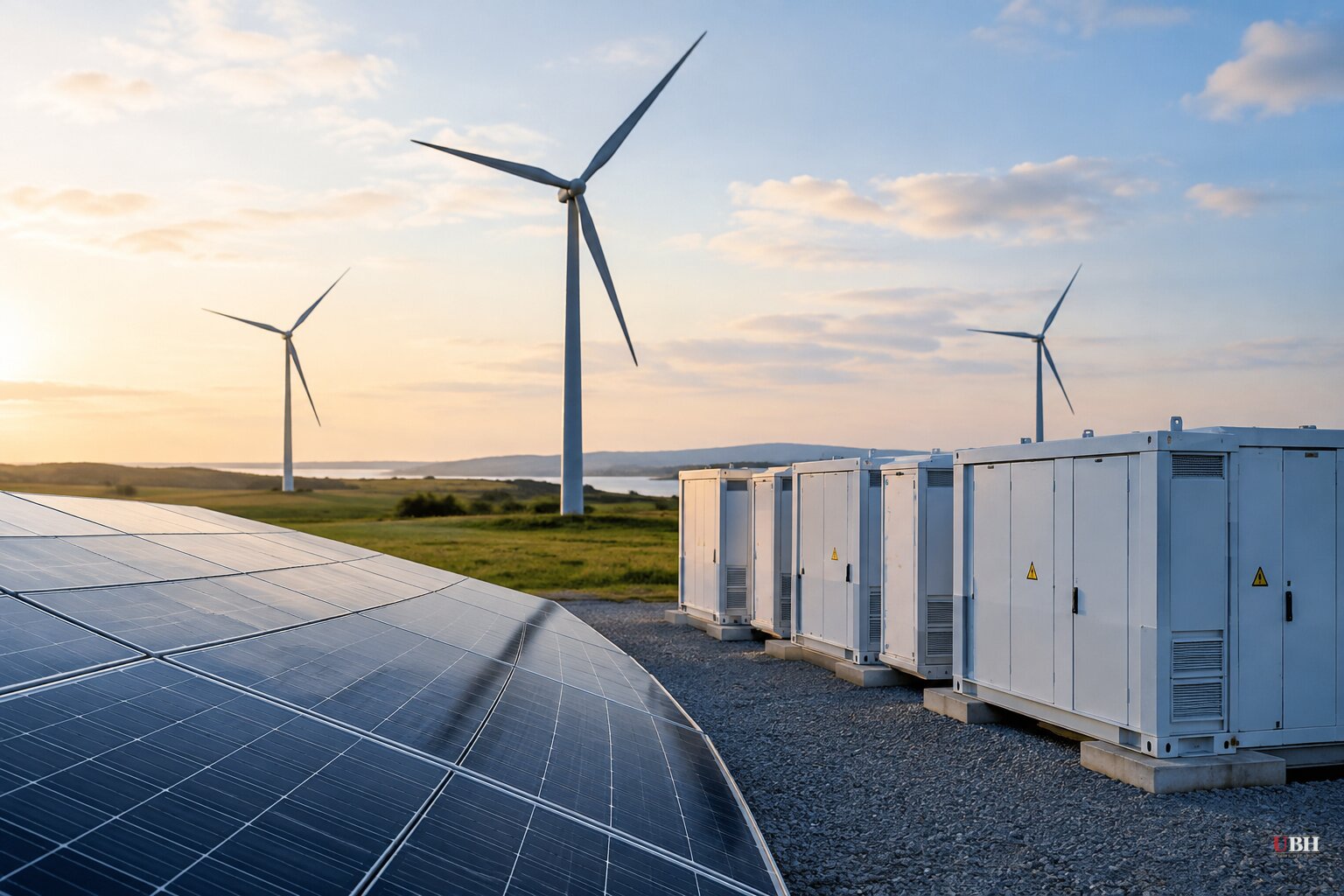
Ember, the UK-based energy think tank, says wind is the missing piece in cheap round-the-clock renewable power. Its November report, Harnessing the Winds, estimates that adding wind to solar and batteries drops the median cost of meeting 90% of electricity demand from $105 per megawatt-hour to $86.
That is a $19 gap, or 18.1%. The remaining 10% of demand would be covered by gas or diesel backup.
These are modeled numbers, not bids or contracts. Ember built them from ten years of hourly weather data, 2015 through 2024.
The cost figures
Ember puts the median cost of fully firm power from solar and wind, with batteries and limited backup, at $89/MWh. Solar and batteries alone cost about $104/MWh, by the report's tally.
The cost climbs with the reliability target. Covering 95% of demand with solar, wind and batteries runs $98/MWh in the model.
Ember projects firm solar-and-wind costs falling from $89 to $52/MWh by 2050. That projection assumes a uniform 7% cost of capital everywhere.
Ember also estimates that regions holding three-quarters of global electricity demand could hit 90% renewable uptime for under $100/MWh with wind in the mix. Without wind, only about half of global demand clears that bar.
Fewer batteries, fewer bad weeks
Most of the savings come from needing less storage. Wind tends to blow when the sun doesn't, across both the day and the seasons.
Ember's modeled battery requirement for 90% reliability falls like this:
- Canada: 24 hours of demand down to 10.
- United States and Europe: 20 hours down to 12.
- China: 18 hours down to 12.
- India: stays at 14 hours, because it sits closer to the equator and gains little seasonal smoothing from wind.
These are modeled storage durations, not batteries anyone has built.
Ember defines a lull as seven straight days of output below half a source's average. Globally, solar has one about four times a year and wind about eight. Both at once happens roughly once every four years, on average. Daan Walter, a principal at Ember, said: "We already know that solar and wind are cheap."
The analysis was produced with the Global Wind Energy Council, according to Electrek. That is the wind industry's trade group, and it is a fair thing to know about a report that concludes more wind is a good idea.
The coal and gas pipeline
Ember counts 845 GW of coal and gas capacity in development worldwide. It estimates that 706 GW of that sits in regions where firm solar, wind and battery power, backup included, comes in under $100/MWh. Without wind, the figure is 520 GW.
The share of planned fossil capacity in regions where renewables can meet 90% of demand for under $100/MWh rises from 71% to 90% with wind, Ember estimates. In China alone, wind pulls in another 91 GW of planned coal and gas.
The $100 line is Ember's benchmark. The report's cost figures are not a head-to-head price comparison against any specific plant, and Ember has not shown that every one of those 706 GW would lose a bid.
Demand is also climbing. In the United States, electricity demand is expected to grow 40%, with natural gas remaining a major source, and the Trump administration backs fossil fuels.
Where the savings shrink
Wind does not help everywhere. Near the equator, where solar output barely changes with the seasons, adding wind does little to costs. India is the example in Ember's own numbers.
Capital costs matter just as much. Ember's regional adjustments show that in Africa, the median cost of 90% coverage rises from $76 to $126/MWh once local financing costs are applied. Wind remains prohibitively expensive to deploy in much of sub-Saharan Africa.
Wind has also been slower to improve than solar and batteries. Turbines are hard to test, since nobody can run a controlled experiment on the atmosphere. Costs are expected to keep falling as technology and supply chains mature, but that is a forecast.
India shows the gap between capacity and delivery. The country announced a 900-gigawatt non-fossil target for 2035 and approved nearly $20 billion for transmission and battery storage under its Green Energy Corridor plan. It already struggles to use all the renewable power it generates because of weak transmission.
"If the grid doesn't catch up, then there is no way India can meet this target," said Nikit Abhyankar of the India Energy and Climate Center at the University of California, Berkeley.
The $86 figure is the headline. The number to watch is the financing cost behind it. Ember's uniform 7% assumption produces the global median, and its own Africa figures show how fast the result moves when the cost of capital changes.
Sources used for this briefing
7 links from 7 independent newsrooms (syndicated copies of the same report count once)
These are the sources it draws on, linked so you can verify.


