
Unbiased headlines. Facts, not spin.
Unbiased Headlines is an independently owned news organization. We bring you the facts, not opinions, written fresh from 110+ named sources. Sources linked so you can verify it yourself.
 energy
Major Story (7/10)
Event date: November 19, 2026 ·
After IEA Grid Warning, Cornell Study Says Data Centers Covered 38% of Their Grid Costs
The International Energy Agency's World Energy Outlook, released this week, said planned data center projects in some fast-growing markets would exceed those markets' current peak power demand if they all got built. Since then, the argument has shifted from how much power the buildout needs to who pays to deliver it.
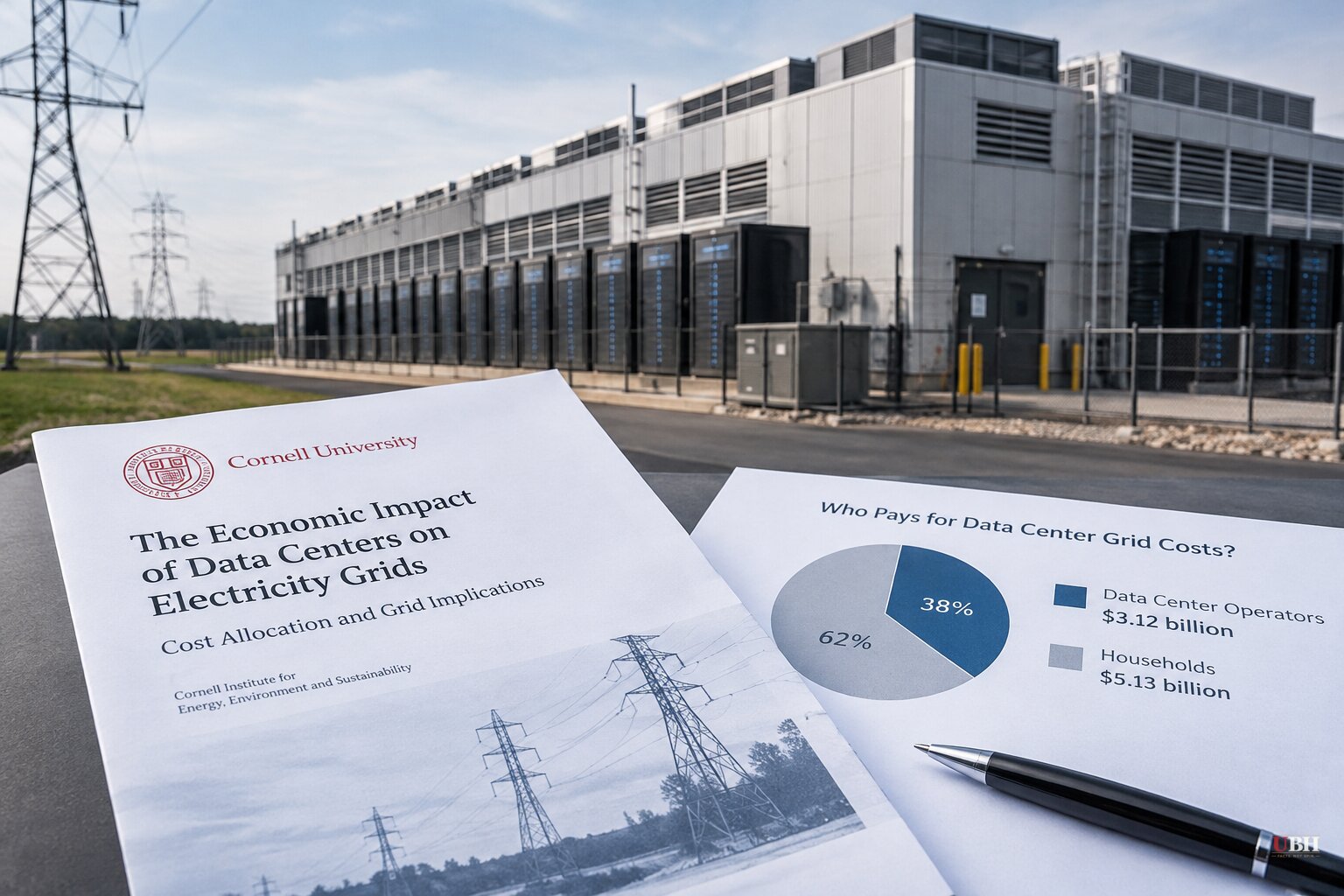
A Cornell University study published this month found that wholesale electricity prices rose in four U.S. regions because of data center demand. It also found that operators covered only 38% of the infrastructure costs tied to connecting to and using the grid. In dollars, that is $3.12 billion from operators and $5.13 billion from households and local communities.
Those figures are the study's findings, not a settled national accounting. They do put a number on the complaint driving local opposition: residents say they are subsidizing facilities they did not ask for.
How big the buildout is
The IEA says global data center electricity use rose 17% in 2025, and investment hit $565 billion. It forecasts another $4 trillion by 2030. Under its Stated Policies Scenario, sector consumption doubles to 1,000 TWh by 2030, with AI-optimized capacity responsible for about three-quarters of the growth.
The agency now tracks 93 large AI data center projects by satellite. Their inferred capacity has grown tenfold in 24 months to 17 GW and is set to reach roughly 50 GW once construction finishes. That is close to Great Britain's peak electricity demand.
Global data center capacity currently stands at about 120 GW, with nearly 80% in China, the EU and the U.S. The IEA projects another 120 GW by decade's end. It says prospective capacity in Denmark, Finland, Northern Virginia and Texas far exceeds what those grids can currently handle.
The Wall Street Journal, citing data from Cleanview, reported about 58 GW of new data centers under construction across 577 U.S. locations. The paper compared that to six times New York City's peak demand. A fifth of it is in Texas.
The IEA stresses that not all of this capacity will be built. Surging connection requests have already forced rule changes in several markets, including priority for credible applications and bring-your-own-power arrangements.
Emissions and the other side of the ledger
The IEA found that data center carbon emissions are set to rise 70% by 2030 because plants burning natural gas and coal are covering part of the new demand. Tech companies are also by far the largest corporate buyers of green electricity.
The agency does not frame AI as purely a drain. It wrote that AI is widely expected to help with energy efficiency and grid optimization. "For the moment," it added, "surging demand from data centres is amplifying strains in some markets and supply chains." Its stated goal is keeping electricity "available and affordable," through better use and expansion of grids and more flexible power systems.
Grid expansion costs money, and the Cornell numbers show where a good share of it has landed so far. A sensible rule is that the customer causing the cost pays it. Bring-your-own-power requirements, which the IEA says some regulators are adopting, move in that direction. They would let the buildout continue without sending the bill to the household next door.
Markets are getting jumpy
The financing behind the buildout is under stress. The five largest U.S. hyperscalers (Alphabet, Amazon, Meta, Microsoft and Oracle) estimate they will spend $800 billion or more on AI infrastructure this year, a 94% jump from 2025, according to the Council on Foreign Relations. A September Brookings Institution report projects U.S. AI-related investment above $10 trillion from 2025 through 2032.
CFR senior fellow Rebecca Patterson said financial markets are growing more skeptical of the "whatever it takes" approach. "The growing use of debt to finance the AI build-out, alongside questions about the timing and degree of revenue, is pushing up the cost of debt for many AI-related firms," she said. CFR says stocks tumbled in November amid rising debt, softening revenues, concern about an AI backlash after Democrats won Congress in the midterms, and an alleged Chinese espionage operation targeting Nvidia's CEO.
CNN reports that Nvidia CEO Jensen Huang resigned amid revelations of extramarital affairs and a board investigation into whether he was the target of a "foreign intelligence effort." Those details rest on CNN's reporting. Nvidia's role in AI financing is documented: it committed $105 billion in August toward an OpenAI data center, holds a major equity stake in CoreWeave, and is expected to take a $10 billion stake in Anthropic's IPO.
Saxo strategist Neil Wilson told CNN that Huang "was key in Nvidia being the backer of last resort across the AI ecosystem." Seaport Research analyst Jay Goldberg pushed back on the "circular financing" label. He said "very aggressive vendor financing" is more accurate. Nvidia's own quarterly filing warns that its commitments and guarantees "expose us to financial, counterparty and execution risks and may not provide anticipated benefits."
What comes next
It is unresolved whether the gap between what operators pay and what communities pay narrows before more of the 58 GW under construction comes online. The IEA says regulators in several markets are already rewriting connection rules. Whether any of them require operators to cover the full cost of their grid impact is not yet established.
Sources used for this briefing
7 links from 7 independent newsrooms (syndicated copies of the same report count once)
These are the sources it draws on, linked so you can verify.


