
Unbiased headlines. Facts, not spin.
Unbiased Headlines is an independently owned news organization. We bring you the facts, not opinions, written fresh from 110+ named sources. Sources linked so you can verify it yourself.
 energy
Major Story (7/10)
Event date: November 19, 2026 ·
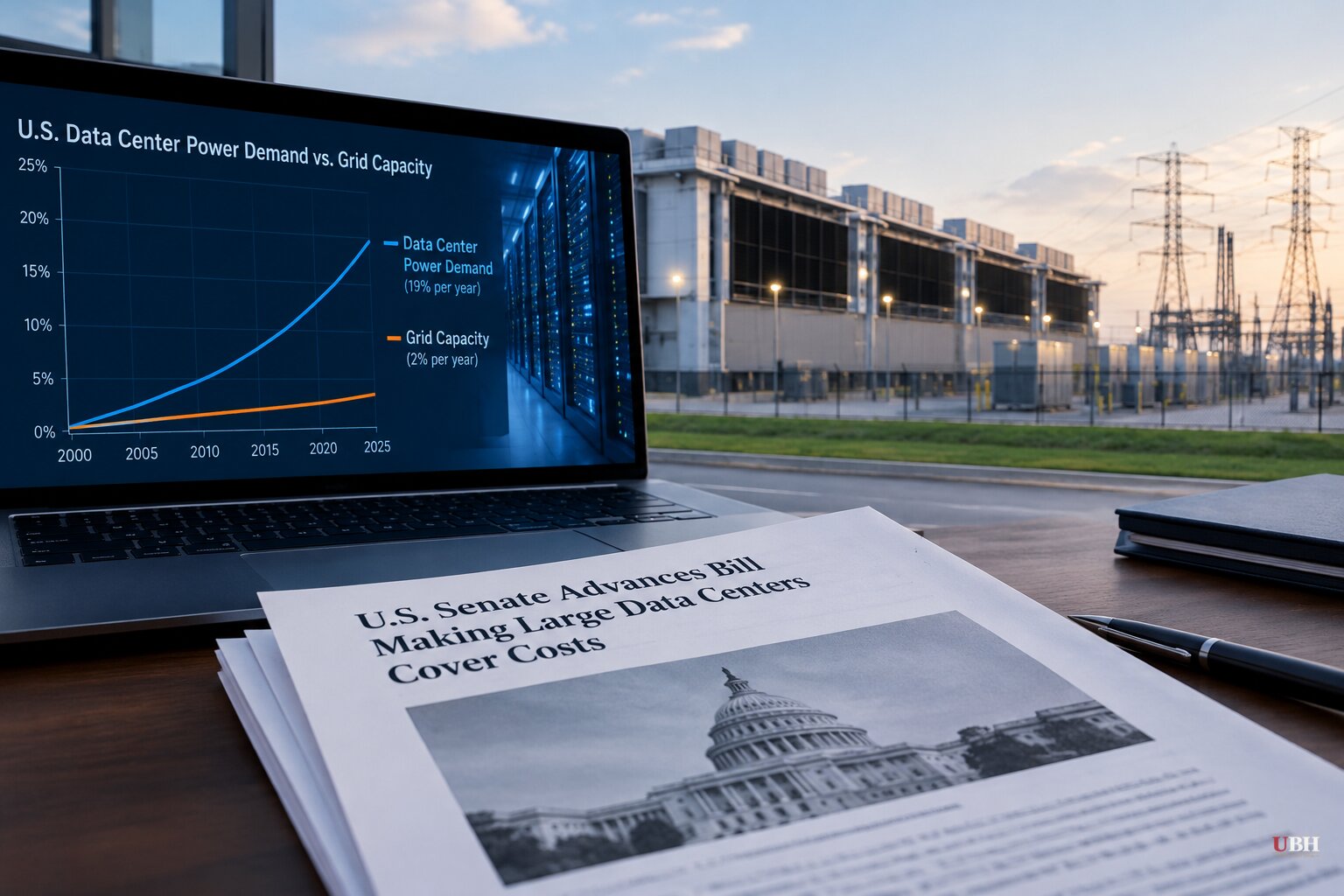
Howden: Data Center Power Demand Up 19% a Year Since 2000, Grid Capacity 2%. Senate Advances Bill Making Large Data Centers Cover Costs
Since the IEA warned that planned data centers could outstrip grid capacity, and a Cornell study split the bill between operators and households, two things have moved: a new estimate of how lopsided the race between demand and supply has been, and a Senate vote on who pays.
The 19% versus 2% gap
Insurance broker Howden published research on November 11 finding that U.S. data center power demand has grown 19% a year since 2000. Grid capacity over the same period grew about 2% a year. Howden built the analysis on EIA data and 451 Research by S&P Global.
Data centers' share of U.S. grid capacity went from 0.1% in 2000 to 5% in 2025, a 50-fold increase, according to Howden.
The comparison is of growth rates, not of total demand against total supply. It shows demand compounding roughly ten times as fast. It does not show a tenfold shortage of electricity.
Howden estimates power constraints are adding 24 to 72 months to build times for the most constrained projects. For the largest builds, with annual revenue approaching $400 million at the top end, it puts lost revenue at $800 million to $2.4 billion. These are Howden's estimates.
The firm also says that for data centers to hold a 5% share of grid capacity at current growth rates, they would need to source up to 58% of their power, about 110 gigawatts, from behind-the-meter generation by 2030. Howden itself calls that unlikely. It expects a mix of more grid share, slower growth at power-constrained sites and on-site generation.
The EIA's own numbers point the same direction. U.S. electricity demand grew about 1.7% a year from 2020 to 2025, after averaging 0.1% a year from 2005 to 2019. The EIA expects national load to rise 1.9% in 2026 and 2.5% in 2027, with the fastest growth in ERCOT, about 10% a year, and PJM, about 3%.
Lawrence Berkeley National Laboratory estimates data centers used 192 TWh in 2024, or 4.7% of U.S. electricity. Its reference case reaches 649 TWh, 11.8% of the total, by 2030.
Rob Gramlich, president of Grid Strategies, calls it a "mismatch in timing." Grid expansion requires "deliberate study and planning" that can take years, he told Fortune in September, and utilities "got out of practice on building new infrastructure" after about 25 years of flat demand. Kathryn Burke of insurer Marsh told Fortune she expects 50% to 60% of data center projects to slip past the one-to-two-year timelines developers are counting on.
Voters weigh in
On November 3, voters rejected data center development in 40 of 41 local ballot measures. Democrats won both chambers of Congress the same night.
A University of Pennsylvania Annenberg Public Policy Center survey from this summer found 61% of all adults oppose new data centers in their area. Among adults under 30, the figure is 70%.
Columbia's Center on Global Energy Policy says the midterms also flipped governorships in Texas, Georgia and Ohio. Many candidates pledged to pause projects or review tax incentives, and nearly all said developers should "pay their own way."
The Senate bill
The Senate advanced the Bipartisan American Affordability and Jobs Act of 2026, known as BAAJA, in a bipartisan vote on Thursday night. The White House backed the final version.
The package would speed environmental reviews, limit legal challenges to projects, protect approved projects and expand the grid across oil, gas and renewables. Senate Environment and Public Works Chair Shelley Moore Capito, R-W.Va., said it makes building "faster and more efficient and easier" without giving up "strong protections for our environment."
The ratepayer section applies to data centers drawing at least 20 megawatts. They would have to cover the cost of the additional power they need and post financial guarantees for new or upgraded facilities. They would also owe the unpaid infrastructure costs if they leave an area. States could charge them higher rates to reduce other customers' bills.
Sen. Martin Heinrich, D-N.M., the Democratic lead, pushed for the stronger language. "We actually require big load centers, whether that's a factory or a data center, to not pass those costs on to the American consumer by statute, not a suggestion, an actual law," he said.
Before the election, Republicans tried to move a narrower safeguard bill from Sen. Jon Husted, R-Ohio. Democrats argued it lacked real enforcement teeth, and it did not pass.
What the bill may not fix
Douglas Arent and Vivek Shastry of Columbia's Center on Global Energy Policy wrote on November 19 that "pay their own way" policies, BAAJA included, can protect other ratepayers from the cost of serving data centers. They said those policies may be insufficient alone because they do not address every way data center demand can lift wholesale capacity and energy prices.
They also suggest near-term plans to build hundreds of gigawatts of data center capacity could be scaled back after the midterms.
The Columbia piece does not say whether the bill has cleared its final votes. No source here reports a House vote date or a signing. Whether 20-megawatt cost-allocation rules can keep up with a grid that has grown 2% a year while the load it serves has grown 19% remains to be seen.
Sources used for this briefing
8 links from 7 independent newsrooms (syndicated copies of the same report count once)
These are the sources it draws on, linked so you can verify.


