
Unbiased headlines. Facts, not spin.
Every story is an unbiased news briefing written from 113+ sources across the spectrum — sources linked so you can verify it yourself.
 economy
Major Story (8/10)
September 24, 2026 at 01:20 AM
economy
Major Story (8/10)
September 24, 2026 at 01:20 AM
Trump's Gaza Board Unveils $2.45 Billion Rebuild Plan, But Only $280 Million of $18 Billion Pledged Has Shown Up
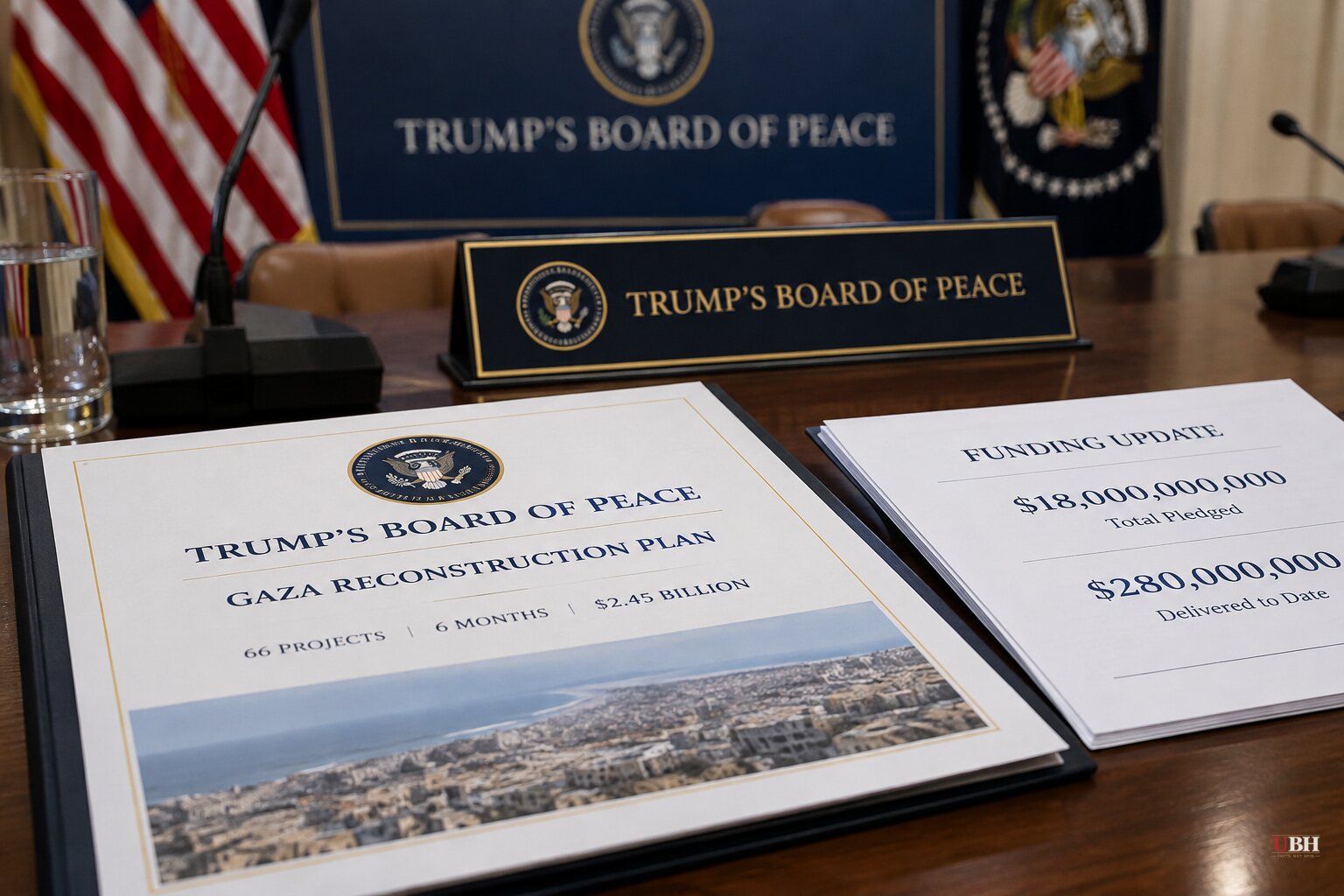
President Donald Trump's Board of Peace unveiled a $2.45 billion plan on Wednesday to begin rebuilding Gaza, on the sidelines of the UN General Assembly in New York. The 66-project blueprint covers six months and targets temporary housing, debris removal, hospital repairs, diesel-powered electricity and economic recovery, according to the BBC and Axios, cited by the Hindustan Times.
The board says $18 billion has been pledged by donor nations, but only $280 million has actually been transferred, according to the BBC. Full physical reconstruction is estimated at $35.2 billion over the medium term, and $71.4 billion over the next decade, according to the Associated Press, which distributed its reporting through PBS, WBOC-TV and CBC.
Jared Kushner, Trump's son-in-law and a member of the Gaza Executive Board, admitted the project has hit "different delays on different things, for whatever reason." He told the meeting the goal was to prove commitment, not celebrate results. "The goal of today was really just to show you that we're really fully committed to doing it," he said.
U.S. envoy Steve Witkoff struck a more upbeat tone, telling the meeting "all of the hostages are home" and that the ceasefire, "imperfect as it may be," still holds. Secretary of State Marco Rubio said at a separate briefing that "a number of countries have stepped forward and pledged financial assistance," and the board is "looking for more that will participate." Former U.K. Prime Minister Tony Blair, also a board member, called the responsibility on the group "huge," according to a report carried by Operativ MM.
A Year In, Almost Nothing Has Moved
The ceasefire took effect Oct. 10, 2025, under Trump's 20-point plan. It was supposed to bring Israeli military withdrawals, Hamas disarmament, an international peacekeeping force, and a new Palestinian technocratic government to run day-to-day affairs.
None of that has happened. The Associated Press reports Israel's military has instead expanded its footprint and now occupies roughly 60% of Gaza. Hamas has not given up its weapons. The international force and the new government have not entered the territory. Reconstruction has not begun. Most Palestinians in Gaza are still living in tent camps or in the ruins of their homes, per the AP.
The board's high representative, Nikolay Mladenov, has said progress hinges largely on Hamas disarming, a step the group has refused to take. He's also pressed Israel to scale back its military operations, and in August warned that a collapse of the ceasefire would be "a point of no return" for the region.
The Hindustan Times, citing Axios, reports that Israeli Prime Minister Benjamin Netanyahu's government agreed in principle to parts of the plan but has refused to start implementing it, citing domestic political reasons ahead of Israeli elections scheduled for Oct. 27. The board reportedly hopes reconstruction can begin after that vote. Hamas, for its part, agreed in principle to disarm in July but that commitment hasn't been tested.
The Death Toll Since the Ceasefire
At least 1,381 Palestinians, including 300 children, have been killed in Israeli attacks in Gaza since the ceasefire began, according to the territory's Hamas-run health ministry. The UN considers those figures reliable, per the BBC. The Israeli military says five of its soldiers have been killed in combat since the ceasefire, and one contractor died in what it described as an "operational accident."
Israel says it's responding to continued threats in a territory where Hamas still has weapons and tunnels. Critics of Israel's continued strikes, including Mladenov himself, say the pace of civilian deaths during a supposed ceasefire undercuts the whole premise of the peace plan.
What's Left Underground
Michael Eisenberg, an Israeli-American Board of Peace member, told the BBC's Newshour that before any rebuilding can start, unexploded ordnance across Gaza needs to be cleared, and hundreds of kilometers of tunnels underneath the territory need to be destroyed. Only after that, he said, can Gazans "get to rebuilding again: whether it's housing, or better sanitation, or other things."
The reconstruction push is happening against a broader UNGA backdrop where Trump-aligned officials, including Witkoff and Kushner, also met with Iranian Foreign Minister Abbas Araghchi in New York, according to the Hindustan Times. Iranian President Masoud Pezeshkian used his own UNGA address to deny his country is pursuing nuclear weapons, even as the International Atomic Energy Agency says Iran is the only non-nuclear-weapon state stockpiling uranium enriched to 60% purity, a level with no credible civilian use, according to Fox News.
The next hard deadline is Israel's Oct. 27 election. Whether Netanyahu's government moves on withdrawal and reconstruction after that vote, and whether Hamas actually disarms rather than just agreeing to in principle, will determine if any of the $18 billion pledged in New York ever turns into $18 billion delivered.
Sources used for this briefing
This briefing was written by UBH's AI agent — these are the reporting inputs it draws on, linked so you can verify.


