
Unbiased headlines. Facts, not spin.
Unbiased Headlines is an independently owned news organization. We bring you the facts, not opinions, written fresh from 110+ named sources. Sources linked so you can verify it yourself.
 economy
Notable (6/10)
Event date: November 19, 2026 ·
Mortgage Rates Climb to 7.28% Days After Pending Home Sales Hit Record Low
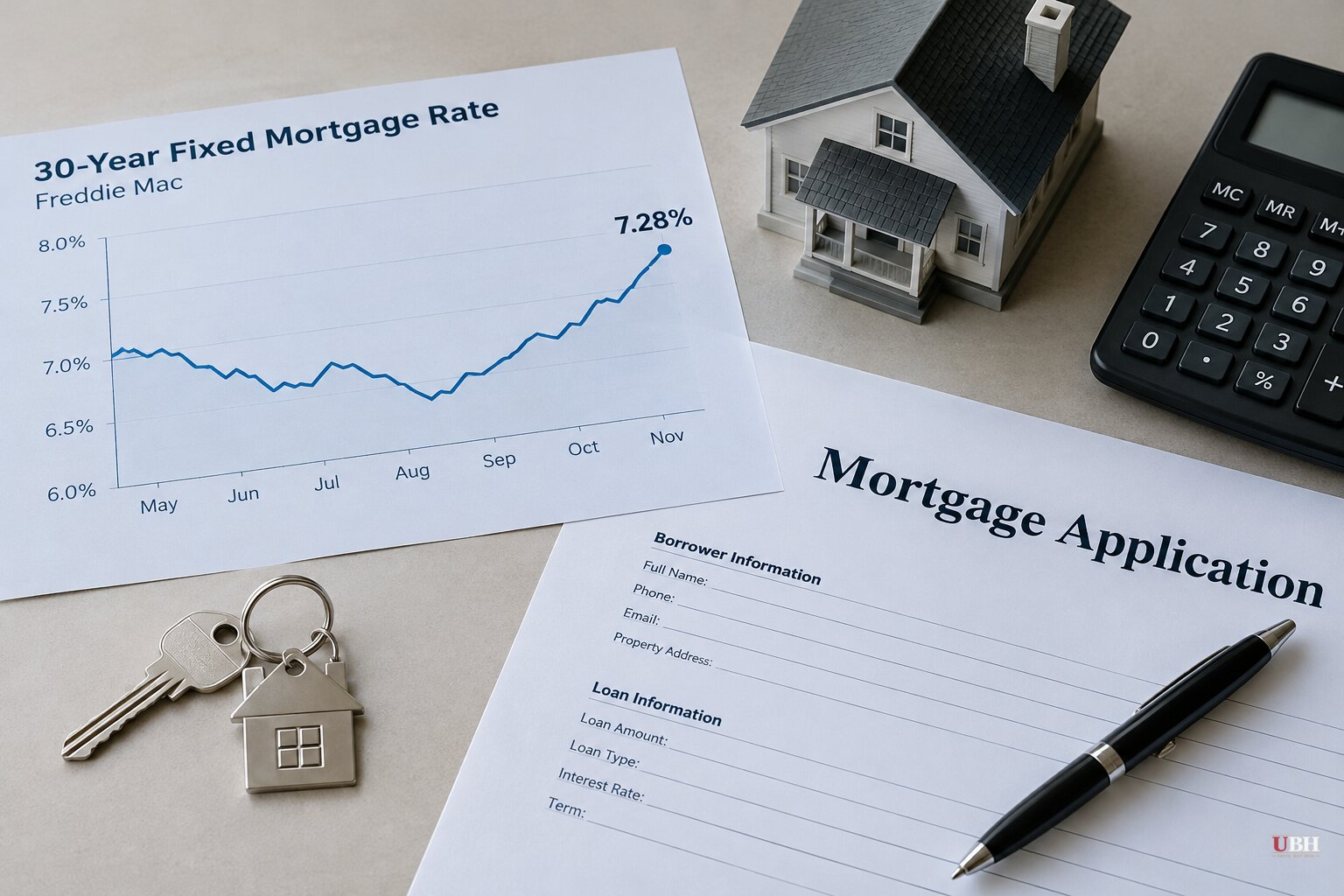
Since the Federal Reserve raised rates on Sept. 16 for the first time since 2023, the housing market has been stuck near a standstill. Two new data points this week show how little has changed.
Contract signings at the lowest level on record
The National Association of Realtors said Nov. 18 that its Pending Home Sales Index fell 4.7% in October from September and 16.7% from a year earlier, to a reading of 63. That is the lowest since the index began in 2001, and the second straight month of record lows. A reading of 100 equals the average level of contract activity in 2001.
Every region fell on both measures. The West dropped 6.9% on the month and 20.3% on the year. The South fell 6.3% and 18.7%. The Midwest fell 2.7% and 14%. The Northeast held up best, down 0.8% and 11.1%.
Even the strongest large metros lost ground. Among the 50 largest, Cincinnati had the smallest annual decline at 4.7%, followed by Austin at 9.7%.
Pending sales track signed contracts that have not closed, and most close within one or two months. NAR chief economist Lawrence Yun said the pattern "point[s] to very sluggish fourth-quarter home sales closings, and annual existing-home sales could be the lowest since the mid-1990s."
Rates turn up again
Freddie Mac's weekly survey put the average 30-year fixed rate at 7.28%, up from 7.11% the week before. It was the largest one-week jump since the week of Oct. 1 and ended four consecutive weekly declines. A year ago the average was 6.26%.
The move follows the 10-year Treasury yield, which climbed back toward 5% after an October inflation report came in hotter than expected. That raised the odds of a Fed hike at its December meeting.
The Mortgage Bankers Association's own survey showed the 30-year rate at 7.35% for the week ended Nov. 13, up from 7.21%. MBA deputy chief economist Joel Kan tied it to the bond market: "Treasury yields rose last week amid data showing inflation accelerated in October and Fed officials acknowledging that additional rate hikes may be needed in the coming months."
As recently as Feb. 26, Freddie Mac's rate stood at 5.98%, the lowest in years. The war in Iran began Feb. 28. Shipping disruptions and energy supply shocks pushed up energy prices and inflation, which has been a major factor in pushing long-term yields higher, according to Newsweek's analysis of the rate path.
Builders are discounting and still not selling
The National Association of Home Builders/Wells Fargo Housing Market Index fell four points to 25 in November, its lowest reading since April 2012. Anything below 50 means more builders see conditions as poor than good.
Nearly half of single-family builders cut prices, the highest share since the COVID-19 pandemic. The average cut held at 6% for the eighth straight month. Some 68% used sales incentives, a post-pandemic high, and at least 60% have done so for 20 months running.
Bankrate analyst Jeff Ostrowski put the weakness in context. "If I were to say, 'Imagine a time when home prices are at record highs, the stock market has soared and the job market is near full employment,' you'd probably say, 'Wow – I bet Realtors are killing it!'" he said. "Instead, October home sales fell to their lowest level since 2010, the pit of the Great Recession."
Realtor.com's Hannah Jones said mortgage rates rose nearly 75 basis points from late August to mid-October, adding roughly $200 a month to the payment on a median-priced home with 10% down. That figure depends on price, down payment, loan term and the exact dates compared, so it is not a universal number.
Is October the bottom?
Yun thinks so. "October could mark the low point in contract signings for this housing cycle, as mortgage rates appear to have topped out," he said. He also raised a bigger question: "Either sizable housing demand is building in the background, or the dream of homeownership is increasingly out of reach for many Americans."
This week's rate jump cuts against the premise that rates have topped out. The MBA is more cautious. Chief economist Mike Fratantoni told the group's October convention in Chicago: "We think the Fed is going to be in a position where they have to hike a couple more times." The MBA expects increases in December and early 2027. The Fed's target range now sits at 3.75% to 4%.
Some buyers see an opening. Realtor.com senior economist Anthony Smith said that with fewer shoppers, "competition has thinned, sellers have shown more flexibility on price, and active inventory continues to rise even as new listings have pulled back." He added that until inflation cools enough to put rates on a durable downward path, "affordability will remain the dominant constraint on the market."
The lock-in effect is working from the other side too. Homeowners with paid-off homes or pre-pandemic mortgages have little reason to sell and take on a 7%-plus loan, which keeps supply tight even as buyers stay away.
What to watch
The Fed's December meeting is the next test. If policymakers hike as the MBA expects, Yun's trough call will be tested against a market where 30-year borrowing costs have stayed above 7% since late September.
Sources used for this briefing
6 links from 6 independent newsrooms (syndicated copies of the same report count once)
These are the sources it draws on, linked so you can verify.


