
Unbiased headlines. Facts, not spin.
Unbiased Headlines is an independently owned news organization. We bring you the facts, not opinions, written fresh from 110+ named sources. Sources linked so you can verify it yourself.
 economy
Notable (6/10)
Event date: November 16, 2026 ·
JPMorgan Projects Big Tech AI Spending Near $2 Trillion by 2030 as New Democratic Governors Target Data Centers
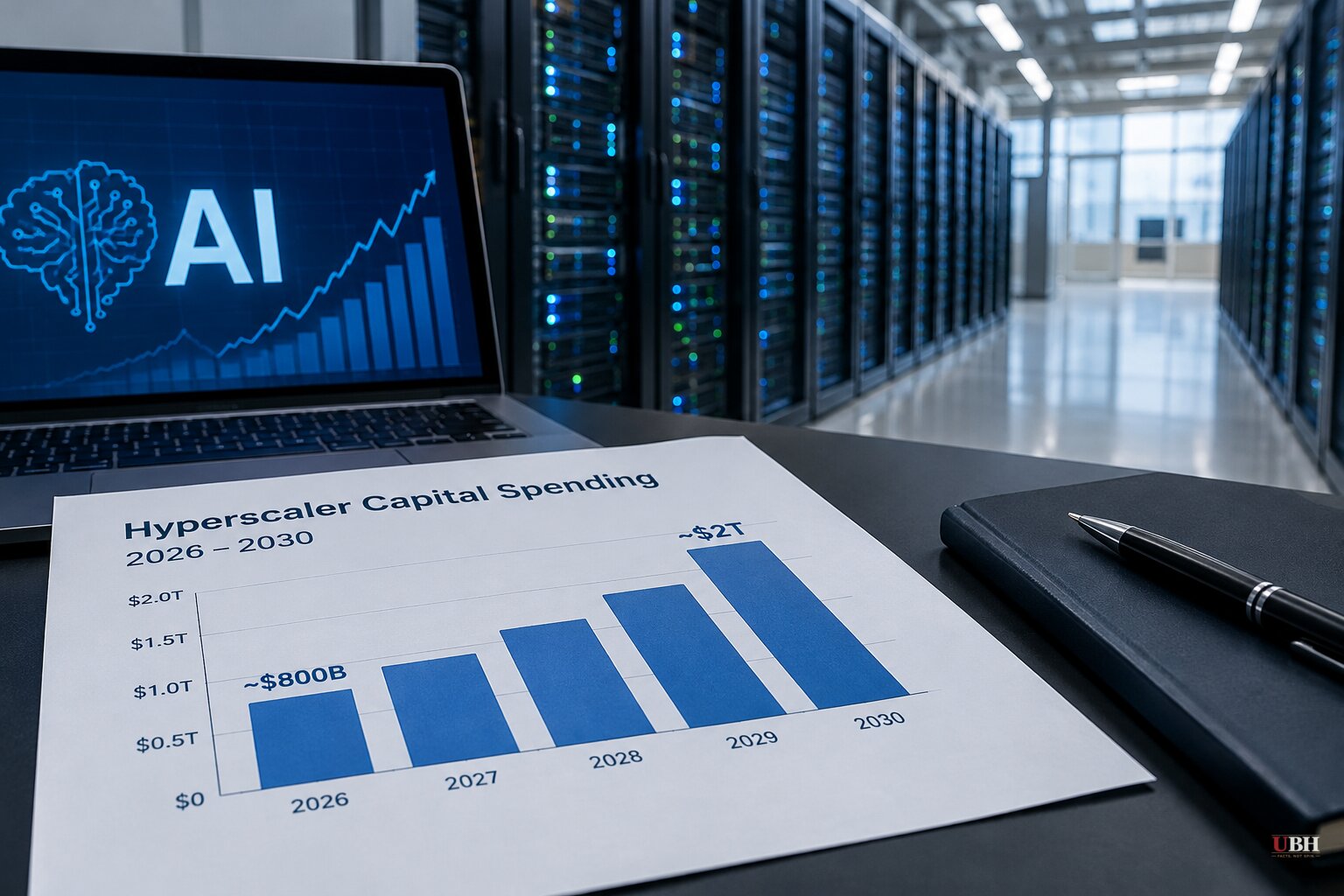
JPMorgan thinks the AI building boom has years to run. The bank expects capital spending by the biggest cloud operators to climb from roughly $800 billion in 2026 to nearly $2 trillion by 2030.
The list covers Amazon, Alphabet, Microsoft, Meta and Oracle.
The growth rate is projected to cool even as the dollar totals rise. JPMorgan sees annual growth slowing from 66% in 2027 to 22% in 2028. The bank estimates 2028 alone adds between $292 billion and $321 billion.
The company-level numbers
JPMorgan's per-company projections are about $470 billion each for Amazon and Alphabet, $330 billion for Microsoft, $290 billion for Meta and $100 billion for Oracle.
The cash picture gets ugly before it improves. The bank expects a cumulative free cash flow burn of about $284 billion across the group through 2028. Then, in its model, operating margins expand to 35% and free cash flow reaches $624 billion by 2030.
That rebound only happens if margins actually reach 35%. Each earnings season will show whether the five companies are tracking toward the bank's figures or away from them.
Who pays for it
A separate JPMorgan forecast, issued Nov. 13 by strategists including Nathaniel Rosenbaum, projects record U.S. investment-grade bond issuance of $2.1 trillion in 2027, up from about $2 trillion in 2026. Technology and media companies are expected to account for $612 billion of that. The bank counts $225 billion from hyperscalers and another $225 billion tied to data center construction and chip financing.
Other banks disagree on the size. TD Securities projects $2.4 trillion in 2027. Bank of America expects $1.9 trillion, as hyperscalers diversify funding and merger activity cools.
JPMorgan Asset Management's 2027 outlook, published Nov. 16, puts the stakes in market terms. AI-related stocks make up about 50% of U.S. and emerging-market benchmarks. The tech sector generated half of 2026's global earnings growth and drove almost three quarters of global equity returns in the first 10 months of the year.
The asset manager says the path ahead "is still likely to be up, but may be bumpier." It says the central question is whether businesses and consumers will pay enough for AI products to feed the whole chain.
The capex research also flags two constraints: strain on existing power infrastructure, and a need for diversified financing, including bond issuance and project-level debt tied to individual data center campuses.
The political variable
The election results this month added a new constraint. Democrats gained governorships in Nevada, Georgia, Ohio and Texas, where candidates campaigned on tighter data center rules. Their proposals include ending tax breaks, tightening climate and electricity restrictions, and letting local governments impose their own moratoriums.
Goldman Sachs estimates that, come January, states controlled by Democrats who support expanding or extending AI construction moratoriums will account for 45% of America's planned data center capacity. Texas alone holds about a quarter of the planned buildout.
That does not mean half the pipeline stops. Donald Trump is still president, and CNN reports he is already waving around his veto hat. Governors also cannot block every project.
JPMorgan Asset Management's view is that the election result may limit further upside to capex plans but is unlikely to lead to major downgrades. Build-out, it says, will have to be done more thoughtfully and potentially at greater cost, because politicians will have to balance campaign promises against the revenues and jobs data centers create.
Columbia Business School economist Stijn Van Nieuwerburgh expects AI infrastructure spending to approach $1 trillion a year for the foreseeable future. ING economists say the AI boom has accounted for as much as a quarter of U.S. economic growth this year.
CNN's analysis argues a slowdown could have upsides. It says the buildout has contributed to rebounding inflation and public antipathy, and that tapping the brakes could put the economy on a more sustainable path. Supporters of the buildout point to the jobs and economic development it supports.
There is a taxpayer angle on both sides. Tax breaks for data centers are a subsidy, and ending them is a government-waste argument as much as a climate one. Cutting them also raises the price of building in a state, and that is a cost the industry will weigh.
How much rides on Nvidia
A separate fight is over how much of the boom depends on one chipmaker. All-In podcast host Jason Calacanis warned on X that "China Hawks are going to get a chip ban, and Americans are going to get a recession." His co-host Chamath Palihapitiya says disruption to what he calls the "Bank of Nvidia" could subtract 50 to 150 basis points from growth and bring a recession by 2028.
The Breitbart Business Digest disputes that. It argues Nvidia "is important, but it just isn't that important," and that the U.S. economy could survive tighter limits on chip sales to China.
The numbers on AI's share of growth vary widely. J.P. Morgan Asset Management estimated in September that AI-related investment accounted for about one-fifth of growth over the prior year, contributing 0.47 percentage points after subtracting imported hardware. Breckinridge Capital Advisors reviewed estimates of 0.3 to 1.2 percentage points this year.
The "Bank of Nvidia" label refers to Nvidia financing its own customers. One example is a $6.3 billion arrangement under which Nvidia agrees to buy CoreWeave's unsold computing capacity through 2032. That guarantee makes other lenders comfortable, and it also means the chip supplier is propping up demand for its own product.
What to watch
The new governors take office in January. Their first moves on tax breaks, power rules and local moratoriums will show whether the campaign promises become policy. The next earnings season will show how Amazon, Alphabet, Microsoft, Meta and Oracle are tracking against JPMorgan's spending figures. The $624 billion free cash flow payoff in 2030 depends on a 35% operating margin that none of these companies has yet had to prove at this scale.
Sources used for this briefing
6 links from 6 independent newsrooms (syndicated copies of the same report count once)
These are the sources it draws on, linked so you can verify.


