
Unbiased headlines. Facts, not spin.
Unbiased Headlines is an independently owned news organization. We bring you the facts, not opinions, written fresh from 110+ named sources. Sources linked so you can verify it yourself.
 economy
Major Story (7/10)
China's STAR 50 Is Down 44% From Its Summer High, and Yardeni Says Xi's Stock-Market Plan Is at Risk
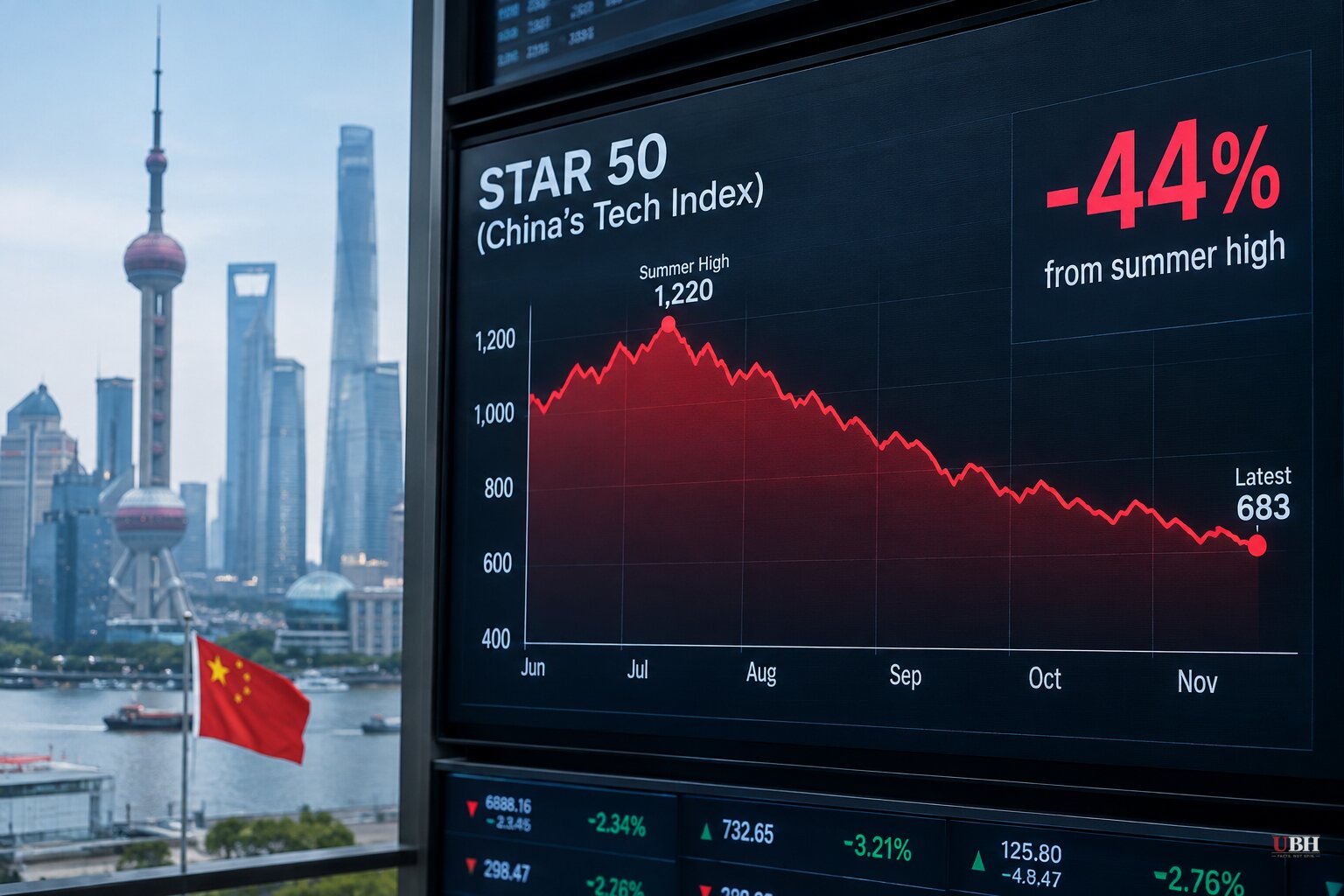
China's AI stock boom is over, and the damage is landing on the one part of the economy Beijing was counting on to replace its busted housing market.
The STAR 50, the Shanghai index of tech and semiconductor leaders, is down 44% from its summer high, according to a November note from Yardeni Research. The Nasdaq is down 18% from its record. That comes even after U.S. stocks just endured their worst week since the early days of the COVID-19 pandemic.
The wealth hole Xi wanted stocks to fill
Real estate makes up roughly 70% of household wealth in China. The property slump has hurt consumer demand and produced intermittent deflation. Property investment fell nearly 22% in October.
Xi's answer was to steer household savings out of apartments and into shares, with retail investors helping to finance the AI buildout. Yardeni says that plan now depends on a rising market.
"To keep AI funding flowing, Xi needs a buoyant stock market," the note said. "Otherwise, AI risks being folded into the state-owned enterprise (SOE) universe that his team has pledged to shrink since 2013, further crowding out the private sector."
"Yet this is a moment of real danger for Xi," the firm wrote.
How big the drop is
The STAR 50 lost about 40% in under four months through early November, erasing roughly $480 billion in market value, according to figures reported in early November. Mainland stocks overall have shed roughly $2.4 trillion since May, according to commentator James Gorrie in The Epoch Times. The broader CSI 300 is in a bear market, down more than 20% from its June peak.
AI-linked companies account for 42% of China's market value and 57% of trading volume, according to Goldman Sachs estimates. That concentration means a theme-wide selloff becomes a market-wide one.
The retail favorites got hit hard. GPU makers MetaX and Moore Threads have dropped roughly 50% since July. Robot maker Unitree drew retail orders for 8,000 times the shares on offer when it listed in August, and it has lost almost half its value since. Battery maker CATL is down 35% this year.
Valuations left little cushion. The STAR 50 was trading at 38 times forward earnings, against 20 times for the Nasdaq 100.
Mainland stocks logged 12 straight weekly declines through the week ending Oct. 30. Morgan Stanley expects offshore Chinese stocks to fall another 10% to 15% before they bottom.
The selloff has spread beyond the mainland. Taiwan's benchmark TAIEX fell 17.5% in its worst week since 1991. TSMC makes up more than 40% of the index.
What Yardeni and others blame
Yardeni lists cutthroat competition, heavier tax burdens, higher energy costs, tariffs, and the risk that trading partners will block ultra-cheap Chinese exports. Gorrie, writing in The Epoch Times, calls those factors "window dressing" and argues the root cause is old-fashioned: prices ran far ahead of profits. He also points to cheap models from DeepSeek and Moonshot AI that rattled chip stocks.
Gorrie also raises the question of who sold and when. He concedes there is no public proof that Communist Party members orchestrated anything. He notes that China's securities regulator warned in June against hyping tech themes, manipulation and insider trading, and that state media that month reported executives and major shareholders at mainland chipmakers were selling into the rally. No investigation or charges tied to the selloff have been announced.
Beijing has leaned on its "national team" of state-backed banks to prop up the market, and on a flood of cheap exports to keep the economy growing. Yardeni notes households carry what it calls "financial PTSD" from earlier busts, including the 2015 crash that required an aggressive rescue and the 2020 tech crackdown. The Shanghai Composite remains well below its October 2007 peak despite GDP growing nearly sixfold.
The counterpoint on China's AI strength
Yardeni does not argue China's AI sector has collapsed in capability. The note says China remains a leader in AI and can "build world-class AI models, train engineers, and spend billions on chips." The firm's concern is financial: whether households that view Shanghai as "a casino with odds set by the Politburo" will fund it.
The stock market and the technology are two different things. A market rout does not by itself stop engineers from building models.
The military stakes for Washington
The technology race has a security side that no stock chart captures. The U.S.-China Economic and Security Review Commission's 2026 annual report says Beijing is trying to circumvent American export controls to obtain advanced chips for military modernization. The report cites an April 2026 assessment from Georgetown's Center for Security and Emerging Technology that the People's Liberation Army was soliciting advanced Nvidia chips.
Commission Vice Chairman Mike Kuiken said, "Anytime the Chinese gain access to advanced chips, we are helping them." Chairman Randall Schriver called for "a comprehensive look at how the Americans are either wittingly or unwittingly contributing to Chinese military modernization."
It is unclear whether Beijing will widen its state-bank support if the slide continues. Morgan Stanley's forecast of another 10% to 15% drop in offshore shares suggests the bottom has not been reached.
The U.S. market is closed for the weekend, so the next test comes when trading resumes Monday, Nov. 23.
Sources used for this briefing
7 links from 7 independent newsrooms (syndicated copies of the same report count once)
These are the sources it draws on, linked so you can verify.


