
Unbiased headlines. Facts, not spin.
Unbiased Headlines is an independently owned news organization. We bring you the facts, not opinions, written fresh from 110+ named sources. Sources linked so you can verify it yourself.
 economy
Major Story (8/10)
Event date: November 18, 2026 ·
Trump Heads to Shenzhen as Tariff Refund Fights, Midterm Fallout and a China Trade Bill Pile Up
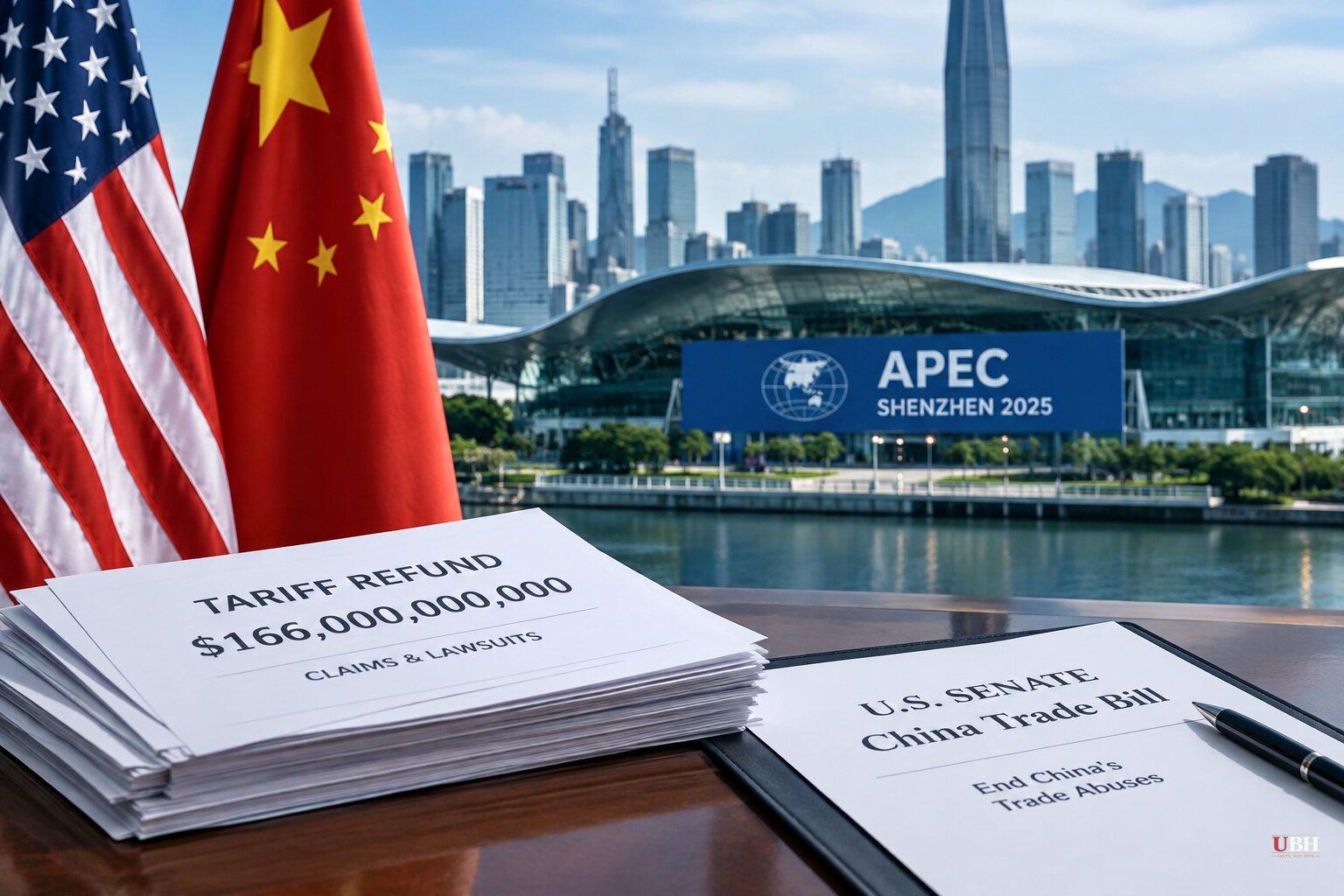
President Trump is expected to sit down with Chinese leader Xi Jinping on the sidelines of the APEC summit in Shenzhen this week, their third face-to-face meeting of 2026. He arrives with tariffs a live political and legal problem at home.
The trade truce the two leaders reached in Busan, South Korea, in October 2025 has been extended through Jan. 10, 2027. Under it, Beijing pledged to buy U.S. soybeans and other farm goods and to hold off on planned rare-earth export controls. Talks on tariffs and rare earths are expected to resume in Shenzhen.
The refund fight
The Supreme Court struck down the tariffs imposed under the International Emergency Economic Powers Act. That created $166 billion in refunds, and the money goes to the companies that paid the duties, not to the households that absorbed higher prices.
Some retailers, including Walmart, Target, Home Depot and Lowe's, have cut prices. Others face class-action lawsuits alleging they kept money that should have gone to consumers. Those claims are allegations, not findings.
A ProPublica investigation alleges that Stanley Black & Decker and several other companies used refund money for bonuses. Stanley Black & Decker has said on earnings calls that an undisclosed portion of its refund would go toward incentive compensation and other costs.
Tariffs cost each household about $1,000 last year, before the ruling. The Budget Lab projects the replacement tariffs will cost at least $900 per household this year.
What the numbers show
USAFacts puts the average effective U.S. tariff rate at 7.6 percent in 2025, more than triple the 2.4 percent of 2024. It averaged 7.3 percent over the first eight months of 2026 and was 6.9 percent in August. Steel and aluminum imports face tariffs of 25 to 50 percent.
Consumer prices rose 3.7 percent year over year in September 2026. Dallas Fed economists Ron Mau and Tucker Smith estimated that tariff collections added 0.8 percentage points to the 12-month core PCE inflation rate.
The trade deficit has not closed. It was $932 billion in 2025, about 5.3 percent wider than the $885.5 billion of 2024. Through the first nine months of 2026 it totaled $662.3 billion, which works out to about $883 billion annualized.
The administration has downplayed any link between tariffs and inflation. Trump's stated aim has been to use tariffs as leverage over trading partners and to encourage domestic manufacturing. Manufacturing's share of nonfarm payroll employment remains historically low, and investment outside the artificial intelligence sector has stagnated.
Energy complicates the inflation picture. Trump has acknowledged that the Iran war pushed up energy prices. National Review wrote that war-driven fuel and fertilizer costs were politically damaging, while arguing that the tariffs' price effect was a deliberate policy choice.
Voters weigh in
Exit polls from the Nov. 3 midterms found that 65 percent of voters believed the tariffs had hurt the national economy and 63 percent said they had hurt their local economy. Foreign Policy summarized the same polling as about two-thirds of voters saying the tariffs hurt them economically.
Democrats spent more than $58 million on ads criticizing tariffs, according to National Review. Republicans spent nothing on ads mentioning the policy.
A September poll found 70 percent of Americans think the president should seek congressional approval before imposing new tariffs. Rep. Richard Neal, the ranking Democrat on House Ways and Means and the expected incoming chair, called the latest Russia sanctions bill "a tariff tyrant's fantasy come true" because it gave Trump more tariff authority. Trump embraced the tariff powers but waived the sanctions on Russia.
Trump has said he does not want to spend his last two years "vetoing everything," according to Foreign Policy. Democrats have vowed to take on tariffs in the new year as part of their push to bring down inflation.
A China bill from the Democratic side
On Nov. 17, Sen. Tammy Baldwin, D-Wis., introduced a bill to strip China of permanent normal trade relations, the status it has held since 2002. It would end 12 months after enactment. The bill also directs the U.S. Trade Representative to produce a report on the economic problems China presents, drawing on the Commerce Department and the U.S. International Trade Commission.
"We need to reset our trade relationship with China," Baldwin said. Her office cited an estimated 3.7 million American jobs lost to the China trade deficit from 2001 to 2018, including nearly 89,000 in Wisconsin. It also pointed to what it called Chinese intellectual property theft and market manipulation. Baldwin voted against granting China the status in 2000.
The cost side is documented too. In August the International Trade Commission estimated that ending the status would make Chinese imports costlier, raise U.S. consumer prices by 0.7 percent over time and trim economic output by 0.2 percent. The U.S.-China Economic and Security Review Commission, a bipartisan congressional body, urged Congress to repeal the status in November 2024.
Trump could veto the bill if it passes.
Allies are hedging
Tariff rates have changed more than 50 times in two years, according to Fortune's count. Canada has kept its distance from Washington. Prime Minister Mark Carney has struck another trade deal with China covering about $400 million in exports, easing duties on Chinese steel and aluminum, and is expected to sign a deal with India. Canada's talks with the U.S. remain acrimonious.
Canada and Mexico have reaffirmed their commitment to renewing the United States-Mexico-Canada Agreement, which covers $2 trillion in annual trade. That puts pressure on Trump to commit to renewal as well.
The next hard dates are Jan. 10, 2027, when the China truce expires, and the new Congress, where Democrats say tariffs will be a first-order fight.
Sources used for this briefing
7 links from 5 independent newsrooms (syndicated copies of the same report count once)
These are the sources it draws on, linked so you can verify.
More coverage: Donald Trump and China


