
Unbiased headlines. Facts, not spin.
Unbiased Headlines is an independently owned news organization. We bring you the facts, not opinions, written fresh from 110+ named sources. Sources linked so you can verify it yourself.
 economy
Breaking / Critical (9/10)
Event date: November 17, 2026 ·
Trump Arrives in Shenzhen for Xi Talks as the U.S. Remains Dependent on China for Critical Minerals
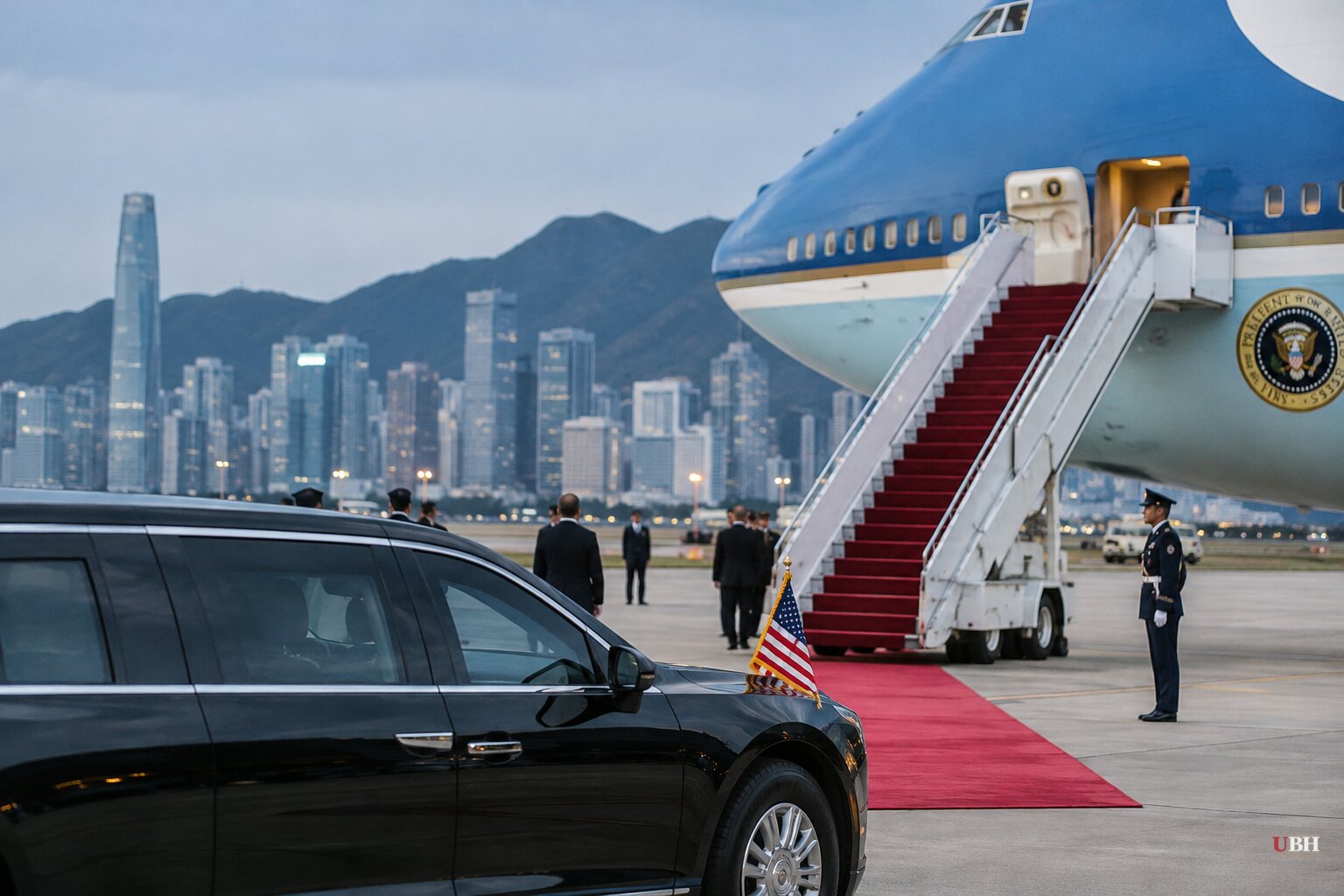
President Donald Trump landed in Shenzhen on Wednesday, Nov. 18, for the Asia-Pacific Economic Cooperation summit. Xi Jinping greeted him at the airport, which is a rare move. Trump later shook hands with Russian President Vladimir Putin after arriving at the summit.
A Trump-Xi bilateral, their third this year, is expected Thursday. Joint talks among Trump, Xi and Putin are also planned for Thursday.
One issue sits under all of it. The U.S. still cannot make enough of what its factories, weapons and data centers need.
The numbers
A U.S. Geological Survey report released last week covers eight minerals: antimony, copper, graphite, niobium, potash, silicon, silver and tungsten. The U.S. imports more than 50 percent of its annual consumption of each. Seven of the eight go into defense production and advanced technology.
USGS says China holds about 70 percent of global natural graphite capacity, about 70 percent of tungsten capacity and roughly 80 percent of silicon metal capacity. The agency projects rising U.S. capacity for antimony, graphite and tungsten through 2030.
"In the 21st century, mineral security is national security," Assistant Secretary of the Interior Andrea Travnicek said.
On rare earths, USGS says China mined about 70 percent of the world's supply in 2025. The International Energy Agency puts China's share of magnet rare earths at about 60 percent and says it refines most other critical minerals.
The magnet gap is wider. The IEA estimates U.S. capacity for neodymium-iron-boron magnets at roughly 4,500 metric tons in 2025. China's was about 210,000.
Billions spent, mines still years out
The administration has put federal money into the problem. It has taken equity stakes in Trilogy Metals and Lithium Americas and set up Pentagon-backed processing partnerships with MP Materials.
The output is not here yet. Thacker Pass and Perpetua Resources are targeting production around 2028 and 2029. Several major copper developments are expected to expand by 2031.
"Right now there are more PowerPoint decks than permits," said Samir Kapadia, head of trade at the Vogel Group. He said the question is how many projects are shovel-ready and how many exist only on paper. Jack Lifton of Technology Metals Research was harsher about where things stand: "Exactly where the Chinese want us."
The White House did not respond to Reuters' request for comment on those assessments.
Trump has offered a far shorter timeline. On Tuesday, ahead of a Quad summit in Manila with leaders of India, Japan and Australia, he said the U.S. is expected to catch up with China on rare earths "within 10 months." He said the four countries had struck several critical-mineral deals so that "none of our nations is vulnerable to coercion by any single foreign supplier."
Indian Prime Minister Narendra Modi said Australian mining, Japanese recycling, American expertise and Indian manufacturing "could provide new strength to supply chains."
The 10-month target hinges on breaking China's hold on refining, which the Quad deals do not yet do. Refineries take years to build. The project dates above run well past that window.
What China says
Beijing says its restrictions are meant to keep the minerals out of military use. It has also accused Washington of abusing export controls by blocking semiconductor sales to China.
China has already imposed export licensing requirements on antimony and graphite. Its April 2025 rare earth licensing rules remain in force.
Those rules bit last year. After the April 2025 tightening, shipments of rare earths and magnets fell sharply, and some U.S. and European carmakers cut output or briefly shut plants, the IEA said in an April report. Ford was among the U.S. manufacturers affected.
Rich Nolan, head of the National Mining Association, put it this way: "The Chinese have been using the critical minerals choke collar on the US when they feel like it."
Braden Harker, director of the USGS National Minerals Information Center, said: "When one supplier holds most of a market, a strike or a flood or a policy change in one country can affect supply for the whole world."
Chips complicate the talks
Chips are the other pressure point. Singapore-based cloud provider Megaspeed is under investigation over allegations that it diverted restricted Nvidia chips to China. Megaspeed denies wrongdoing.
Representative John Moolenaar, chairman of the House Select Committee on China, has urged Congress to "act quickly to pass bipartisan export control legislation in the year-end national defense bill." Bills in play include the AI Overwatch Act, the Chip Security Act and the MATCH Act. Over the weekend, the Commerce Department issued an interim final rule on remote access to computing power. How it will be enforced is still unclear.
The Atlantic Council notes that tighter chip rules could invite retaliation through stronger rare earth controls. That would hit the exact vulnerability the USGS report describes.
Trump and Xi may agree to extend the trade truce struck in October 2025. It is due to expire in January and includes export-control waivers for certain critical minerals. China has extended the suspension of its broader restrictions through Jan. 10, 2027.
Analysts interviewed by Reuters say that dependence limits how hard Trump can press on tariffs and export controls. The Thursday meeting will show whether the truce is extended before the January deadline.
Sources used for this briefing
7 links from 7 independent newsrooms (syndicated copies of the same report count once)
These are the sources it draws on, linked so you can verify.
More coverage: Donald Trump and China


