
Unbiased headlines. Facts, not spin.
Unbiased Headlines is an independently owned news organization. We bring you the facts, not opinions, written fresh from 110+ named sources. Sources linked so you can verify it yourself.
 economy
Major Story (7/10)
White House Itemizes $17 Billion in Southeast Asia Deals; $12 Billion Is One Boeing Sale
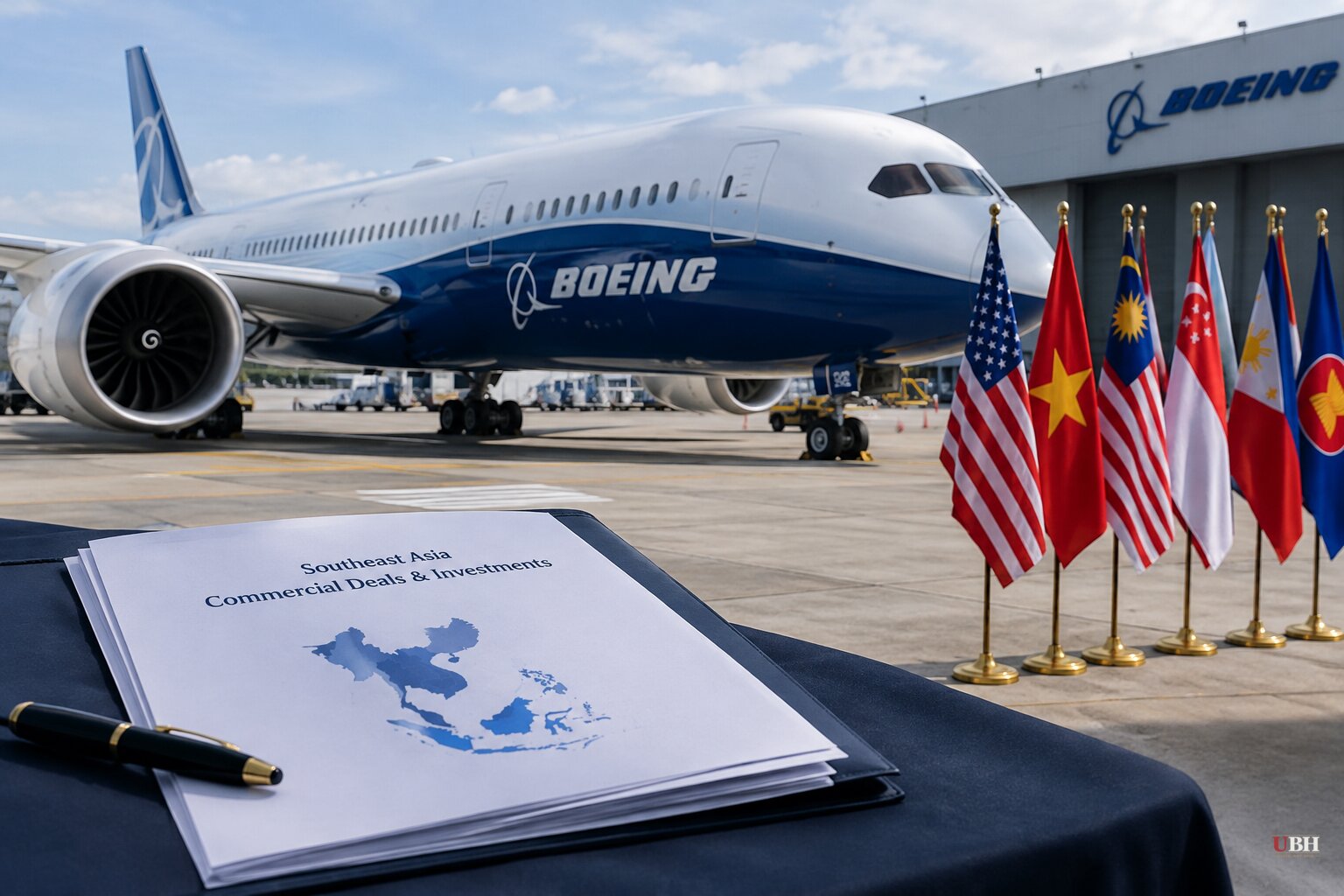
Since Trump told a Manila state luncheon on Wednesday, Nov. 18, that he had "consummated" a very big trade deal with Ferdinand Marcos Jr., the White House has put numbers behind the claim. A statement released late that day lists more than $17 billion in commercial deals and strategic investments for U.S. companies in the Philippines, Thailand, Indonesia, Malaysia and Brunei.
The White House says the package will "support tens of thousands of American jobs."
The Philippines: Boeing, then defense financing
The largest line item is a $12 billion sale. Boeing and GE Aerospace finalized a deal with Philippine Airlines for up to 20 Boeing 787 aircraft with GE engines. The White House says it supports 47,000 U.S. jobs. That is the White House's own estimate.
The next piece is defense. Washington and Manila "will pursue" a Foreign Military Financing loan package of more than $2 billion for Philippine purchases from U.S. suppliers. The White House says it would support over 7,000 American jobs and protect "returns for the American taxpayer."
Separately, the U.S. committed $400 million in Foreign Military Financing to expand Philippine reach and deterrence in the South China Sea. That covers long-range fires, command and control, infrastructure and multi-domain drones, and the White House says it supports 1,500 U.S. jobs. The White House has not said whether that money is a grant or a loan.
Smaller Philippine items:
- A $37 million Department of National Defense contract for AI-enabled military mission support.
- A $63 million initiative to modernize defense cloud infrastructure.
- A potential $200 million satellite connectivity deal with U.S. company Astranis.
- A $40 million fuel depot at Subic Bay, to be built by Subic Grain.
- Modernization of Basco Airport for military access, disaster response and supply chains.
- Exploration of civil nuclear cooperation.
The rest of the region
Thailand plans to spend up to $123 million on U.S.-made HIMARS rocket systems. The statement says that could be the first such deal in mainland Southeast Asia.
In Indonesia, Latitude Energy and the sovereign wealth fund Danantara are negotiating a $2 billion coal project using U.S. technology. Negotiating is not signing.
In Malaysia, the Navajo Transitional Energy Company signed a three-year, $100 million deal to supply coal to a unit of utility Tenaga Nasional Berhad. Malaysia's communications regulator said a U.S. consortium will help develop the government's sovereign AI cloud, with Washington offering $50 million in support.
In Brunei, Unified National Networks plans to award a data center tender to U.S. firm Vertiv, with nearly $1 billion of spending sourced from U.S. vendors.
What is finished and what is not
The statement's own verbs vary. The Boeing sale is "finalized" and the Navajo coal deal is "signed." Those two come to about $12.1 billion. The financing package "will be pursued," the Indonesian project is under negotiation, the Brunei tender is something the buyer "plans" to award, and the Astranis deal is "potential."
The statement also says Trump and Marcos "committed to eliminate the U.S. trade deficit with the Philippines" through more Philippine imports of American energy and agricultural products. The White House has not put a timeline or a dollar target on that pledge.
The $400 million for the South China Sea and the $2 billion-plus loan package are different in kind from the commercial sales. They depend on U.S. government financing, so American taxpayers are on the hook in some form, and the terms of neither have been published. The White House says the loan package is structured to protect taxpayer returns.
The political backdrop
The trip came as Trump faces a weakened domestic position after this month's midterm losses. Edgard Kagan, a former U.S. ambassador to Malaysia now at the Center for Strategic and International Studies, described the logic of presidential travel this way: "This is a way in which you start changing the narrative, and remind people that, you know, the president is still the president." Trump, asked Monday whether the midterm results could reduce his influence abroad, answered "No," saying he was not the one on the ballot.
The White House frames the deals as strategic. It says they "bolster regional security" and support "a free and open Indo-Pacific." The defense items, the HIMARS sale and the South China Sea funding all point at Beijing, though Trump went on from Manila to China for the APEC summit.
What to watch
The $12 billion Boeing order is done. The rest depends on follow-through. The $2 billion-plus Philippine loan package still has to be negotiated and, as a U.S. government financing program, approved. The Danantara coal talks and the Vertiv award in Brunei have to actually close. Whether the Astranis satellite deal reaches $200 million remains open, since the White House calls it only a potential agreement.
Sources used for this briefing
7 links from 7 independent newsrooms (syndicated copies of the same report count once)
These are the sources it draws on, linked so you can verify.


