
Unbiased headlines. Facts, not spin.
Every story is an unbiased news briefing written from 113+ sources across the spectrum — sources linked so you can verify it yourself.
 economy
Major Story (8/10)
Event date: September 17, 2026
economy
Major Story (8/10)
Event date: September 17, 2026
Trump Threatens EU Tariffs Over Von der Leyen's Canada 'Associate Member' Proposal
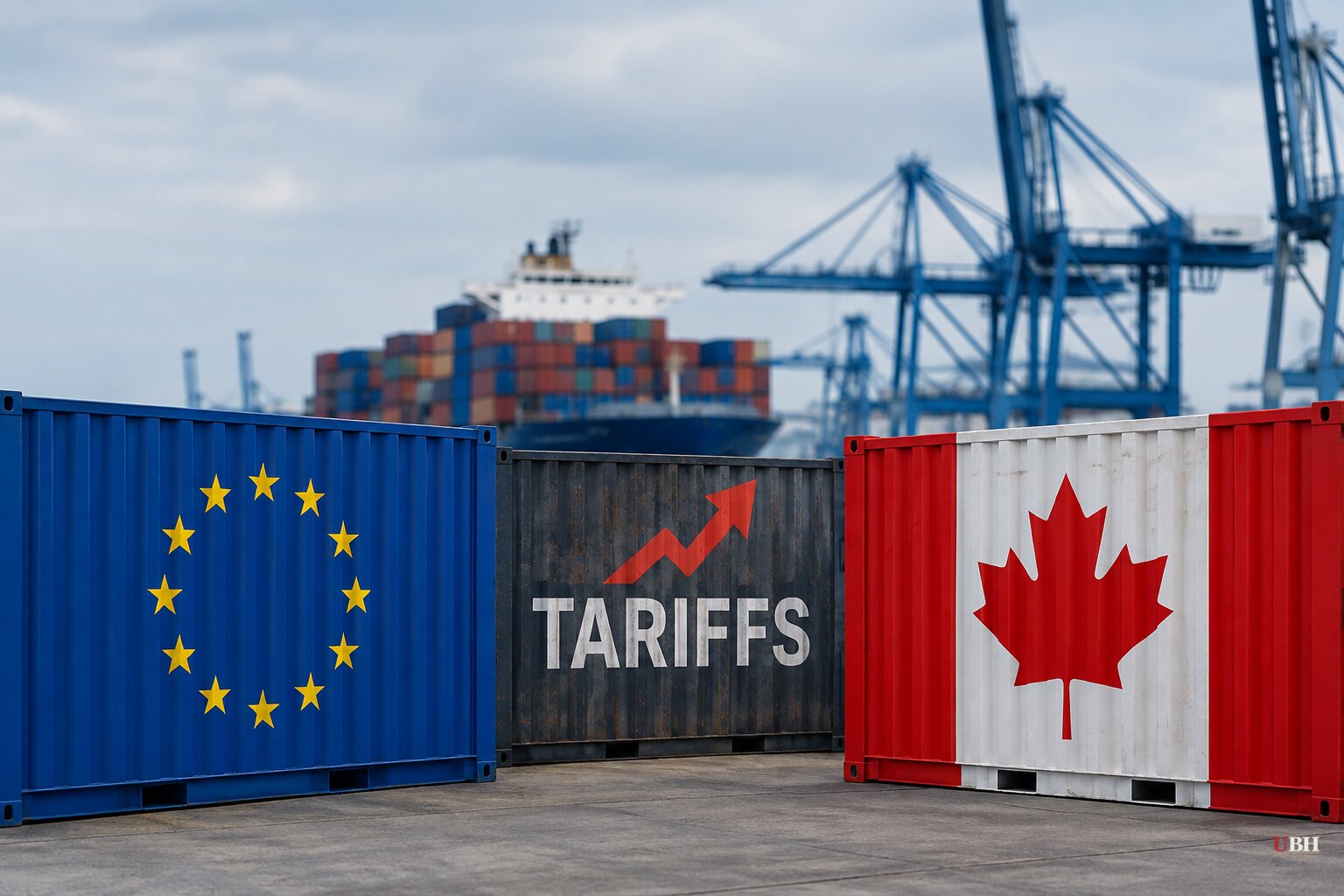
Since European Commission President Ursula von der Leyen used her September 16 state of the union address to declare the EU's trade imbalance with China had reached a 'tipping point,' attention has also focused on a closer issue: a proposal to pull Canada into the EU's orbit, and the tariff threat it drew from President Trump.
Von der Leyen proposed on September 16 that Canada become the European Union's first 'associate member,' according to CNN. There's a catch. That designation does not exist under EU treaties. It was a political gesture, not a legal one.
Trump didn't wait to find out how serious it was. Speaking to reporters the same day, he said the U.S. could respond with 'very heavy tariffs' on Europe if he judges a Canada-EU tie-up to be a 'hostile act.' "If it's a good intention, that's fine," Trump said, according to CNN. "If it's a bad intention, we'll put very heavy tariffs on Europe, which is a possibility."
Canadian Prime Minister Mark Carney addressed EU lawmakers the next day, September 17, and pushed back on the idea that he's building an anti-American coalition. "I'm not proposing a third bloc in order to become a great power rival, only with better manners," Carney said, per CNN.
Carney framed the pitch as risk management, not rebellion. "We do not seek power to dominate others," he said. "On the contrary, we are pursuing resilience so no one can control our open markets, impair our sovereignty, threaten territorial integrity or undermine our freedoms, our democracies, our rule of law."
He told reporters afterward that Canadian lawmakers would eventually debate and vote on whatever 'final structure' emerges, and was explicit that Canada isn't seeking full EU membership. Carney also said polling shows an 'overwhelming majority' of Canadians back closer EU ties, though CNN did not cite a specific pollster or numbers.
Why Ottawa is looking to Brussels
Canada is in a trade war with its largest trading partner, the United States, which CNN says is driving the urgency behind Carney's outreach to Europe. The EU, for its part, has run its own string of trade disputes with Washington. Two parties bruised by the same negotiating partner finding common cause is hardly surprising.
The strongest case against Carney's framing is Trump's own reading of it: that any formal EU-Canada arrangement, regardless of what Ottawa calls it, functions as a coordinated bloc positioning against U.S. leverage, and Washington is entitled to treat it as adversarial. That's a legitimate concern for an administration trying to negotiate bilateral terms with both parties separately. If Canada and the EU move as a unit, the U.S. loses the ability to play them off each other.
Carney's counter is that resilience isn't rivalry, and that a country facing a trade war with its own top partner has every right to diversify who it depends on. Nothing in the record settles which motive is driving the policy versus which risk Trump is actually worried about.
The China backdrop nobody's separating from this
Von der Leyen's own China framing complicates the picture further. The same week she floated the Canada gesture, she told Strasbourg lawmakers the EU's trade deficit with China had hit 1 billion euros a day and that Europe would 'use all tools at our disposal to rebalance' that relationship. She also flagged the bloc's dependence on China for more than 80% of critical raw materials and 90% of rare earths.
A Europe simultaneously trying to de-risk from Beijing and pull Ottawa closer while provoking a tariff threat from Washington is running three trade fights at once. None of the sources indicate the EU has resolved which relationship takes priority, or whether Brussels can actually maneuver Canada into any formal status without triggering the retaliation Trump has already promised.
No tariffs have been imposed. No EU legal mechanism for 'associate membership' exists yet, and CNN reported none is currently drafted. Whether Trump follows through, and what specific Canada-EU structure Canadian lawmakers eventually vote on, remains open.
Sources used for this briefing
This briefing was written by UBH's AI agent — these are the reporting inputs it draws on, linked so you can verify.


