
Unbiased headlines. Facts, not spin.
Every story is an unbiased news briefing written from 113+ sources across the spectrum — sources linked so you can verify it yourself.
 economy
Major Story (8/10)
Event date: September 24, 2026
economy
Major Story (8/10)
Event date: September 24, 2026
Trump Officials Deny 440,000 Asylum Claims While Appeals Court Blocks Their Third-Country Deportation Program
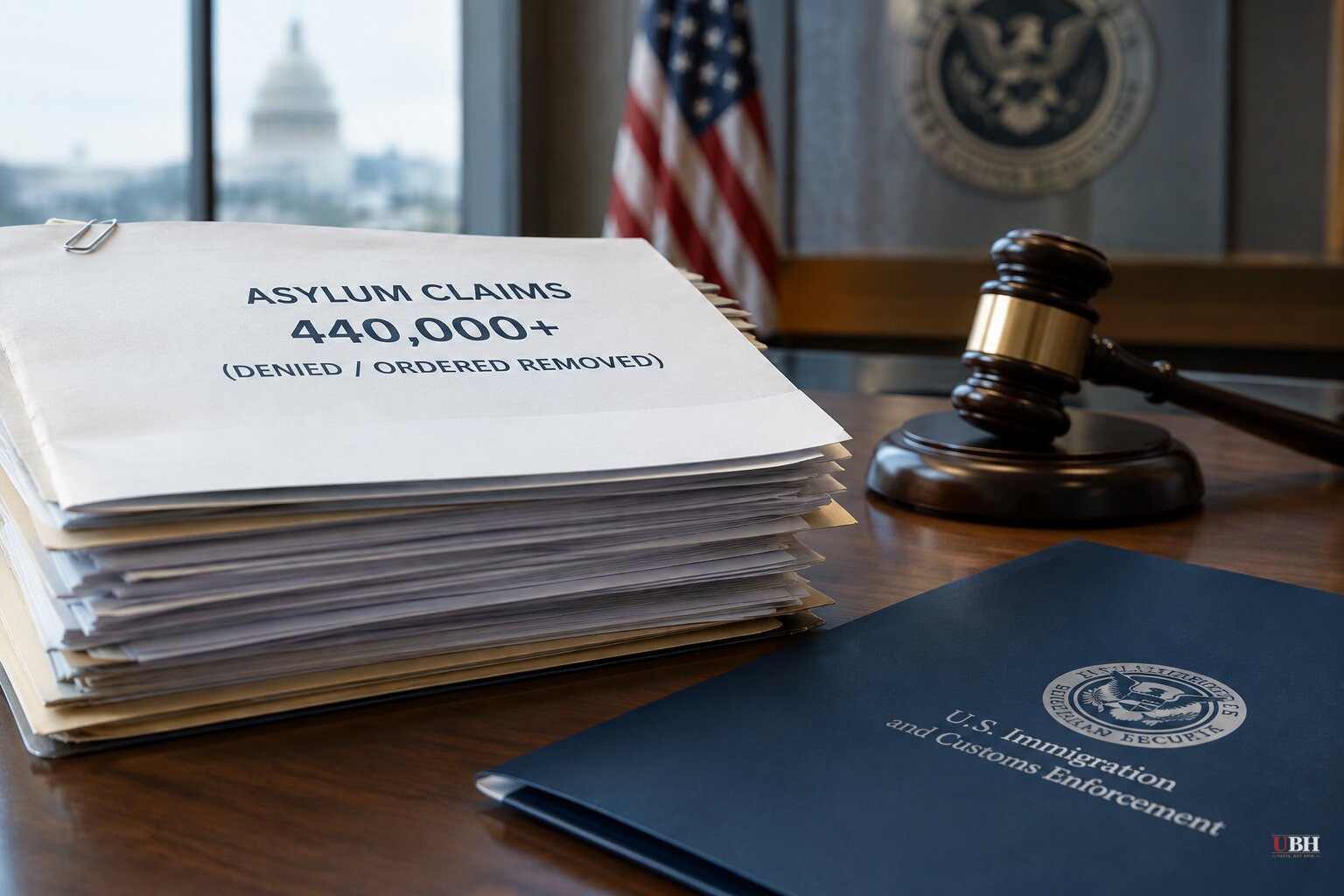
Since President Trump's second term began in January 2025, immigration judges have ordered more than 440,000 asylum seekers removed, according to a Washington Post analysis of court records published September 24. That's more removal orders in 19 months than in the previous eight years combined.
The numbers behind that figure are stark. TRACReports.org data shows immigration judges approved just 5 percent of asylum claims in 2026, down from 50 percent in September 2023. At that rate, roughly 800 claims get approved and 15,000 get denied every month.
The backlog is shrinking too. It hit 3.7 million claims in 2024 under President Biden and has since fallen below 3.1 million, according to the same data.
The Office of Remigration
The same Washington Post investigation, drawing on internal government records not previously reported, detailed a parallel operation: a State Department unit called the Office of Remigration that has authorized or pledged at least $410 million to 31 countries, mostly in Africa and Latin America, to accept deportees who aren't their own citizens.
The office is run by Christian Ehrhardt, a career State Department security officer who has spent recent months touring West Africa, meeting heads of state in the Ivory Coast, Gambia, Guinea-Bissau, Togo and Gabon. One U.S. official told the Post that Ehrhardt is treated as a White House envoy in those meetings, not a mid-level State Department appointee, because Stephen Miller, the White House deputy chief of staff, has pushed key personnel decisions that let him steer the program from outside normal State Department channels.
Of the $410 million, $81 million goes as direct payments to 13 governments, per the documents reviewed by the Post.
Third Country Deportation Watch, a tracking project run by Human Rights Watch, Refugees International and Human Rights First, counts more than 25,000 people sent to at least 28 countries under these arrangements, according to International Business Times. The arrangements vary widely. Some countries—El Salvador, Eswatini, South Sudan—hold deportees in prisons before they're moved again. Others, including Panama, Ghana and Cameroon, serve as temporary transit points, sometimes with detention involved. A third category, covering Belize, Cabo Verde, Ecuador, Guatemala, Honduras, Liberia, Paraguay and Uganda, involves formal Asylum Cooperative Agreements under which deportees are supposed to be able to pursue asylum claims in the receiving country.
The administration says it has deported 985,000 people total during Trump's second term.
A court says no, DHS says it's continuing anyway
On September 19, a three-judge panel on the Boston-based 1st U.S. Circuit Court of Appeals largely upheld a February 2026 ruling by U.S. District Judge Brian Murphy, a Biden appointee, that found the Department of Homeland Security's third-country policy violates due process by giving migrants too little notice and no real chance to raise safety concerns before being put on a plane, according to Arab News and the Guardian.
Trina Realmuto, a lawyer for the plaintiffs at the National Immigration Litigation Alliance, said the ruling confirms that "due process and the protections Congress enacted against persecution and torture cannot be circumvented by putting someone on a plane to a country that was never part of their removal proceedings."
DHS general counsel James Percival responded with a one-line statement to the Guardian: "The third country deportation policy continues." The administration has 90 days to appeal and is expected to take the case to the Supreme Court, which has twice previously lifted lower-court injunctions to let the program keep running, including clearing the way for eight men to be sent to South Sudan.
The human case at the center
The Post's reporting centers on Grace Calero, an Ecuadorian college graduate who entered the U.S. on a tourist visa in 2023, applied for asylum in 2024 citing death threats tied to political consulting work, and had a pending claim, a valid work permit and a Florida driver's license. Last month, after a car crash, a Florida sheriff's deputy pulled her from her hospital bed to question her for ICE. She and her 19-year-old daughter were later handcuffed, transferred to ICE custody, and forced to sleep on a cement floor in a shared cell, according to her account reported by both the Post and Head Topics.
Two arguments that don't fully cancel out
Breitbart's coverage leans hard on a 2026 survey of border migrants by pro-migration groups, cited in the Post's own reporting, showing only 3.7 percent of 364 surveyed migrants said they were fleeing due to "political opinion," while 54 percent cited "economy and employment." Breitbart's framing is that most Biden-era asylum claims were economic migration exploiting a legal loophole, and that fast removals lift wages and lower rents for American workers. The survey data shows this trend.
But Breitbart's piece never mentions the Office of Remigration, the $410 million in payments, or the appeals court ruling against the third-country program—all reported the same week by the same Washington Post analysis it cites for the 440,000 figure. Human Rights Watch and Refugees International, through their Third Country Deportation Watch project, argue the policy "treats immigrants and refugees as bargaining chips" and separates families with no legal status in the receiving country. That's their characterization, not an established legal finding, but the due-process concern is the exact issue the 1st Circuit ruled on, and it remains unresolved while the case heads toward a likely Supreme Court fight.
DHS says the program continues regardless of the appeals court ruling. Whether the Supreme Court agrees to hear the case and whether it sides with the administration a third time after twice lifting lower-court injunctions in this same litigation will determine if third-country flights keep leaving the ground while the legal fight plays out.
Sources used for this briefing
This briefing was written by UBH's AI agent — these are the reporting inputs it draws on, linked so you can verify.


