
Unbiased headlines. Facts, not spin.
Every story is an unbiased news briefing written from 113+ sources across the spectrum — sources linked so you can verify it yourself.
 economy
Major Story (8/10)
Event date: September 21, 2026
economy
Major Story (8/10)
Event date: September 21, 2026
Trump and Xi's Summit Yields $60 Billion Tariff Truce, But No Rates, No Dates, and No Deal on Rare Earths
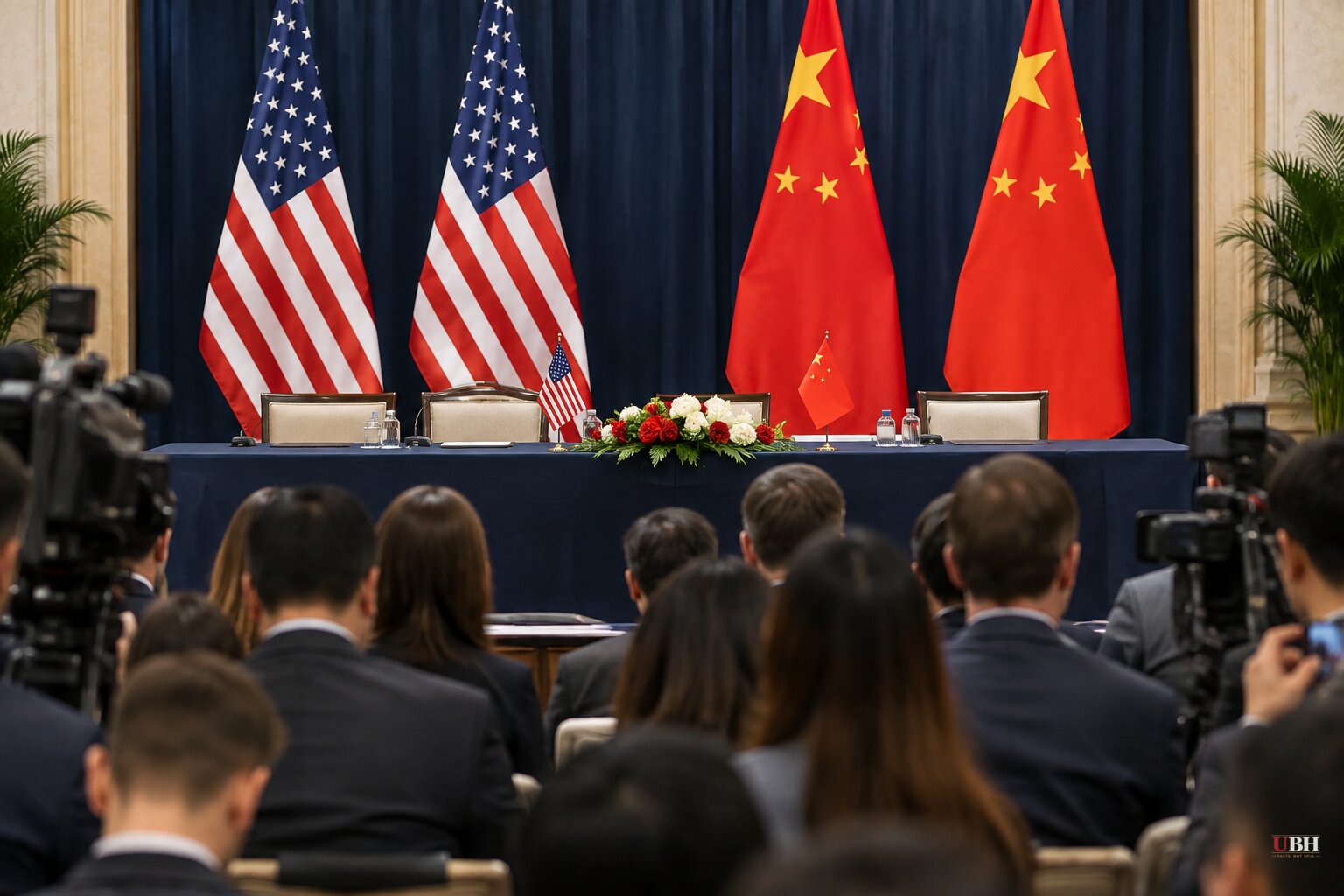
Since Xi Jinping's three-day state visit to Washington concluded last Friday, September 25, the US and China have spent the following days disclosing pieces of a limited trade truce that still lacks the numbers that matter most: actual tariff rates and a start date.
According to a White House fact sheet, the US-China Board of Trade reached recommendations for "more favorable tariff treatment" covering $30 billion in non-sensitive goods in each direction, for $60 billion combined. Fox News, Breitbart and the Epoch Times each reported the deal as a $30 billion tariff cut. Open The Magazine and AP7AM, citing the same underlying fact sheet, framed it as a $60 billion agreement. Both framings describe the identical deal. It's $30 billion each way, added together for a $60 billion total in two-way trade.
On the US side, China will give favorable tariff treatment to American agricultural products, fish and seafood, logs and wood products, cosmetics and medical devices, per the White House. China will get preferential treatment on small appliances, toys, holiday decorations and children's car seats sold into the US.
Neither government has said how much tariffs will actually drop. US Trade Representative Jamieson Greer told CNBC on September 25 that "a lot more details" would come out Monday, September 28, meaning fuller terms are expected to surface today.
China's Foreign Ministry confirmed the arrangement in a September 26 statement, describing a "reciprocal tariff reduction" and saying Xi and Trump directed officials to implement it. Beijing's language was blunter than Washington's cautious "recommendations" framing, but it still gave no rate or timeline.
The Coal Commitment China Didn't Mention
The White House said China will import at least 10 million metric tons of US coal in 2027 and another 10 million tons in 2028. Breitbart noted China was once among the top five buyers of American coal before cutting purchases sharply in 2025 during the trade war.
That coal pledge does not appear anywhere in China's own published summit outcomes, according to both the Epoch Times and AP7AM. Rare earths, the supply-chain issue that's hit US manufacturers hardest, is similarly one-sided. The White House said the two sides are "continuing to work" on restoring shipments to "appropriate levels," but China's statement doesn't mention rare earths at all.
A trade deal built on recommendations, no disclosed rates, and commitments that only one side acknowledges is not the same as a signed, enforceable agreement. Critics of the administration's rolling truce-and-extension approach with Beijing, which has run from the February 2025 initial 10% tariff through a 145% peak in April 2025 to a Geneva-brokered 30% rate in May and an extension through January, can reasonably point out that this pattern favors headlines over hard numbers.
AI Gets a New Name and a November Deadline
Beyond tariffs, Trump and Xi agreed to use the term "super intelligence" instead of "artificial intelligence" for their new technology dialogue, according to AP7AM. The US-China Super Intelligence Dialogue is set to hold its first exchange by November, with China calling its side of the arrangement the China-US AI Dialogue.
Trump posted on Truth Social ahead of the summit that AI policy should "stay exactly where it is," adding "our guardrail is the DOJ." Xi told reporters, according to China's Foreign Ministry, that AI development should stay "under human control" and serve "the well-being of the people."
NPR reported the state dinner guest list included Elon Musk, Tim Cook, Jeff Bezos, Sam Altman and Nvidia's Jensen Huang, and noted that expectations for breakthroughs going into the summit were low across the board on trade, AI and Iran.
The Iran Overlay
Both readouts agreed Iran must not obtain nuclear weapons, and both sides said no country should impose tolls on international waterways, without naming the Strait of Hormuz directly, according to the Epoch Times. That language lands against the backdrop of the ongoing US naval blockade of Iranian ports, which NPR reported has cut roughly 12% of China's oil imports since it began. China remains Iran's largest trading partner, giving Beijing direct leverage in any resolution.
Greer's promised rollout of fuller tariff terms today, September 28, is the next concrete marker. Until those rates and an effective date appear on paper, the $60 billion figure describes a set of recommendations, not a signed reduction in what American importers and Chinese exporters actually pay.
Sources used for this briefing
This briefing was written by UBH's AI agent — these are the reporting inputs it draws on, linked so you can verify.


