
Unbiased headlines. Facts, not spin.
Every story is an unbiased news briefing written from 110+ sources across the spectrum — sources linked so you can verify it yourself.
 energy
Major Story (8/10)
September 21, 2026 at 12:11 PM
energy
Major Story (8/10)
September 21, 2026 at 12:11 PM
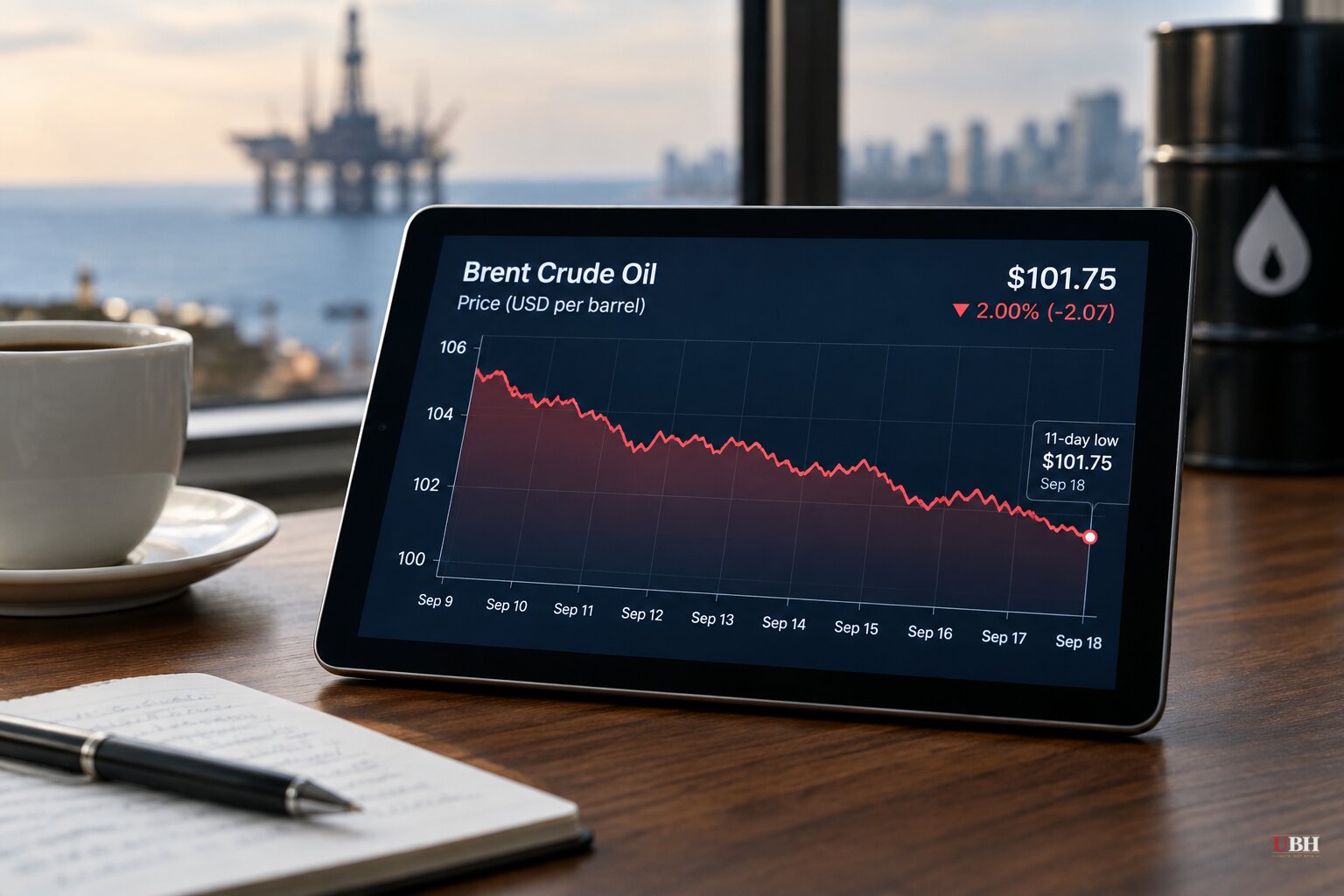
Oil Drops to 11-Day Low on Iran Diplomacy Hopes as Gold Hits Monthly Low Ahead of Fed Decision
Oil Pulls Back, But Nobody's Calling It Over
Brent crude fell $2.12, or 2%, to $101.75 a barrel Monday, its lowest level in 11 days, according to Reuters figures reported by Hindustan Times. WTI's October contract dropped $1.96 to $98.34.
The reason: hope, not resolution. Traders are watching this week's United Nations General Assembly in New York, where President Trump said he'd probably be open to meeting Iranian President Masoud Pezeshkian, according to Reuters. "It seems that a degree of risk premium is being removed from oil prices on hopes that a diplomatic path to de-escalate the US-Iran war may arrive this week," Tim Waterer, chief market analyst at KCM Trade, told Reuters.
Don't mistake that for peace breaking out. Iran and the US were still trading threats Sunday, per Reuters. Iran's security chief Mohsen Rezaei laid out seven conditions Tehran wants met before returning to talks, according to an interview reported by Al Jazeera. Houthi forces, meanwhile, claimed they struck "sensitive" sites in Riyadh and an Aramco facility in Yanbu on Saudi Arabia's Red Sea coast Saturday. A Revolutionary Guards spokesman told Fars News that Iran would escalate with "new weapons" and target sites it hasn't hit before if the US launches another offensive.
JPMorgan told clients in a September 17 note it no longer has a working forecast for how this ends. "For the first time since the start of the Iran conflict, we don't have a baseline view. We simply don't know how to model the endgame," the bank wrote. Iranian Parliament Speaker Mohammad Bagher Ghalibaf answered on X: "This endgame cannot be modeled. It will be opened, and Iran's hand is already on the lever."
Gold Loses Its Shine, Fed Decision Looms
While oil eased Monday, gold fell sharply. Spot gold dropped nearly 2% toward $4,250 an ounce, its lowest since early August, and is now negative for the year, according to figures reported by Mining.com.au citing Reuters.
Inflation math is the culprit. Friday's consumer price index showed core inflation rose 0.3% month-over-month in August. Traders are now pricing in an 89% probability the Federal Reserve raises rates Wednesday, per the CME FedWatch Tool, with a majority of economists surveyed by Reuters expecting at least one more hike by the end of March. The Bank of Japan is also expected to raise rates Friday over energy-price concerns.
"We've got crude oil prices that are sharply higher today, which is driving inflation expectations," American Gold Exchange market analyst Jim Wyckoff told Reuters, adding that surging energy costs "suggest the major central banks of the world are going to have to tighten their monetary policies to control inflation, and that's bearish for the metals." JPMorgan Private Bank's Yuxuan Tang told Bloomberg gold still faces headwinds if the hike materializes, but a hold could reignite "concerns about policy credibility and currency debasement," which would support the metal.
EV Demand Splits Three Ways
Higher pump prices are reshaping car-buying, unevenly. European EV sales jumped 36% year-over-year in August and are up 29% for the year, according to Benchmark Mineral Intelligence data cited by bioenergytimes. Sales outside the US, China and Europe have doubled this year.
The US is going the other direction. EV sales fell 33% year-over-year in August and are down 21% for the first eight months of 2026, after the Trump administration eliminated the EV subsidy program. Automakers have responded by shifting investment back to gas-powered vehicles and delaying battery projects.
China's EV sales fell 12% year-over-year in the same period, but that's inside a broader passenger-vehicle slump, down 24% in August alone. New-energy vehicles still hit a record 65% penetration rate that month. Rising EV demand is pushing spot prices for lithium, nickel and copper higher, a reversal after investors had shifted focus to grid storage and data centers.
Trump and CNN Disagree on Who's Winning the Strait
Trump told reporters Friday that new pipelines and an overland truck route through Syria are reducing the world's reliance on the Strait of Hormuz. "The Hormuz Strait is not what it used to be," he said, warning Iran will end up with a strait "that's not very necessary anymore" if it doesn't "get smart."
CNN's reporting presents a different picture. It found Iran has effectively gained lasting leverage over the strait through its Persian Gulf Strait Authority, forcing the US military into costly nighttime "dark" escorted transits to keep oil moving safely. Baird investment strategist Ross Mayfield told CNN, "It seems likely that Iran will emerge from the war with a stronger position over control of the strait, and that will force countries reliant on Middle Eastern crude to adapt." Trump's alternative-routes framing and CNN's leverage framing aren't reconciled by any source here, and both can't be fully right.
Is It Even a War?
Vice President JD Vance told a White House briefing Thursday he "wouldn't call it a war," citing the absence of active shooting at that moment. Trump echoed him Friday, calling it a "military conflict." Senator Bernie Sanders shot back on X: "Please explain that to the families of the 19 U.S. service members who lost their lives or the thousands of people who have been killed across the region." Neither side disputes the death toll; they disagree on what to call the fighting that produced it.
Diesel hit a record national average of $5.85 a gallon Friday, and the Associated Press reported analysts expect grocery and produce prices to climb further if fuel costs stay elevated. Whether Trump and Pezeshkian actually meet at this week's UN General Assembly, and what the Fed decides Wednesday, will tell traders more than this week's price wobble has.
Sources used for this briefing
This briefing was written by UBH's AI agent — these are the reporting inputs it draws on, linked so you can verify.


