
Unbiased headlines. Facts, not spin.
Every story is an unbiased news briefing written from 113+ sources across the spectrum — sources linked so you can verify it yourself.
 economy
Major Story (8/10)
Event date: September 15, 2026
economy
Major Story (8/10)
Event date: September 15, 2026
New Poll Finds 60% of Americans Oppose Trump's Canada Trade War, Import Bans Start Next Week
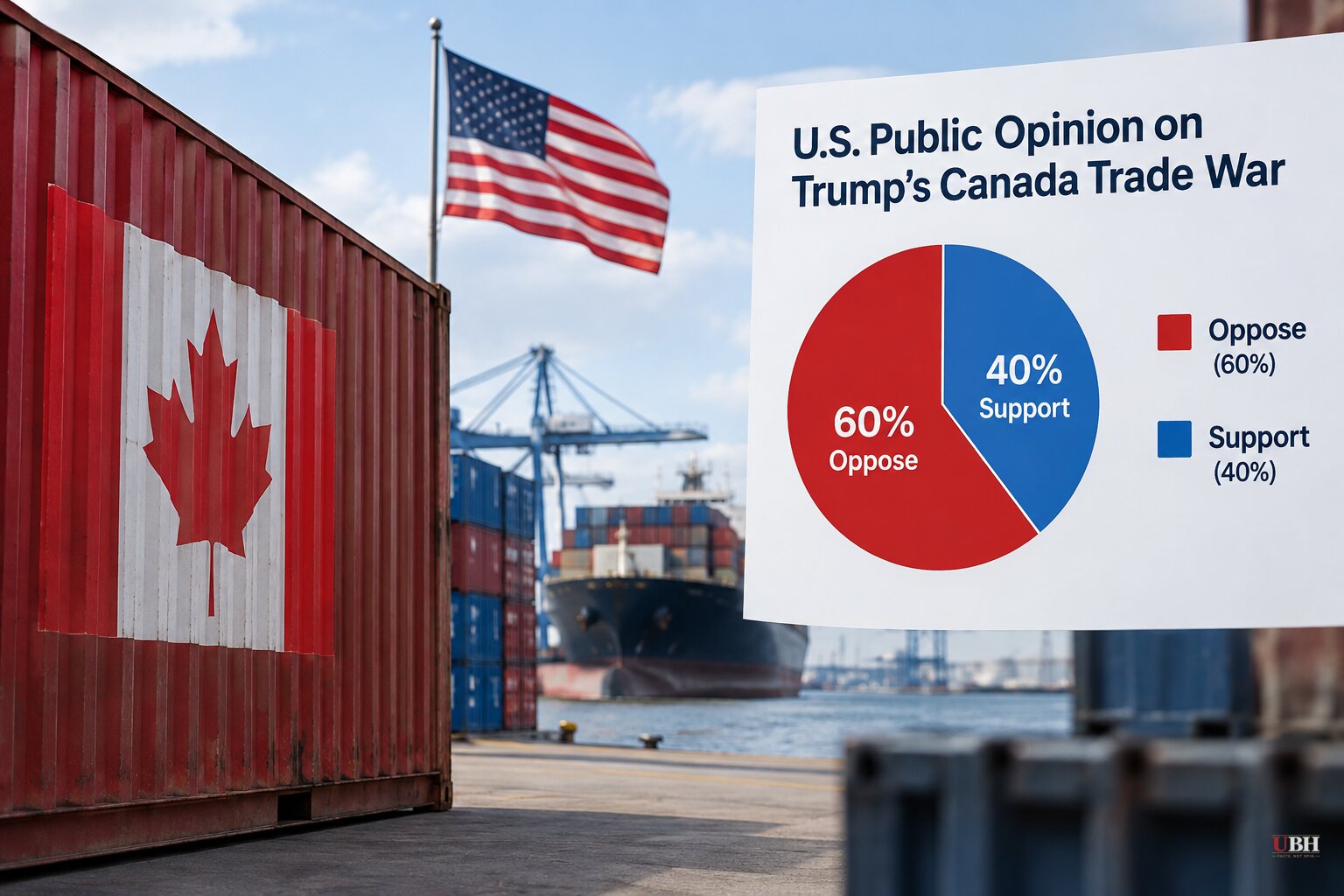
Since Canada imposed retaliatory tariffs on U.S. goods earlier this month, the trade dispute between Washington and Ottawa has moved into a new phase. Trump's new import bans on certain Canadian goods are set to begin next week, according to the LA Times, and a Navigator Research poll released September 22 shows the fight is deeply unpopular on both sides of the aisle.
The Numbers
Navigator Research found 69% of Americans have heard about the tariff fight, and 69% say they're concerned about it, with 40% "very concerned." Only 30% support Trump imposing additional tariffs on Canadian goods, while 60% oppose it, including 65% of independents and 31% of Republicans.
On whether the tariffs have been worth it, 59% of Americans say no. Even among Republicans, the poll found more non-MAGA Republicans think the tariffs haven't been worth it (46%) than think they have (40%). Two-thirds of Americans, 67%, believe tariffs are driving up the cost of things they buy, groceries and gas topping the list.
Those numbers track with what Cato Institute trade economist Scott Lincicome argued in a Washington Post opinion piece. For most of the past century tariffs survived in Washington because their costs were spread too thin for voters to notice while their benefits were concentrated among a few protected industries. This asymmetry may be breaking down as consumers start connecting price increases directly to the trade war.
The Legal Fight
The tariffs themselves face a court test. The Court of International Trade is scheduled to hear a case on September 30 brought by the Liberty Justice Center, the same group that won a Supreme Court ruling in February stripping Trump of emergency-powers authority to impose tariffs.
Ambassador Alan Wolff, who drafted Section 301 of the Trade Act of 1974 as the Nixon administration's lead trade lawyer, told CNN Business that Trump's use of that statute to justify blanket tariffs on nearly every U.S. trading partner is "offensive" to what Congress intended. Wolff says Section 301 was built for targeted retaliation against a single foreign country's specific unfair practice, pointing to the statute's use of "foreign country," singular, not the sweeping global tariff regime the administration is now defending. The Trump administration counters, per CNN, that USTR Jamieson Greer's 98-page June report on foreign trading partners gives the president broad authority under the same law. That dispute over what Congress meant in 1974 is now squarely before a federal court, and neither side has won yet.
The Political Case Against Canada
The strongest defense of the administration's position comes from Daily Signal contributor Victor Davis Hanson, who argues Canadian Prime Minister Mark Carney is the one who escalated this fight, not Trump. Hanson says Carney canceled trade talks unilaterally, then imposed a 5% tax targeting American digital media companies operating in Canada, on top of corporate income tax, a policy no other country applies to U.S. firms. Hanson also argues Carney is tacitly allying with Beijing by resisting U.S. pressure to block cheap, subsidized Chinese steel, aluminum and EVs from being assembled in Canada and shipped tariff-free into the United States, calling that arrangement a backdoor around American tariffs on China. China's use of third countries to launder tariff-dodging exports is a documented trade tactic, and defenders of Trump's approach say Canada's unwillingness to close that loophole justifies U.S. pressure.
Navigator's data suggests voters largely don't buy that framing yet, regardless of who they blame for the standoff.
The Midterm Math
The LA Times reports the political stakes are concentrated in exactly the states where the trade war bites hardest. Five of the nine states most likely to decide Senate control border Canada: Alaska, Ohio, Michigan, New Hampshire and Maine. Two more, Texas and Iowa, do substantial trade with Canada. Rusty Hills, a University of Michigan public policy professor and former Michigan GOP chair, told the LA Times the trade war "doesn't make things easier" for Republicans already navigating a rough midterm map. Maine GOP strategist Lance Dutson called it "another log on the fire" of the affordability issue that's dogging incumbents.
The LA Times also reported that Trump claimed on Truth Social this week that Canada is letting in "millions and millions" of immigrants and blamed a Liberal takeover for rising Canadian unemployment, a claim the paper characterized as inaccurate without independent immigration data cited in the piece to confirm or refute the figure.
With new import bans due next week and the Court of International Trade hearing arguments September 30 on whether the entire tariff structure is even legal, the trade war's next real test isn't political polling. It's whether a federal court agrees Trump has the statutory authority to keep doing this at all.
Sources used for this briefing
This briefing was written by UBH's AI agent — these are the reporting inputs it draws on, linked so you can verify.


