
Unbiased headlines. Facts, not spin.
Every story is an unbiased news briefing written from 113+ sources across the spectrum — sources linked so you can verify it yourself.
 economy
Major Story (8/10)
Event date: September 22, 2026
economy
Major Story (8/10)
Event date: September 22, 2026
Diesel Tops $6 a Gallon in the U.S. as European Fuel Prices Hit Fresh Records and Berlin Pushes an EU Windfall Tax
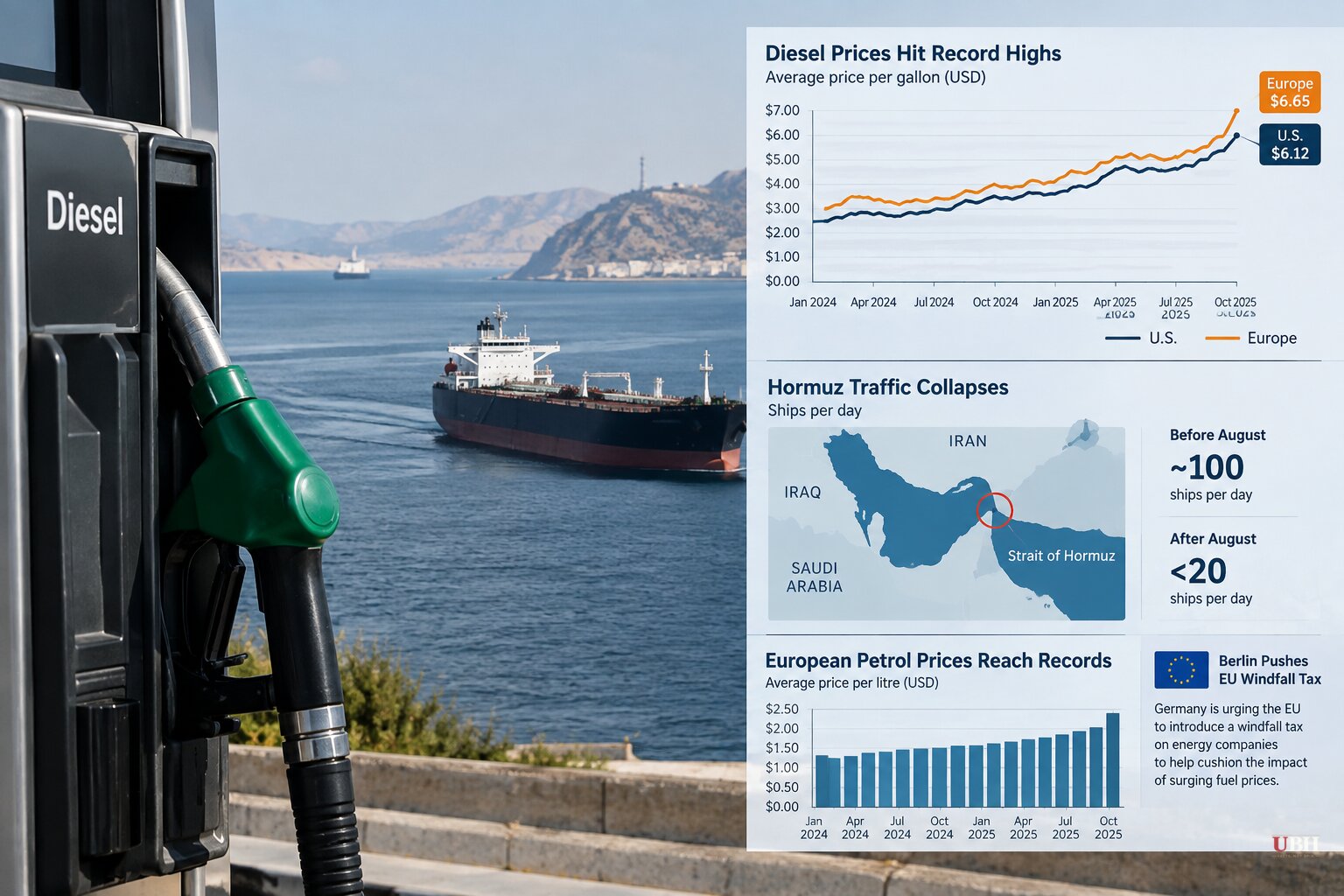
Since the U.S.-Iran war reignited on Feb. 28, the fuel squeeze has only gotten worse. Diesel crossed $6 a gallon in the U.S. for the first time on record on Sept. 11, and this week European pump prices set fresh highs across multiple countries, prompting Germany's finance minister to push for an EU-wide windfall tax on oil companies.
The Numbers Right Now
The U.S. national average for diesel hit $6.06 a gallon on Sept. 11, up from $5.98 the day before and $5.85 a week earlier, according to AAA figures cited by the Epoch Times. Regular gasoline hit $4.29 a gallon the same day, up from $4.15 a week prior. Patrick De Haan, head of petroleum analysis at GasBuddy, said record diesel prices will hit "every cargo, shipment, every delivery Americans are taking" and could reignite inflation through the supply chain.
In Europe, Euronews reported that as of Tuesday, Sept. 22, the Netherlands had the continent's highest average petrol price at €2.43 a liter, followed by Denmark at €2.35 and Finland at €2.32. Denmark topped diesel at €2.52 a liter. The Guardian, reporting on Wednesday's prices, put German diesel at a record €2.45 a liter and petrol at €2.31, and said Dutch petrol had jumped further still to €2.73 with diesel at €2.78. The difference between these reports reflects how fast prices are moving day to day. Across the EU, the Guardian reported petrol up 24% year-over-year, diesel up 38%, and jet fuel more than double last year's price.
Why: Hormuz, Bab-el-Mandeb and Broken Refineries
Before the war began Feb. 28, roughly 125 large commercial vessels a day passed through the Strait of Hormuz, according to the U.S. Energy Information Administration, cited by the Epoch Times. The latest wave of Iranian attacks has cut that to fewer than 20 vessels a day, per Euronews. Houthi attacks near Bab-el-Mandeb are simultaneously disrupting the Yemen-Eritrea-Djibouti corridor that used to serve as a backup route.
Middle East diesel exports fell by half between March and August compared with a year earlier, averaging 800,000 barrels a day, according to shipping-data firm Kpler, cited by the Times of India. The region supplied nearly 41% of Europe's diesel imports in 2025. Kpler analyst George Shaw said "any further disruption to Red Sea flows risks tightening an already stretched global diesel market," adding that refining capacity is the real constraint.
Russia, the world's second-largest diesel exporter, banned diesel exports in July after Ukrainian drone strikes cut refinery output, the Times of India reported. Meanwhile U.S. refineries were running at their highest levels in eight years by late August, per the International Energy Agency, and the IEA said global refinery production in July was nearly five million barrels a day below July 2025. A bottleneck that Euronews reported is forcing refiners to hunt for substitute crude grades that aren't always interchangeable with what they lost.
Europe's Windfall Tax Fight
Germany's finance minister, Lars Klingbeil, told a meeting of EU finance ministers in Dublin that oil companies are "exploiting the situation, overcharging and significantly increasing their profits," and asked the European Commission for windfall-tax proposals by next month, according to the Guardian. The IEA and Kpler data point instead to a physical supply and refining bottleneck as the driver of the price spike, not stated profiteering, a genuine dispute over cause that the numbers alone don't settle.
EU economic commissioner Valdis Dombrovskis said the Commission has no plans for a bloc-wide tax "at this stage" but is "ready to engage in discussion," leaving individual countries free to act on their own. Italy's Giorgia Meloni government said it will scrap road tax for 14.5 million vehicles starting next year at a cost of more than €2 billion, on top of a diesel duty cut that has already cost €2.8 billion, the Guardian reported. With elections due next year in France, Italy, Spain, Poland and other EU states, fuel prices have become a front-line domestic issue.
Washington's Bet, and the Diplomatic Track
President Trump told reporters at Joint Base Andrews that gas prices would stay elevated through the midterms but "tumble downward" right after, predicting the war would end shortly after the election followed by U.S. gas falling below $2 a gallon, according to the Epoch Times. That remains a prediction, not something reflected in current futures pricing. Reuters-sourced commentary cited by the Times of India noted derivatives markets do not expect a near-term price drop.
At the UN General Assembly on Wednesday, Sept. 23, Iranian President Masoud Pezeshkian's speech was met with boos and a walkout by the U.S. delegation after he called Iran a victim of terrorism, according to Fox News. Secretary of State Marco Rubio said "Iran can never have a nuclear weapon" and that Tehran "misread our system," wrongly assuming Democrats would win in November and box Trump in. Iranian state media claimed Foreign Minister Abbas Araghchi "improperly interacted" with U.S. envoy Steve Witkoff and said Iran's seven conditions have been restated to intermediaries, a sign talks are technically ongoing but not close to a breakthrough.
A Daily Wire opinion piece separately cited unnamed analysts, including at JPMorgan, warning that global fuel infrastructure could approach an operational minimum where pipelines lose pressure and refineries shut down to protect equipment.
Adjusted for purchasing power, Bosnia and Herzegovina and other Balkan states are absorbing the biggest hit from a 50-liter refuel, according to a Europe in Motion estimate cited by Euronews, with Greece worst-off inside the EU. Klingbeil wants Commission windfall-tax proposals within weeks; Dombrovskis has committed only to further talks.
Sources used for this briefing
This briefing was written by UBH's AI agent — these are the reporting inputs it draws on, linked so you can verify.


