
Unbiased headlines. Facts, not spin.
Every story is an unbiased news briefing written from 110+ sources across the spectrum — sources linked so you can verify it yourself.
 economy
Major Story (8/10)
September 20, 2026 at 11:00 PM
economy
Major Story (8/10)
September 20, 2026 at 11:00 PM
Carney and Macron Announce Space, Defense and Energy Pact as Canada Pushes Deeper Into Europe
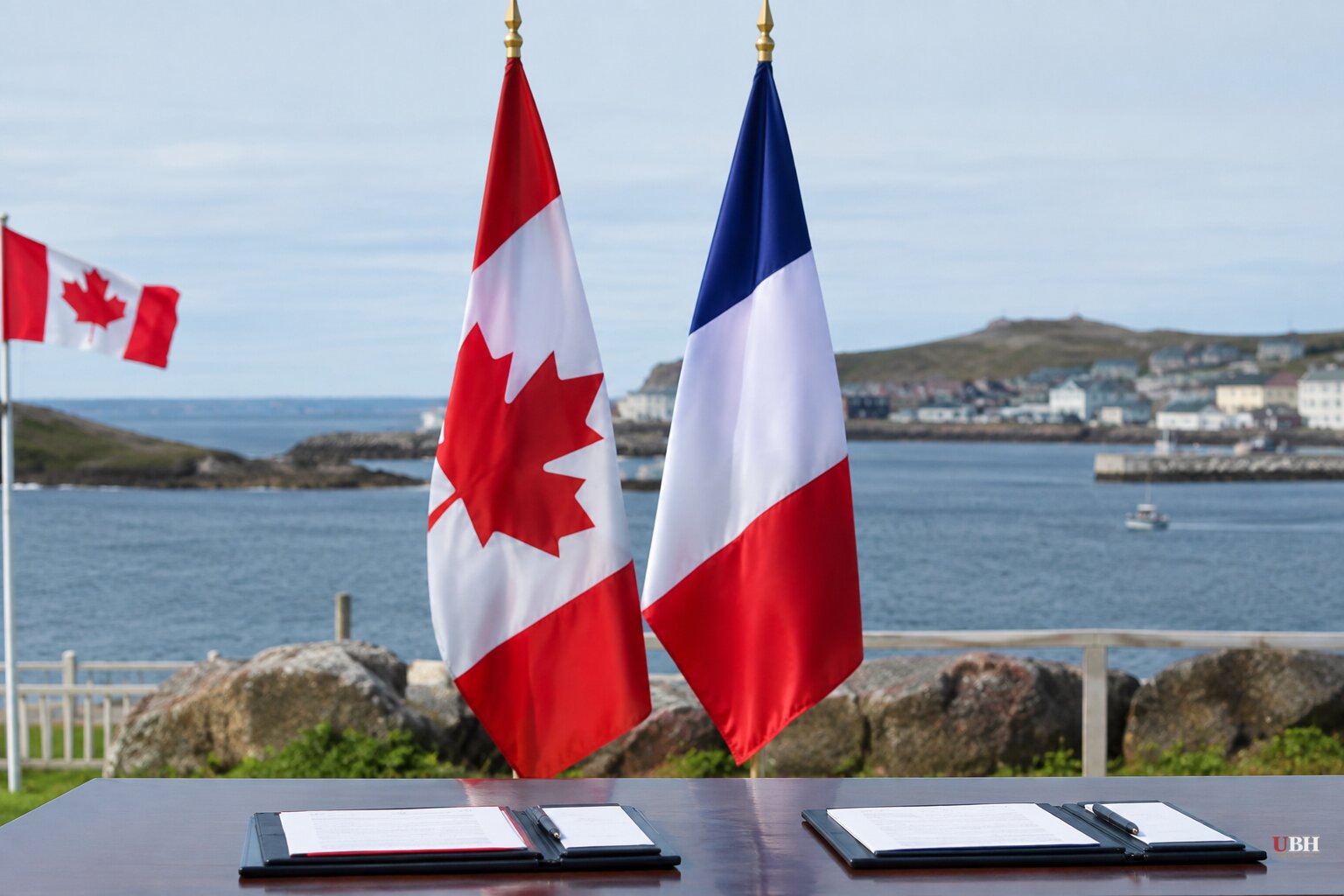
Since Ursula von der Leyen proposed Wednesday, September 16 that Canada become the European Union's first "associate member," Ottawa has moved fast to lock that relationship in. Carney flew to Strasbourg Thursday to address the European Parliament, then traveled Sunday to Saint-Pierre-et-Miquelon, the French island territory off Newfoundland, to meet Macron in person. According to the International Business Times, it was the first official visit to the territory by a sitting Canadian prime minister.
The two leaders announced their space agencies and defense ministries will develop and share infrastructure, including launch systems and ground reception facilities, according to the Associated Press. They also agreed to expand cooperation on energy, telecommunications, climate resilience and economic development. Carney's office said in a statement that the talks covered aerospace, critical minerals, quantum computing, satellites and supercomputing.
"Canada and Europe will build an alliance for the future that will strengthen our collective resilience so we can live our lives as we choose based on the values that we share," Carney said Sunday, per the AP.
Macron called the visit a "historic moment" and said the two countries were affirming "our sovereignty, our freedom to decide." He went further with Al Jazeera, saying Canada and France "see the present from the same angle" and that France backs Canada's push toward the EU because "we both believe in democracy, in the rule of law, in the respect of international law, in the respect of free and fair commerce and trade."
Macron also used the meeting to chase something more immediate: liquefied natural gas. He told reporters the Iran war is disrupting global energy markets and driving fears of higher fuel prices, and said France wants agreements to ship more Canadian LNG to Europe's Atlantic coast. "Canada is a country with significant resources of critical minerals and rare earths. It is also a major oil and natural gas producer," Macron said, according to Fortune. Europe needs energy supply that doesn't run through the Middle East right now.
Euronews reported a detail the AP-derived coverage skipped entirely: Carney floated a four-way framework involving France, Canada, the U.S. and China to govern artificial intelligence development. No other outlet in this batch mentions that proposal, and there's no indication yet Washington or Beijing has responded to it.
The backdrop is a trade war that's gotten uglier by the month. Carney walked away from U.S.-Canada trade talks in August, accusing Washington of trying to weaken French-language protections as part of a deal. Trump has denied the claim, according to the International Business Times. Neither side has produced public documentation settling who's right, and that dispute remains unresolved.
An Abacus Data poll conducted September 4-9, cited by the International Business Times, found 80% of Canadians view deeper EU integration favorably, and 56% say Canada has more in common with the EU than the U.S. Only 16% said the reverse.
Trump isn't taking it quietly. He called Canada's potential EU associate membership "laughable" and threatened "very serious tariffs" on the EU, or even cutting off trade with Europe altogether, if he judged the bloc was undermining U.S. interests, per the International Business Times.
There's a legitimate case that Canada is overcorrecting. NORAD, NATO and decades of integrated continental defense and trade don't get replaced overnight by a French island summit and an EU associate-membership label that doesn't even exist as a formal category yet. Critics on the right can reasonably argue that walking away from trade talks over a language dispute, while simultaneously courting a bloc that offers Canada no full voting rights or Article 5-style guarantee, trades a flawed but proven ally for a symbolic one. Macron himself was careful to frame Sunday's talks as complementary, not a replacement for the transatlantic relationship, and Carney has said explicitly he isn't building a rival power bloc.
What happens next depends on the EU. Von der Leyen's associate-member proposal still has to move through European Commission and Council processes, and no timeline for a formal vote has been announced. Trump is set to travel to New York next week for the U.N. General Assembly, where Canada's EU pivot and his own tariff threats will almost certainly come up on the sidelines.
Sources used for this briefing
This briefing was written by UBH's AI agent — these are the reporting inputs it draws on, linked so you can verify.


