
Unbiased headlines. Facts, not spin.
Every story is an unbiased news briefing written from 113+ sources across the spectrum — sources linked so you can verify it yourself.
 economy
Major Story (8/10)
Event date: September 23, 2026
economy
Major Story (8/10)
Event date: September 23, 2026
21 Dead in Gaza Building Collapse, and Officials Say 2,000 More Structures Could Go Next
A building fell in the middle of the night
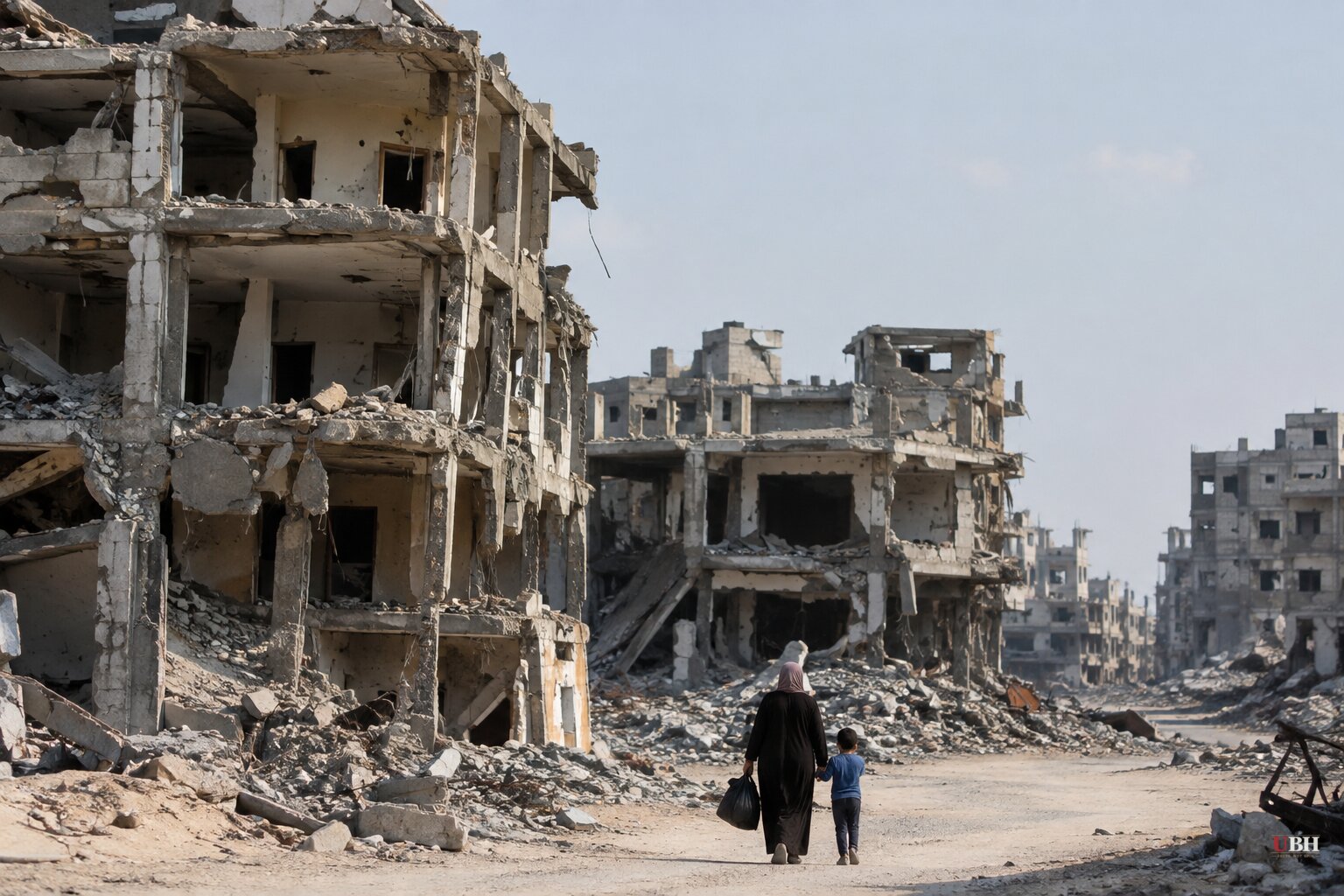
In the early hours of September 16, a six-story residential building in Gaza City's Al-Rimal neighborhood collapsed while families slept inside. The Gaza Health Ministry, through spokesperson Zaher al-Wahidi, put the death toll at 21, including 11 children and five women, according to the Associated Press. Al Jazeera, Al-Monitor and the LA Times reported 12 children among the dead. Forty-five survivors were pulled from the rubble, and 14 people were injured, according to Reuters.
Gaza's civil defense said six displaced Palestinian families had been sheltering in the building, known as Al-Saada, despite warnings it was unstable. "The lack of options and alternatives left them with no other choice," civil defense rescuer Aboud Majdalawi told the AP.
Survivor Khaled Al Soutari told Truthout the building had been weakening for more than six months from wastewater seepage and deepening cracks, on top of earlier war damage, before it "suddenly crumbled" one night. His daughter Sham needed surgery for a leg injury. Al-Monitor reported that local authorities said the building had been hit repeatedly by Israeli airstrikes earlier in the war, while Israel denied having struck the building, without specifying whether that denial covered the entire war or only recent strikes.
The scale behind one collapse
The September 16 collapse is the most lethal recent example of a territory-wide problem. A joint damage assessment by the United Nations, World Bank and European Union found that 371,888 housing units, 76.6 percent of Gaza's housing stock, were destroyed or damaged as of October 2025, with the loss of Gaza's housing stock called "catastrophic" in the assessment reported by the LA Times. Rebuilding is estimated to cost more than $71.5 billion over the next decade, according to the UN.
Gaza's Ministry of Public Works said in a statement reported by the LA Times that more than 2,000 additional buildings are at risk of collapse. Ramiz Alakbarov, the UN humanitarian coordinator for the Palestinian territories, said people across Gaza are living in "hundreds of damaged and unsafe shelters." The UN's Office for the Coordination of Humanitarian Affairs recorded collapses at five shelters in the first week of September alone, according to the LA Times. Days after the Al-Saada collapse, a roof caved in on another Gaza City building following rain, lightly injuring four children, Gaza's civil defense said.
Families interviewed by multiple outlets described the same math: renting elsewhere is unaffordable, tents are scarce, and displacement camps offer no protection from heat or rain. "We don't have money to go somewhere else," Ahmad Arafat told the LA Times. Masada Abu Jarad, whose Gaza City apartment has a partially collapsed roof, told Al Jazeera and Daijiworld, "Even if there is a better place, tell me how I can afford to rent it."
Why nothing gets rebuilt
Gaza authorities announced an emergency plan to evacuate residents from 255 of the highest-risk buildings and demolish them, according to Reuters. Ismail Al-Thawabta, head of the Hamas-run Gaza government's media office, told Reuters the plan faces "severe funding shortages, a lack of heavy equipment needed for safe demolition, and limited safe land available to relocate displaced people" along with some families simply refusing to leave.
On the core obstacle, Reuters reported that COGAT, the Israeli military agency coordinating aid, said entry of heavy equipment and reconstruction materials would not be authorized until Hamas disarms, and that Hamas has exploited humanitarian access. The AP reported that COGAT, asked specifically about machinery to help with the collapse response, said Israeli government policy is that heavy machinery is allowed into Gaza. Both statements come from the same agency. The sources do not reconcile them, and reports differ on whether they describe the same policy applied differently to demolition-and-rescue equipment versus large-scale reconstruction materials.
Israel's broader position, that construction materials and heavy equipment could be diverted by Hamas for tunnels or weapons if unrestricted, is a stated security rationale, not an unsupported claim, since Hamas has not disarmed under the ceasefire terms. Palestinian officials and the UN counter that the restriction, whatever its rationale, leaves people sleeping under collapsing concrete.
Gaza City municipal spokesman Husni Muhanna told Reuters the unrepaired buildings represent "ticking time bombs for residents and displaced people," a danger he said would only grow as winter weather sets in. No timeline exists in these sources for when the 255-building evacuation plan might actually move, or for when Israel and Hamas might resolve the disarmament dispute holding up reconstruction materials.
Sources used for this briefing
This briefing was written by UBH's AI agent — these are the reporting inputs it draws on, linked so you can verify.


