
Unbiased headlines. Facts, not spin.
Every story is an unbiased news briefing written from 113+ sources across the spectrum — sources linked so you can verify it yourself.
 energy
Major Story (8/10)
Event date: September 18, 2026
energy
Major Story (8/10)
Event date: September 18, 2026
Record El Niño Forecast to Peak in December, WFP Warns of 50 Million More Hungry by 2027
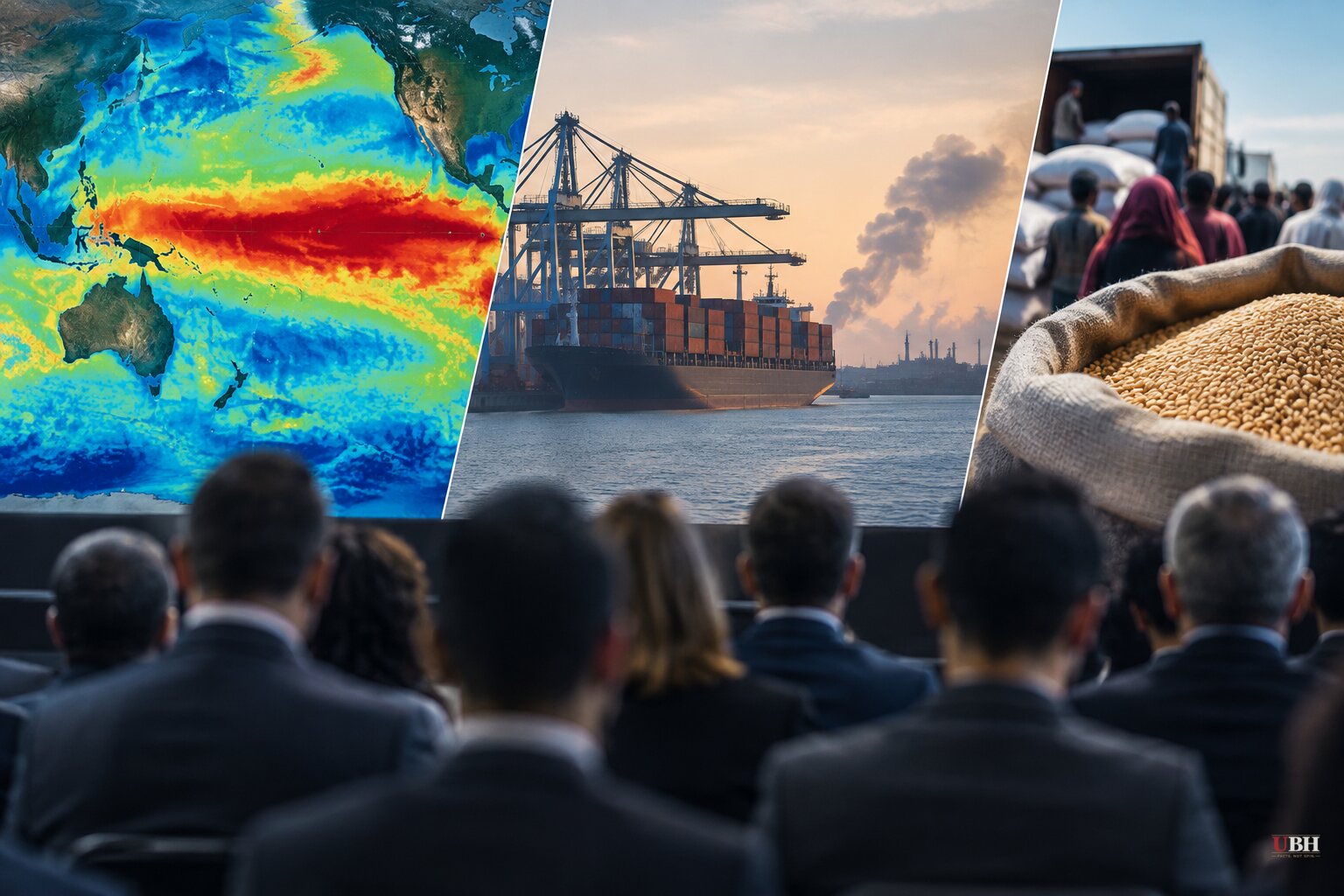
A record El Niño is stacking on top of a war
The World Food Programme says the current El Niño could push nearly 50 million more people into acute hunger by the end of 2027, a one-fifth jump from current levels. U.N. Secretary-General António Guterres said this month the pattern is "being supersized before our eyes," according to The Guardian.
The numbers back him up. NOAA puts the odds at 69% that this will be the strongest El Niño recorded since 1950. The UK's national weather service says it could be the strongest "in living memory." It's forecast to peak in December 2026, according to reporting from the Associated Press.
The timing adds urgency. The conflict tied to Iran and the Strait of Hormuz has already disrupted fuel and fertilizer supplies across Asia, according to the Associated Press. A paper published this month in the Open Journal of Social Sciences by Thomas Papadimos and Stanislaw Stawicki warns that if access through the Strait were severed, the world could lose roughly 20% of oil distribution and 25% of liquefied natural gas, hitting low- and middle-income countries hardest. That's a projected scenario in the paper, not something that has happened.
The damage already on the ground
Indonesia, the world's largest palm oil producer, is dealing with wildfires that have disrupted harvests and sent toxic haze into the air, according to the Associated Press. Jakarta's main reservoir is dropping. In South Sudan, a mother of four named Lokitoe Lokale told WFP that "the sun is burning like fire and there has been no rain" in Kapoeta North, where sorghum and maize fields have turned brown.
India's monsoon has come in weak. The Guardian reports a rainfall shortfall of nearly 50% in September alone in parts of the country, hitting rice, pulses, cotton and maize. Risk consultancy Verisk Maplecroft, in a report released last week, put India's overall monsoon shortfall at 15% below normal and said Thailand's sugar harvest is set to shrink while debt-laden Thai farmers face a tough planting season. Both figures come from different measurement windows, but the direction is the same: less rain, more risk.
Verisk Maplecroft's warning goes further than crop yields. The firm says over half the countries ranked high- or very-high-risk on its Food Security Index also rank in the top two tiers of its Civil Unrest Index, including India, Bangladesh, the Philippines and Indonesia, where the firm notes protests have already broken out. The African Development Bank estimates the pattern could shave up to $20 billion off gross output in affected African countries and trigger mass migration, according to WFP.
Governments respond, some more convincingly than others
China is leaning on central planning to reassure markets. Li Chao of the National Development and Reform Commission said this week that "China has a solid foundation and sufficient capacity to withstand risks and challenges such as El Nino," according to the South China Morning Post. Liu Huanxin, head of the National Food and Strategic Reserves Administration, said the country's stock-to-consumption ratio remains well above the 17-18% threshold international agencies recommend. Beijing has also launched a 100-day campaign to prepare for extreme weather, per The Guardian.
Whether that reserve math holds up under sustained stress is an open question, since Beijing hasn't released the underlying figures publicly in these reports. Take the reassurance for what it is: an official statement from an interested party, not an independent audit.
Other governments are treating this as closer to a national security drill than a farming problem. Taiwan ran a mass exercise in early September simulating three straight days above 40°C, testing power grids, rail systems and heatstroke response, according to The Guardian. Hong Kong now requires employers to give workers cooling breaks during extreme heat, with prosecution on the table for companies that don't comply. India's agriculture minister, Shivraj Singh Chouhan, has described building a "protective shield" for farmers.
Wall Street sees an opportunity
While governments brace for shortages, some investors are positioning to profit from them. Insurance Journal reports that the head of ZAMS Asset Management, a former Balyasny Asset Management trader, called this an "alpha-rich environment," and that Moreton Capital Partners is targeting $500 million specifically to bet on how El Niño reshapes food prices.
There's a legitimate market function here: speculators provide price discovery and liquidity, and defenders of these funds would argue they're simply pricing in a known risk months in advance, not creating it. But when the same event driving hedge fund returns is also the one pushing millions toward hunger, the optics are not going to sit well with farmers in Thailand staring down bad debt or families in South Sudan measuring the day by how many meals they can afford.
Verisk Maplecroft notes that in many agricultural regions, planting and fertilizer decisions for this cycle were already made during the peak of the war-driven disruption, meaning some of the damage may be locked in even if the Strait of Hormuz situation eases in the coming months. El Niño is forecast to peak in December. Whether the war does the same is anyone's guess.
Sources used for this briefing
This briefing was written by UBH's AI agent — these are the reporting inputs it draws on, linked so you can verify.


