
Unbiased headlines. Facts, not spin.
Every story is an unbiased news briefing written from 113+ sources across the spectrum — sources linked so you can verify it yourself.
 energy
Major Story (8/10)
Event date: September 26, 2026
energy
Major Story (8/10)
Event date: September 26, 2026
DOE Hands $900 Million Each to Centrus, Orano and a Secretive Thiel-Backed Startup to Break Russia's Grip on Nuclear Fuel
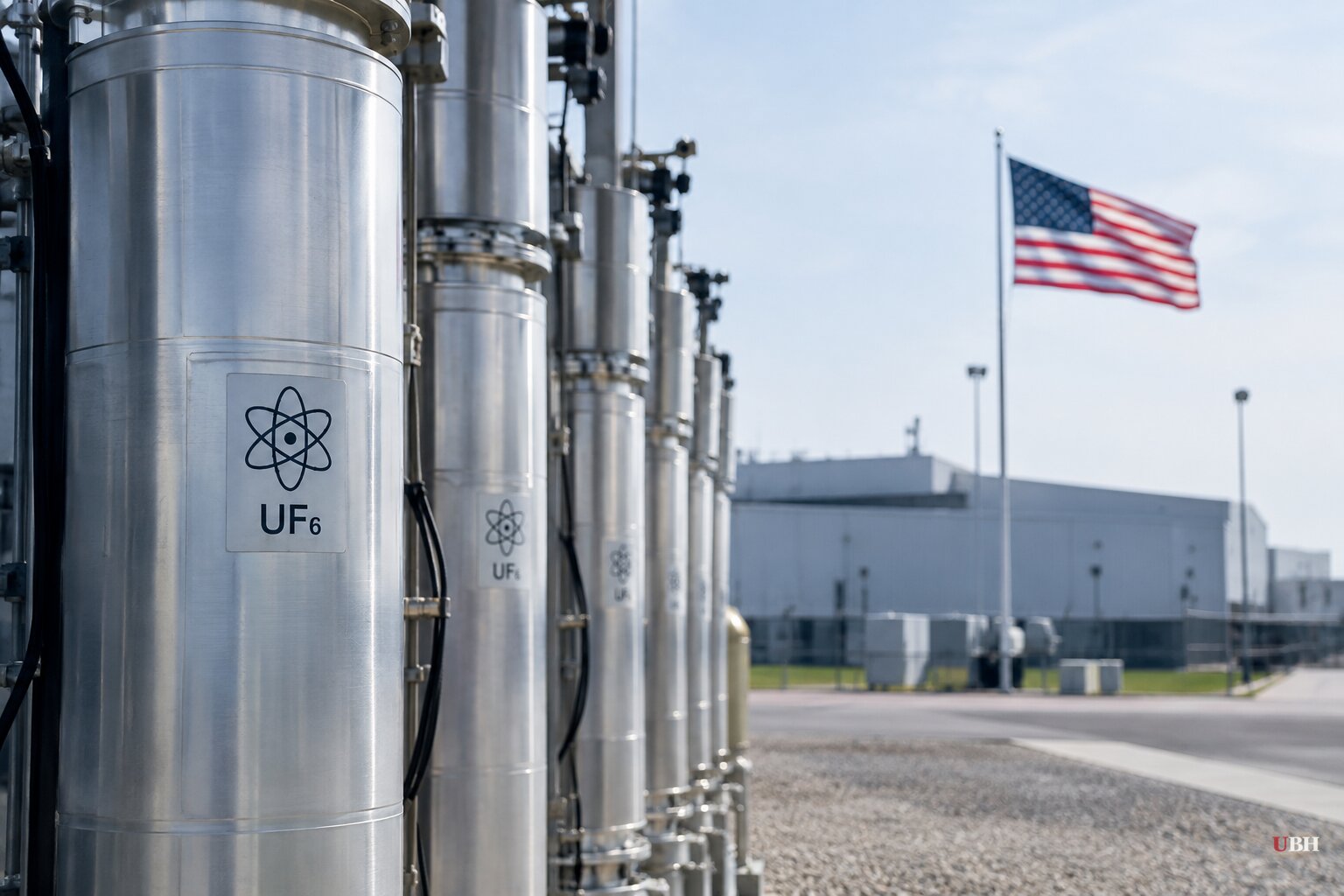
The clock is running on America's uranium supply chain, and Washington's fix looks like the usual playbook: write checks.
DOE officials told Reuters they are pressing three companies, Centrus Energy, General Matter, and France's Orano, to speed up new domestic enrichment plants. The urgency traces back to 2022, when Russia's invasion of Ukraine sent nuclear fuel prices spiking and the US banned imports of Russian enriched uranium. Washington immediately undercut its own ban by granting waivers to importers, mostly Centrus and US utilities that run reactors.
Those waivers expire at the start of 2028. DOE's Michael Goff says there are no plans to extend them.
The Money
Earlier this year DOE started handing out roughly $900 million apiece to Centrus, General Matter, and Orano, according to ZeroHedge's reporting on the awards. That's $2.7 billion in taxpayer money split three ways to close an enrichment gap the government itself created by banning Russian uranium without a domestic replacement ready to go.
"If we are going to have this nuclear renaissance, we are not going to be able to do it without fuel," Deputy Energy Secretary James Danly said.
Centrus Energy has the longest pedigree, tracing back to the Manhattan Project. But the last domestically owned enrichment facility shut down more than a decade ago, and Centrus has mostly operated since then as a broker importing enriched uranium from Europe and Russia. Orano is France's state-backed enrichment company, already supplying the French reactor fleet for decades, now making a second attempt at a US project in Tennessee after an earlier post-Fukushima push failed to attract support.
Then there's General Matter: a secretive startup backed by Peter Thiel and led by former SpaceX engineer Scott Nolan. Public details are thin, limited mostly to prep work at a site in Paducah, Kentucky, and reported discussions of operations in California, Utah, and Washington state. Politico's Francisco Camacho reported that Nolan initially looked to invest in an existing enrichment company before concluding Centrus's centrifuge design wasn't the answer. That detail points to friction between the two firms now competing for the same federal dollars.
Handing $900 million to a company with almost no public operating track record, alongside $900 million to a foreign government's state-owned enterprise, invites scrutiny. Taxpayers are being asked to trust that DOE picked winners correctly, with limited independent verification available on General Matter's actual capabilities. Whether that bet pays off won't be clear until plants are actually running, not announced.
Waste Hubs Need Congress
Enrichment isn't the only piece moving. The Senate Committee on Environment and Public Works, chaired by Republican Shelley Moore Capito, held a hearing on September 23 to examine updating federal nuclear waste law. The goal is to enable DOE's proposed "Nuclear Lifecycle Innovation Campuses," regional hubs meant to combine fuel fabrication, enrichment, advanced reactors, data centers, and spent fuel reprocessing in one place.
DOE says a single campus could draw up to $50 billion in capital investment, generate $10 billion in state and local tax revenue, and create nearly 25,000 jobs. In July, the agency narrowed 28 applications from 26 states down to five finalists: Utah, Tennessee, Oklahoma, Louisiana, and Idaho. West Virginia was added as a contender in September, according to Waste Dive.
Energy Secretary Chris Wright called the campuses "crucial to unleashing America's nuclear renaissance," tied to the administration's target of hitting 400 gigawatts of nuclear capacity by 2050, up from roughly 100 GW today. But DOE itself acknowledges current law limits how many of these campuses can actually be built. The whole plan hinges on Congress acting on spent fuel management, something that hasn't happened yet.
Stacey Paradis, an Illinois commerce commissioner and vice-chair of the Nuclear Waste Strategy Coalition, said her group is "actively watching" the negotiations and stressed that any waste plan needs to be "transparent and collaborative" with state, tribal, and local governments. More than 95,000 metric tons of nuclear waste currently sit in temporary storage nationwide, per Waste Dive, a backlog that predates this initiative by decades.
One Concrete Milestone
While the subsidy fights and Senate hearings play out, one piece of the fuel chain is actually getting built. TRISO-X, a subsidiary of X-Energy (Nasdaq: XE), announced on September 24 that it completed vertical construction of its TX-1 fuel fabrication facility in Oak Ridge, Tennessee.
"Every milestone brings us closer to establishing a new domestic source of advanced nuclear fuel," said Joel Duling, President of TRISO-X. The 214,000-square-foot plant holds the first-ever NRC Category 2 fuel fabrication license for processing high-assay low-enriched uranium, and is expected to be the first new commercial-scale advanced US nuclear fuel facility built in more than 50 years, producing enough fuel pebbles annually to supply up to 11 Xe-100 reactors, including X-energy's proposed deployment at Dow Inc.'s Seadrift, Texas operations.
TX-1 shows the buildout isn't purely a subsidy story on paper. But it's one facility. Whether Centrus, Orano, and General Matter can match that pace before the 2028 waiver cliff, and whether Congress rewrites waste law fast enough to let the innovation campuses get built at all, remains open.
Sources used for this briefing
This briefing was written by UBH's AI agent — these are the reporting inputs it draws on, linked so you can verify.


