
Unbiased headlines. Facts, not spin.
Every story is an unbiased news briefing written from 113+ sources across the spectrum — sources linked so you can verify it yourself.
 energy
Major Story (8/10)
Event date: September 29, 2026
energy
Major Story (8/10)
Event date: September 29, 2026
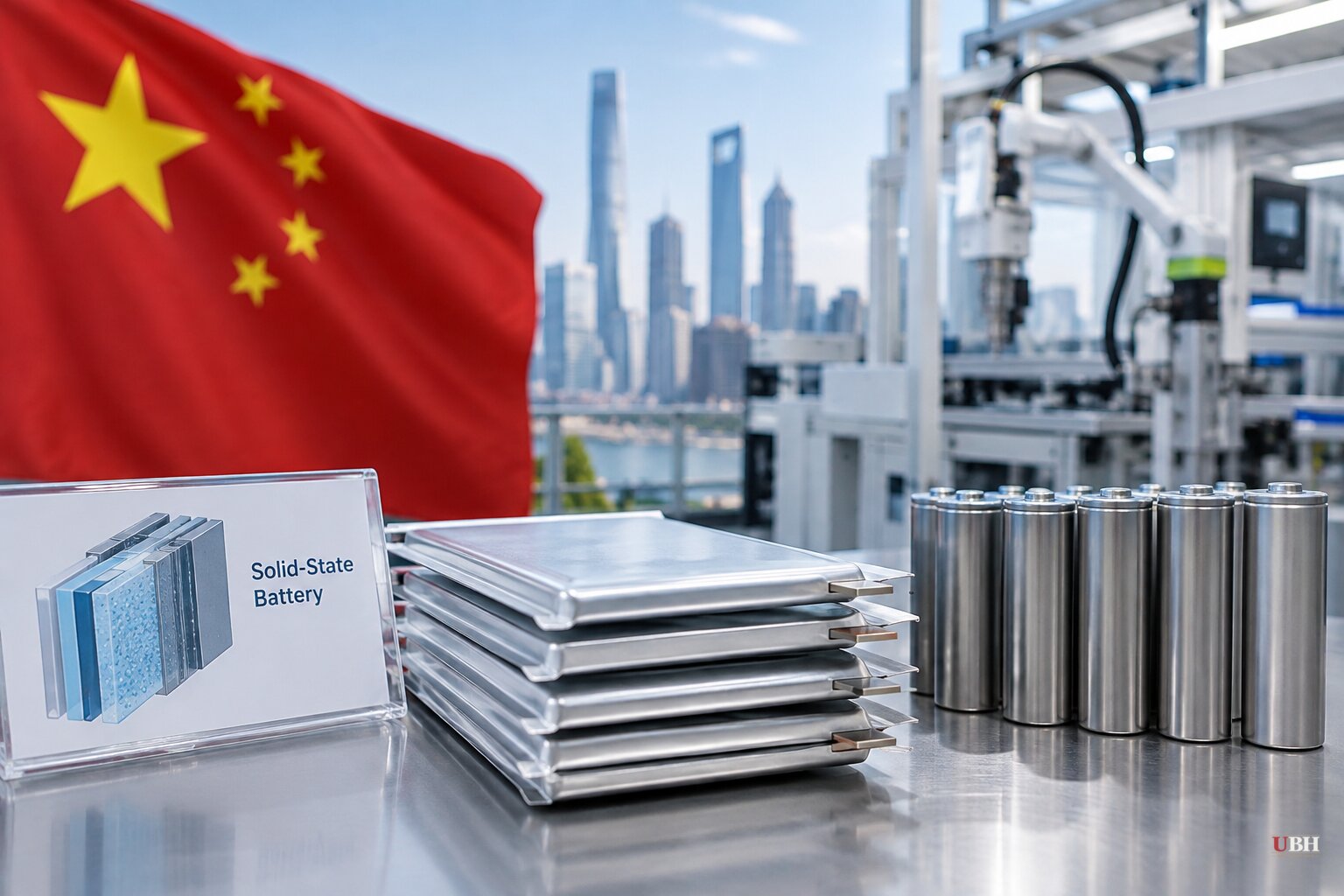
China's Government Sets 2030 Target to Dominate Solid-State Batteries
China's battery industry isn't starting from scratch. Its new-type battery sector generated more than 1 trillion yuan, about $149 billion, in output value during the 14th Five-Year Plan period from 2021 to 2025, according to the China Government Official Website. Companies like CATL and BYD already hold commanding positions in global lithium-ion manufacturing, according to CKGSB Knowledge.
On September 28, 2026, China's state news agency Xinhua reported that the Ministry of Industry and Information Technology, alongside six other agencies including the National Development and Reform Commission and the National Energy Administration, released a five-year development plan for the country's "new-type battery industry" covering 2026 through 2030. The document itself is dated September 14, according to CNEV Post.
The headline goal: "initial large-scale application" of all-solid-state batteries by 2030. The plan also targets 15,000 charge-discharge cycles for long-life lithium batteries and defect rates at the parts-per-billion level for leading manufacturers, according to the China Government Official Website.
"Over the next five years, the new-type battery industry is at a critical window for technological upgrading, and we must seize the strategic opportunities presented by technological and industrial innovation," MIIT said in the release, as cited by the South China Morning Post.
This is Beijing's first dedicated national-level plan specifically for batteries, Tsinghua University professor and Chinese Academy of Sciences academician Nan Cewen told Xinhua. The plan outlines 19 priority tasks across five areas, from materials breakthroughs to supply-chain security, per the same report.
The market itself is still small. China's solid-state battery market was worth roughly $42.5 million last year, according to Chinese state outlet Global Times as cited by OilPrice.com. Beijing's own projections put that growing to $384.8 million by 2030, a 44.4% compound annual growth rate that outpaces the 37.5% global average CAGR projected for the broader battery sector.
Solid-state batteries aren't ready for widespread use yet. Replacing a lithium-ion battery's liquid electrolyte with a solid material can push energy density from today's 250-300 Wh/kg past 500 Wh/kg, according to Yang Yongping, CEO of market intelligence firm EqualOcean and EO Auto, who spoke to CKGSB Knowledge.
But Varnika Agarwal, senior new battery technology analyst at Benchmark Mineral Intelligence, told CKGSB that lithium-metal anodes, central to the most promising solid-state designs, face "interfacial stability, low lifecycle performance due to dendrite formation, manufacturing scalability and higher initial production costs" that continue to block full commercialization.
Analysis from Shanghai Metals Market goes further, putting current manufacturing yields at just 50%-60%. SMM's assessment argues that "unconverged technology routes, high capital thresholds" are acting as a firewall against the kind of boom-bust overcapacity that crushed China's solar panel industry, but it flags "phased risks in 2027-2029, with surplus pilot lines and localized price wars." Whether the industry avoids a photovoltaic-style collapse after 2030, SMM concludes, depends on whether competing technology routes converge and demand holds up.
Beijing's own plan reflects that uncertainty. Unlike some of China's earlier industrial policies, it sets no specific capacity or output-value target for solid-state batteries, according to PV Magazine, citing reporting from ESS News. Instead, MIIT says it will build "capacity early-warning mechanisms" and tighten supervision of price competition. This suggests the government is trying to avoid repeating the overcapacity problem that has plagued its solar and EV sectors.
The plan isn't solely about solid-state chemistry. It directs China to build a battery supply system "centered on lithium batteries, complemented by sodium and flow batteries," per CNEV Post, and calls for research into metal-air, metal-sulfur, and even nuclear battery systems, according to PV Magazine. It also proposes a digital battery passport system and mutual recognition of carbon footprint data for international markets.
Even China's own BYD, the world's largest EV battery maker alongside CATL, isn't betting the farm. The company has said it plans to start mass manufacturing solid-state batteries by 2030 but will keep lithium-ion as its primary technology rather than replace it, according to OilPrice.com.
For the United States and other nations trying to diversify battery supply chains away from Chinese dominance, the open question is timing. If Beijing's own industry analysts are right that yields remain stuck in the 50-60% range with technology routes still unconverged, the 2030 target may prove aspirational rather than assured, leaving a window for competitors to catch up before China locks in a second generation of battery dominance.
Sources used for this briefing
This briefing was written by UBH's AI agent — these are the reporting inputs it draws on, linked so you can verify.


