
Unbiased headlines. Facts, not spin.
Unbiased Headlines is an independently owned news organization. We bring you the facts, not opinions, written fresh from 110+ named sources. Sources linked so you can verify it yourself.
 energy
Major Story (7/10)
Event date: October 23, 2026 ·
Brent Falls Roughly 15% in a Month, but the 10-Year Treasury Yield Still Sits Above 5%
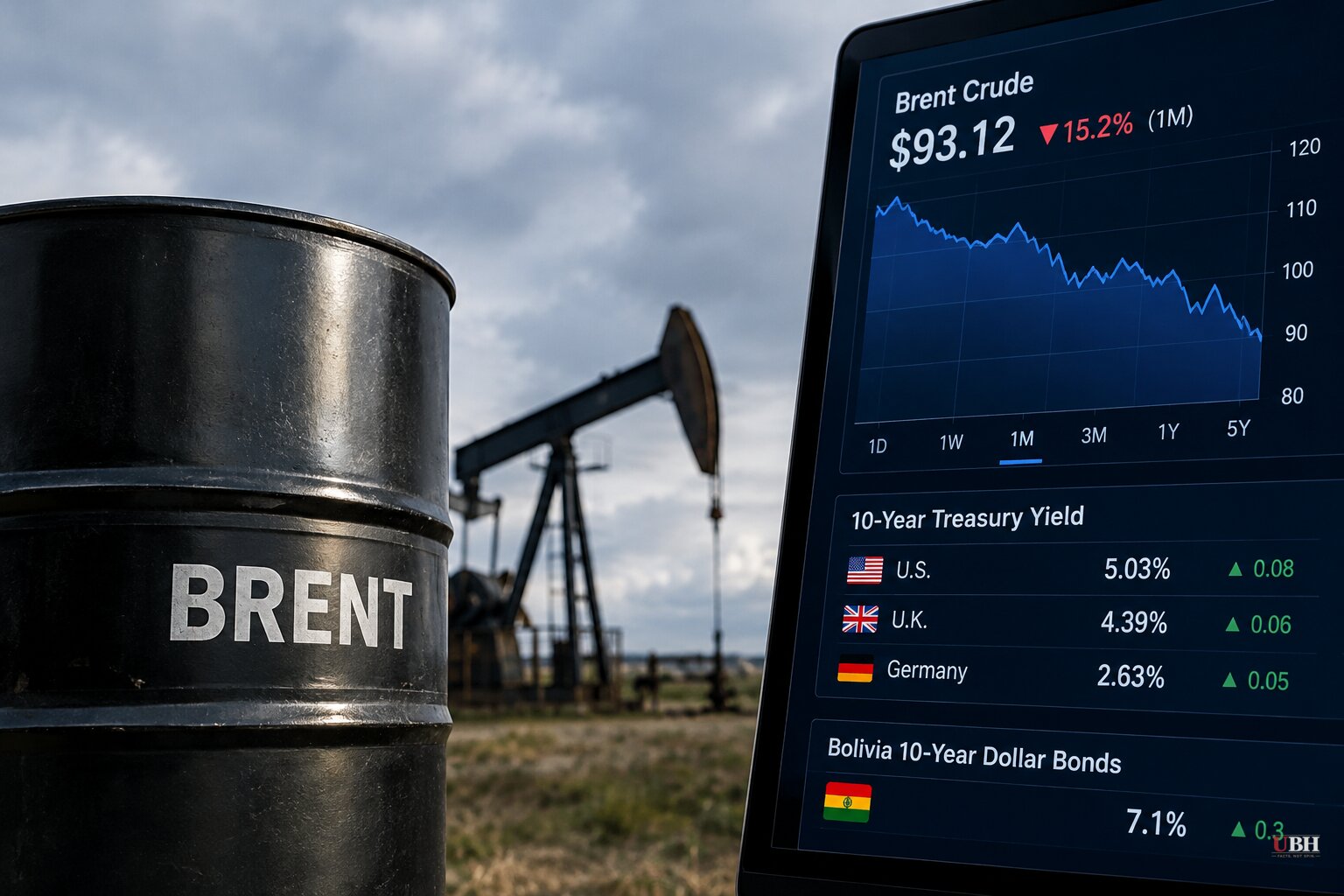
For most of 2026, oil prices were the best guide to what government bonds would do. That link has weakened. Brent crude has fallen to about $93 a barrel, roughly 15% below where it was a month ago, and the 10-year US Treasury yield still finished above 5%.
According to the Financial Times, the correlation between oil and government bond yields has dropped from about 65% in September to below 20%. One analysis of FactSet data found the 30-day correlation peaked on September 10, turned negative in late October and has stayed slightly below zero since.
How the Hormuz shock set the pattern
The earlier tight link had a simple logic. When the Strait of Hormuz closed during the Iran war and crude rose above $120, traders bet central banks would have to raise rates to fight the price shock. Higher expected rates push yields up. In September the oil-Treasury link hit its tightest level in 35 years, according to European Business Magazine's account of the data.
Cheaper oil was supposed to unwind that. It has not, at least so far.
Inflation moved beyond energy
European Business Magazine's analysis points to price increases that have spread through the rest of the economy. On November 10, US bond markets had their worst day in 19 months after hotter-than-expected inflation data. Fed Governor Christopher Waller said he could back a half-point rate rise in December. The minutes of the Fed's October meeting listed AI investment as a serious source of inflation risk.
The same publication reports that eurozone inflation reached 4% in October, the highest since 2023. Core inflation was revised up to 2.6%, and services inflation rose to 3.3%. Services matter because they do not get cheaper when oil does.
The European Central Bank has raised rates twice this year, to 2.5%. Markets expect a third increase on December 17.
In Britain, inflation hit 3.6% in October, a one-year high. The Bank of England raised its rate to 4% on November 5, its first increase since 2023, and expects inflation to approach 5% next summer. The 10-year gilt yield is around 5.3%. European Business Magazine also argues that France has overtaken Italy as Europe's biggest bond market risk, a judgment that comes from that publication's own assessment.
Subsidies split the emerging markets
Among emerging markets, how a government handled fuel prices is separating the winners from the losers, according to Bloomberg's reporting on bond returns.
Bolivia ended a program that kept diesel prices artificially low. Bloomberg reports the move has eased pressure on public finances and handed investors returns of more than 7% on the country's dollar bonds this year, the best in Latin America.
Angola sits on the other side. It exports crude, so higher oil prices should help. But it imports refined fuels, and those costs have eaten into government finances, leaving it struggling to capture the full benefit of the price rise.
A subsidy is a bill sent to the treasury. When fuel prices spike, a government that pays to hold the pump price down absorbs the spike itself. Bolivia chose to stop paying and took the political pain. Bond investors have rewarded that so far.
Debt leaves little room
The Bank for International Settlements has described the underlying problem in general terms. In remarks prepared for its 2025-26 research conference, hosted in Lima by the Central Reserve Bank of Peru, the BIS said shocks now spread faster and further across connected economies, and that several are arriving at once. It listed the war in Ukraine, now in its fifth year, US tariffs at levels not seen in a century, and this year's conflict in the Middle East.
The BIS said public debt is close to record levels in many countries, which limits how much governments can do when shocks hit. Its example fits the current situation: an energy shock raises inflation, central banks must keep rates high, and higher rates then press on indebted governments.
The BIS also noted that uncertainty tends to act like a demand shock in advanced economies and more like a supply shock in emerging markets.
What comes next
Mortgage rates, corporate borrowing costs and government interest bills are all tied to yields that have not fallen with oil, according to European Business Magazine. The next hard test is the ECB's December 17 meeting, where markets are pricing in another rate increase. The Fed's December meeting follows, with Waller on record that a half-point move is on the table for him.
Sources used for this briefing
3 links from 3 independent newsrooms (syndicated copies of the same report count once)
These are the sources it draws on, linked so you can verify.


