
Unbiased headlines. Facts, not spin.
Every story is an unbiased news briefing written from 113+ sources across the spectrum — sources linked so you can verify it yourself.
 defense
Major Story (8/10)
Event date: September 20, 2026
defense
Major Story (8/10)
Event date: September 20, 2026
Xi Arrives Wednesday for Third Trump Summit in a Year, as Stanford Data Shows US-China AI Gap Down to 2.7%
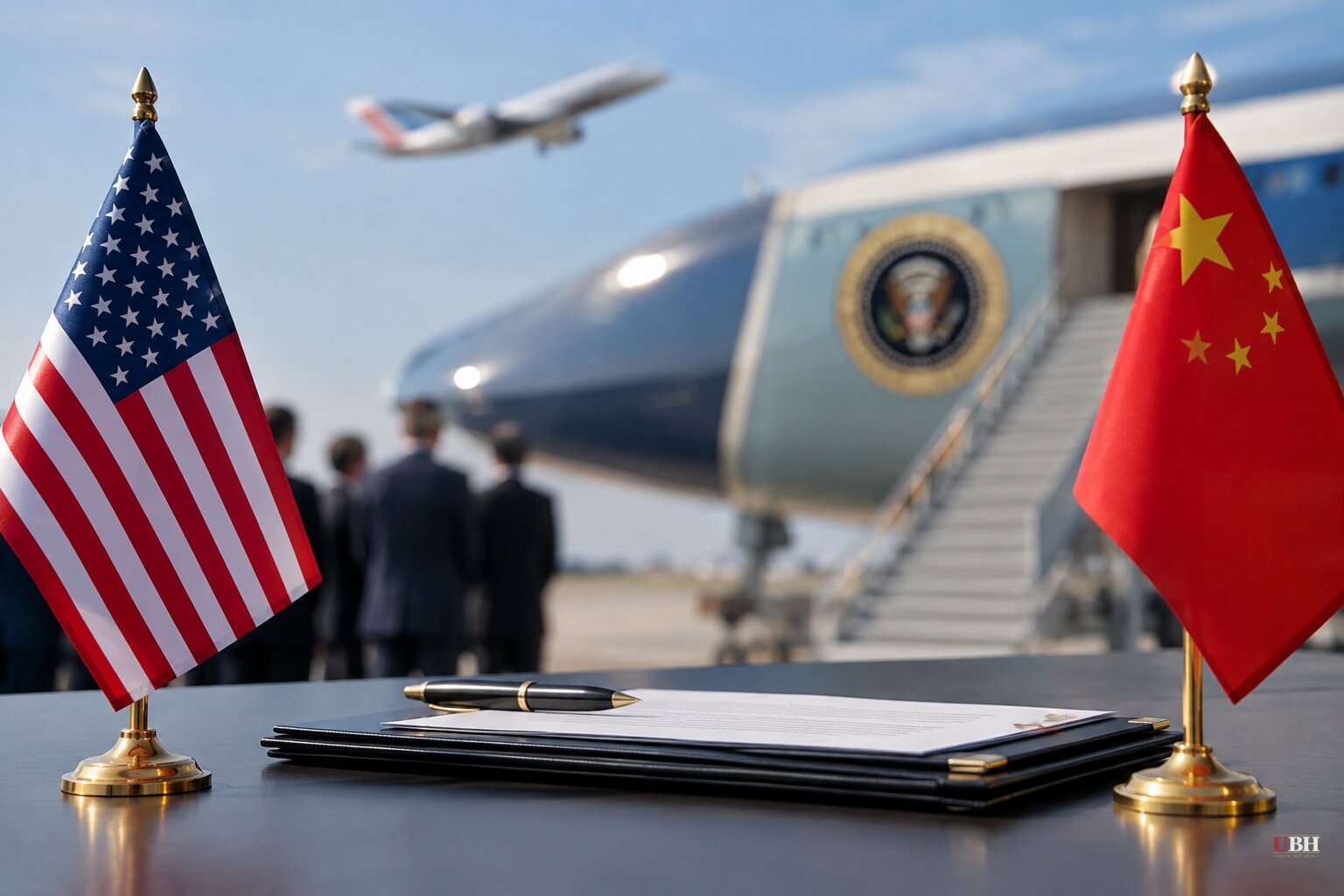
Since President Trump's May trip to Beijing produced what the Atlantic Council calls an "uneasy pause" in U.S.-China hostilities, Xi Jinping is scheduled to arrive in Washington Wednesday, September 24, for their third in-person meeting in under a year, with the formal summit set for Thursday. New details are surfacing about what each side wants and who's showing up.
Stanford's 2026 AI Index found that as of March 2026, the leading U.S. AI model held only a 2.7 percent advantage over the leading Chinese model on the benchmark it measures, according to the Epoch Times. This represents a significant narrowing from the gap Washington assumed it had.
The picture isn't one-sided. U.S. private AI investment hit $285.9 billion in 2025, compared to $12.4 billion in China, per the same Stanford data cited by the Epoch Times. China's edge is elsewhere: it leads in AI publications, patents, and industrial robot installations, having installed roughly 295,000 industrial robots in 2024, 54 percent of the global total, according to figures reported by the Epoch Times.
Breitbart reports Chinese firms DeepSeek and Moonshot AI have released open-weight models, downloadable and modifiable by anyone, that now trail top U.S. systems from OpenAI and Anthropic by only a small margin, with Moonshot's Kimi K3 model cited by analysts as the clearest evidence of that narrowing gap.
China's Minister of State Security, Chen Yixin, called AI "the main battleground for global competition and a new track for major power strategic rivalry" in remarks reported by Breitbart. House Speaker Mike Johnson, meanwhile, warned this week that if Congress rushes emergency AI regulation, "we will lose the race to China, and that is a threat to every single American," per Breitbart. Rep. Jay Obernolte (R-Calif.), who chairs the House Task Force on AI, has staked out a more optimistic position, telling Fox News Radio's Rundown podcast he believes Congress can realistically regulate AI without sacrificing competitiveness.
OpenAI CEO Sam Altman told Fortune that Trump and Xi would deserve a Nobel Peace Prize if they reached even a limited agreement on shared AI safety standards. The Daily Signal reports Trump has shown no interest in that idea, and Altman is scheduled to attend Thursday's state dinner alongside Nvidia's Jensen Huang and Qualcomm's Cristiano Amon, according to the Daily Signal.
Iran, Chips, and the Sanctions Question
Treasury Secretary Scott Bessent has announced sanctions targeting countries that support Iran, and the Daily Signal reports that raises an open question of whether China, described by America First Policy Institute's Adam Savit as Iran's top trading partner, gets swept in. Savit said China accounted for roughly 90 percent of Iran's oil revenue before the war with Israel, funding what he called Iran's "treasure chest." Heritage Foundation's Andrew Harding told the Daily Signal that Washington is "walking a tightrope," trying to hold Iran's backers accountable while keeping the broader U.S.-China relationship stable.
On chips, Breitbart reports the Trump administration has eased licensing rules for some semiconductor exports even as it tightens others, a move that has frustrated China hawks in Washington who want a harder line across the board.
The Calendar Beijing Wants Locked In
The Atlantic Council reports Beijing is angling to use this week's meeting to set up Trump's attendance at the APEC summit in China this November, with Xi reciprocating at the G20 summit in Miami in December, a sequence that would lock in leader-level meetings through year's end. Chinese Foreign Minister Wang Yi has pushed what Beijing calls "constructive strategic stability," which the Atlantic Council says amounts to a request that Washington handle Taiwan "with extra prudence" and stop taking actions Beijing views as antagonistic.
The Manufacturing Argument
Rep. Ro Khanna (D-Calif.), writing in The Hill, argues Trump has nothing to show for his China posture on the manufacturing front. Khanna cites roughly 1,300 United Auto Workers members laid off at the Ultium Cells battery plant in Lordstown, Ohio, after Trump ended the federal EV tax credit; hundreds of union job cuts at a Whirlpool plant in Amana, Iowa, alongside a new Whirlpool plant opening in Mexico; the closure of Conn-Selmer's brass instrument factory in Eastlake, Ohio, eliminating 150 union jobs; and Goodyear cutting 1,700 United Steelworkers jobs in Fayetteville, North Carolina. Khanna also points to manufacturing employment down roughly 35,000 since Trump took office and factory construction spending down 28 percent since January 2025.
Those figures come from Khanna's own opinion piece and reflect his argument for what he calls "economic patriotism," including a tariff-funded industrial development bank and new trade schools. No other source in this reporting independently verified the job-loss totals, though the individual plant closures and layoffs he names are consistent with reporting on those specific companies elsewhere. Whether Trump addresses any of it at Thursday's summit, or whether the AI and Iran-sanctions questions produce anything beyond a joint photo op, remains to be seen when the two leaders actually sit down.
Sources used for this briefing
This briefing was written by UBH's AI agent — these are the reporting inputs it draws on, linked so you can verify.


