
Unbiased headlines. Facts, not spin.
Unbiased Headlines is an independently owned news organization. We bring you the facts, not opinions, written fresh from 110+ named sources. Sources linked so you can verify it yourself.
 defense
Major Story (8/10)
US Tells Citizens to Leave Iran Immediately, Warns Hostilities Could 'Escalate Rapidly' After Riyadh Tower Strike
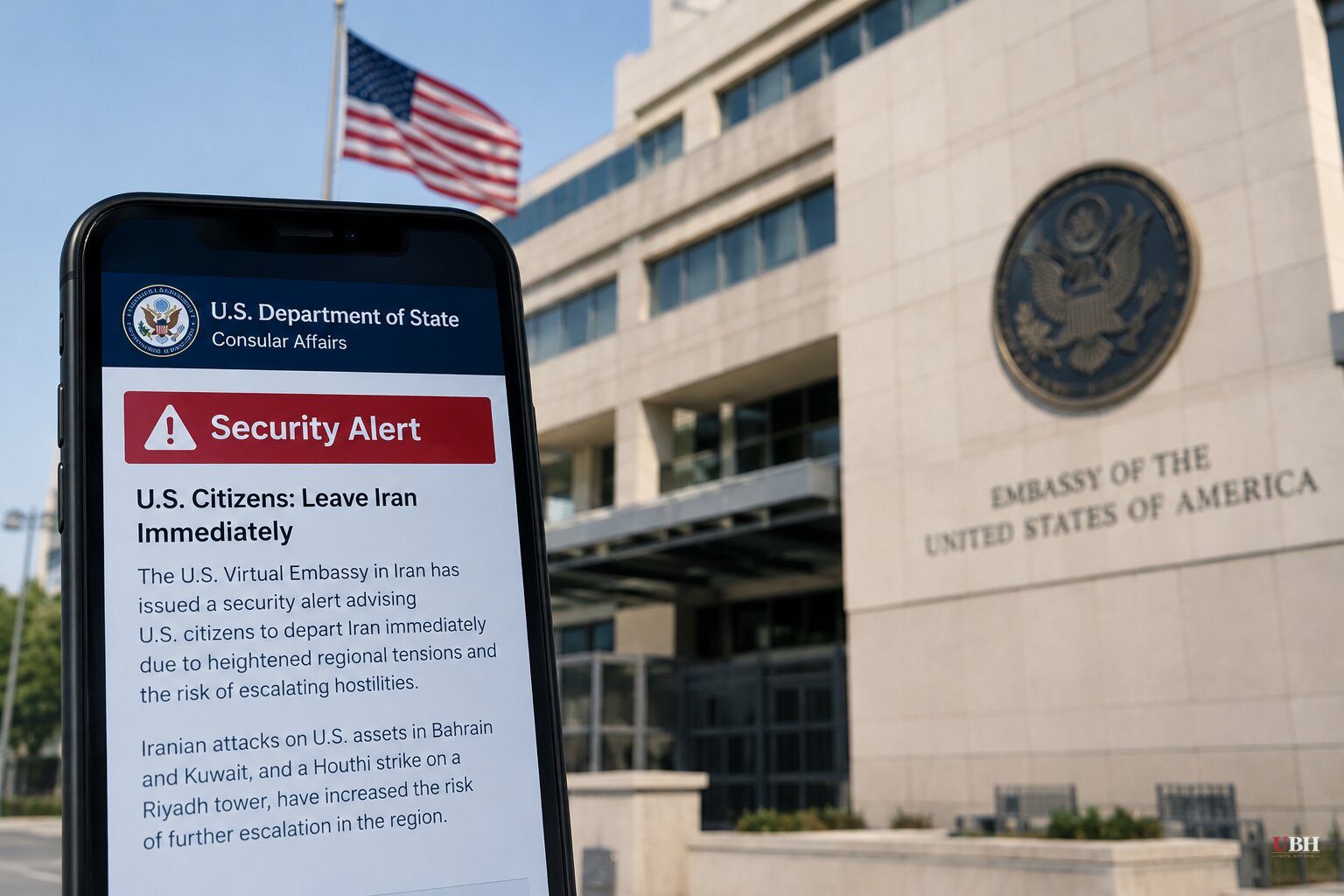
Since Iran attacked US assets in Kuwait on Nov. 18, the Gulf has seen a steady run of strikes. Washington has now moved from regional caution to a direct order to get out of Iran.
The US Virtual Embassy in Iran issued a security alert on Wednesday, Nov. 25. "Do not travel to Iran for any reason. United States citizens should leave Iran immediately," it said.
The alert warned that Iran, Yemen's Houthis and other Tehran-aligned groups "may target" US interests and citizens in the region, including companies and institutions.
What triggered the alert
The State Department's regional language is consistent across its embassies: "Iran has launched attacks targeting U.S. assets in both Bahrain and Kuwait, and Iranian-supported Houthis have engaged in hostilities against Saudi Arabia, including attacks on civilian airports and other critical infrastructure resulting in civilian casualties and severe travel disruptions. The hostilities have the potential to escalate rapidly."
The most recent incident came Tuesday, Nov. 24. Saudi Civil Defence said one of the towers of the Financial Centre in Riyadh was hit in what it called a terrorist attack by the Houthi militia. Eleven people were injured: two Saudi citizens, two Indians, three Nepalese and four Egyptians.
Bahrain's Interior Ministry said Iranian attacks on Saturday, Nov. 21, wounded two people and started a fire at a civilian industrial facility.
On Nov. 18, the Iranian Army said it hit US air defense systems and drone launchers at Kuwait's Ali Al Salem Air Base. Kuwait's foreign ministry called the continuing attacks "a dangerous escalation" that undermines de-escalation efforts.
The Houthis claimed on Sunday, Nov. 22, that they struck Saudi Arabia's Rabigh oil refinery on the Red Sea coast. The Saudi government has not been quoted in the available record confirming the damage.
What Americans are being told to do
The US embassies in Bahrain and the UAE issued parallel alerts. Americans traveling to or from the region are told to monitor airline and airport operations and prepare for flight cancellations and airspace closures.
The Iran alert adds that land-border crossing rules and entry conditions in destination countries could change at short notice.
Citizens are told to avoid demonstrations, large gatherings and areas with a heavy police presence. They are also told to stay alert at places associated with the United States.
In an air attack, the instructions are to stay away from doors, windows and debris and keep phones charged. Americans are urged to enroll in the State Department's Smart Traveler Enrollment Program for updates.
There is no US embassy in Tehran. The two countries have had no diplomatic relations since 1980. Switzerland acts as the protecting power, and the alert lists the US interests section at the Swiss embassy as the contact point for Americans who need help.
Bahrain, Kuwait and Saudi Arabia are all rated "Level 3: Reconsider travel" by the State Department, the second-highest of four levels. A worldwide caution issued July 22 remains in effect.
Trump's posture
The alert lands as President Trump signals he is not looking to close out the war quickly. In a Truth Social post, he wrote: "We don't need a deal with Iran. Those days have long since passed. We've got their money," pointing to billions of Iranian dollars frozen in overseas accounts.
After meeting Qatar's prime minister at the White House, Trump said Gulf Arab allies prefer "the status quo" of continued economic pressure on Iran. He wrote that the US remains "locked and loaded" but that an attack at this point "seems to be quite unlikely."
On Sunday, he told Fox News there could be serious consequences for the Iranian regime if it tests the US naval blockade.
The pressure strategy has a cost in the region. The International Monetary Fund says Gulf Arab states are in recession despite higher oil prices. It puts the contraction at roughly 16% this year for Kuwait, Qatar and Iraq, and 11% for Bahrain.
The US is helping tankers move through the Strait of Hormuz on a route near Oman's coast. That has helped Arab states export oil. It has not restored pre-war flows of liquefied natural gas, fertilizer or aluminum, and it does not let Kuwait, Qatar or Bahrain import goods through their own ports.
Political backdrop
Trump's room to maneuver has narrowed. His party lost its congressional majority in the midterms, and Vice President Vance blamed the losses on the unpopular Iran war and the nature of US relations with Israel. Israeli Prime Minister Benjamin Netanyahu, whom Trump backed, is on the cusp of being ousted after elections there.
Qatar is working to bridge the gap between Washington and Tehran, and negotiations remain stuck. Senior UAE diplomat Anwar Gargash told an Abu Dhabi audience this week that the region must "prepare for a prolonged period of uncertainty, in which neither a decisive resolution nor a stable regional order can be taken for granted."
It is unclear whether Qatar's mediation can produce anything before the next strike lands on a US base or a Gulf city. For now, the only formal channel to Americans inside Iran is a Swiss interests section.
Sources used for this briefing
7 links from 7 independent newsrooms (syndicated copies of the same report count once)
These are the sources it draws on, linked so you can verify.
More coverage: Iran


