
Unbiased headlines. Facts, not spin.
Unbiased Headlines is an independently owned news organization. We bring you the facts, not opinions, written fresh from 110+ named sources. Sources linked so you can verify it yourself.
 defense
Major Story (7/10)
China Launches Shenzhou-24 With Pakistani Astronaut, the First Foreigner Sent to Its Space Station
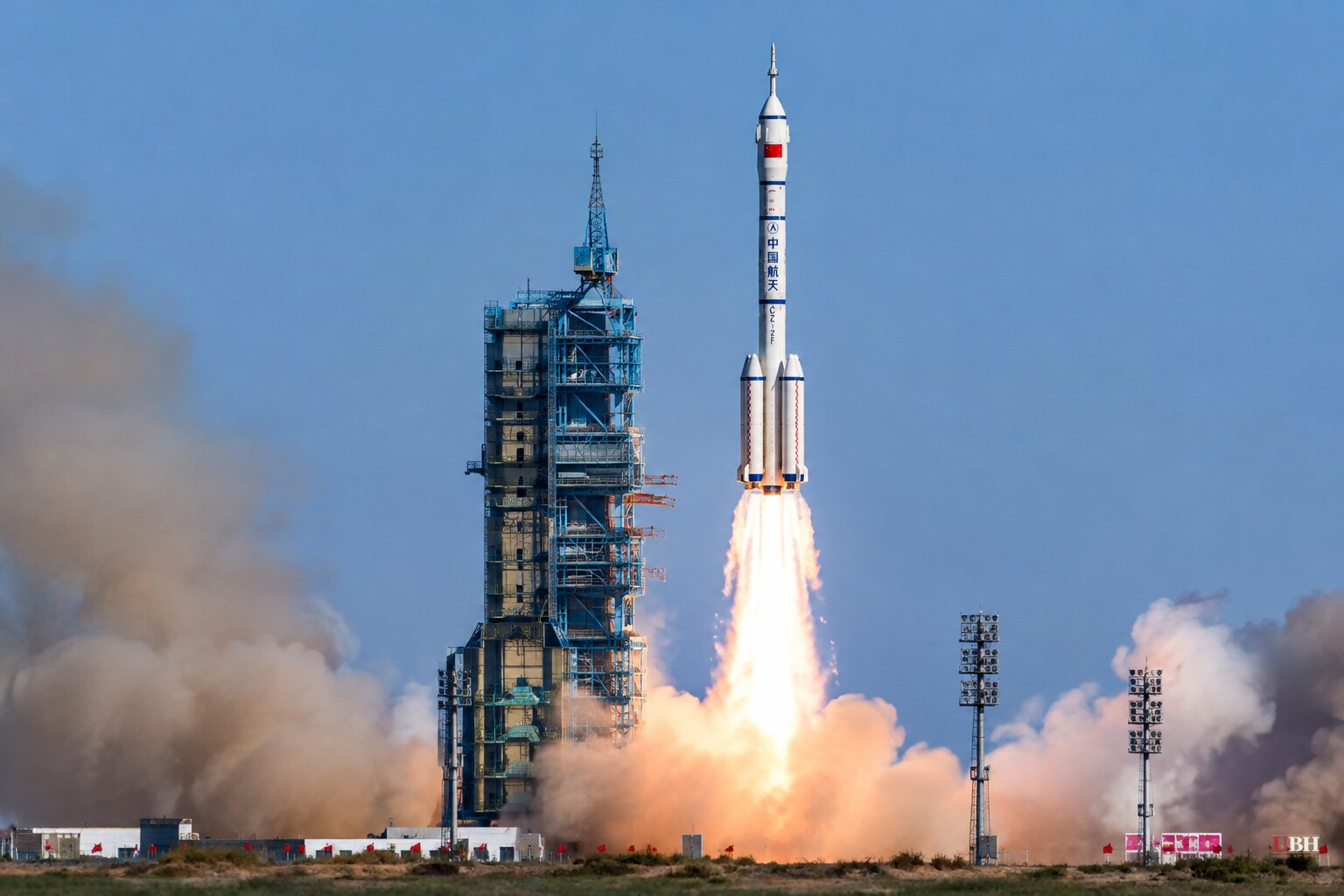
Since Shenzhou-23 lifted off in May, Tiangong has been crewed only by Chinese astronauts. That changed on Wednesday, Nov. 25, Beijing time, when Shenzhou-24 launched with a Pakistani national aboard.
The Long March-2F rocket left the Jiuquan Satellite Launch Center in northwest China at 8:18 a.m. Beijing time (0018 GMT). About 10 minutes later the spacecraft separated from the rocket and entered its designated orbit, the China Manned Space Agency said. It called the launch "a complete success" and said the astronauts were in good condition.
Who is on board
The crew is mission commander Tang Hongbo, 51, flight engineer Wu Yi, 39, and Muhammad Zeeshan Ali, 40, a former Pakistan Air Force pilot who will serve as a payload specialist. It is the first joint flight of Chinese and foreign astronauts in the history of China's crewed program.
Tang is on his third mission and, per China's CCTV, is set to become the first astronaut to board Tiangong three times. It is the first spaceflight for Wu and Ali.
Ali trained for seven months in Beijing. He took intensive Chinese-language classes and read Chinese poetry. Khurram Dawood, the other candidate who reached the final stage of selection, also trained in China.
Ali told reporters on Tuesday: "I'm not flying for myself. I carry the name of Pakistan on my shoulder." He added that he was carrying "the hopes of 250 million Pakistanis."
What the mission will do
The spacecraft is due to perform a fast, automated rendezvous and docking with the station, after which the crew enters Tiangong. The agency said the station was already in docking orbit with good conditions for the approach. Docking had not been announced in the launch statements.
China Manned Space Agency spokesperson Zhang Jingbo said more than 90 experiments and technology tests are planned. They cover space life sciences, materials science, microgravity fluid physics, combustion, fundamental physics and space medicine.
Four China-Pakistan joint projects in biotechnology and materials are part of the mission. Ali will run an in-orbit experiment on photosynthetic cyanobacteria. He will also study the effects of radiation and microgravity on seeds.
The flight follows an agreement China and Pakistan signed in February 2025.
A short visit and a long stay
Ali's time on the station is short. He is set to stay 5 to 10 days, well under the usual six-month Chinese rotation. He will come home aboard Shenzhou-23 with two members of that crew.
Tang and Wu will remain in orbit for roughly six months. They will be joined by Shenzhou-23 astronaut Zhu Yangzhu, who is staying behind to support research on how the human body copes in space. When Zhu leaves, he will hold the record for the longest single stay in orbit by a Chinese astronaut, at about a year.
That research is a crucial step toward China's plan to put astronauts on the moon by 2030. NASA is aiming for a lunar landing in 2028. China's Chang'e-7 lunar mission failed to meet launch conditions this year amid adverse weather, though Beijing's 2030 goal is unchanged.
Why Beijing wants the optics
China is promoting Tiangong, fully operational since late 2022, as a hub for international cooperation. The NASA-led International Space Station faces possible retirement by 2030.
Blaine Curcio, founder of Hong Kong-based Orbital Gateway Consulting, described what Pakistan gets from the arrangement: "It brings prestige, important science and technology know-how, and a level of deeper collaboration and diplomatic goodwill with China."
Pakistan does not have its own spacecraft to send astronauts to space, so a Chinese seat was its route to orbit. Space cooperation between the two countries dates to the early 1990s. China has launched Pakistani satellites, and a Pakistani-built rover is set to fly on a Chinese lunar mission around 2028.
Pakistani Prime Minister Shehbaz Sharif called the flight "a historic first" in a post on X on Tuesday and thanked Chinese President Xi Jinping. "Pakistan-China friendship is surpassing the heights of the Himalayas, in its journey to outer space," he wrote.
Ali said he hopes cooperation will grow "from one astronaut in one flight to multiple joint flights and to the moon, Mars and beyond."
The next milestone is the docking with Tiangong and the crew's entry into the station. Ali is then set to return to Earth aboard Shenzhou-23 after a short stay, leaving Zhu in orbit to complete a year-long stay.
Sources used for this briefing
8 links from 8 independent newsrooms (syndicated copies of the same report count once)
These are the sources it draws on, linked so you can verify.


