
Unbiased headlines. Facts, not spin.
Unbiased Headlines is an independently owned news organization. We bring you the facts, not opinions, written fresh from 110+ named sources. Sources linked so you can verify it yourself.
 defense
Major Story (7/10)
Event date: November 24, 2026 ·
Solomon Islands Signs Security Treaty With Australia, Pledges No Foreign Military Bases
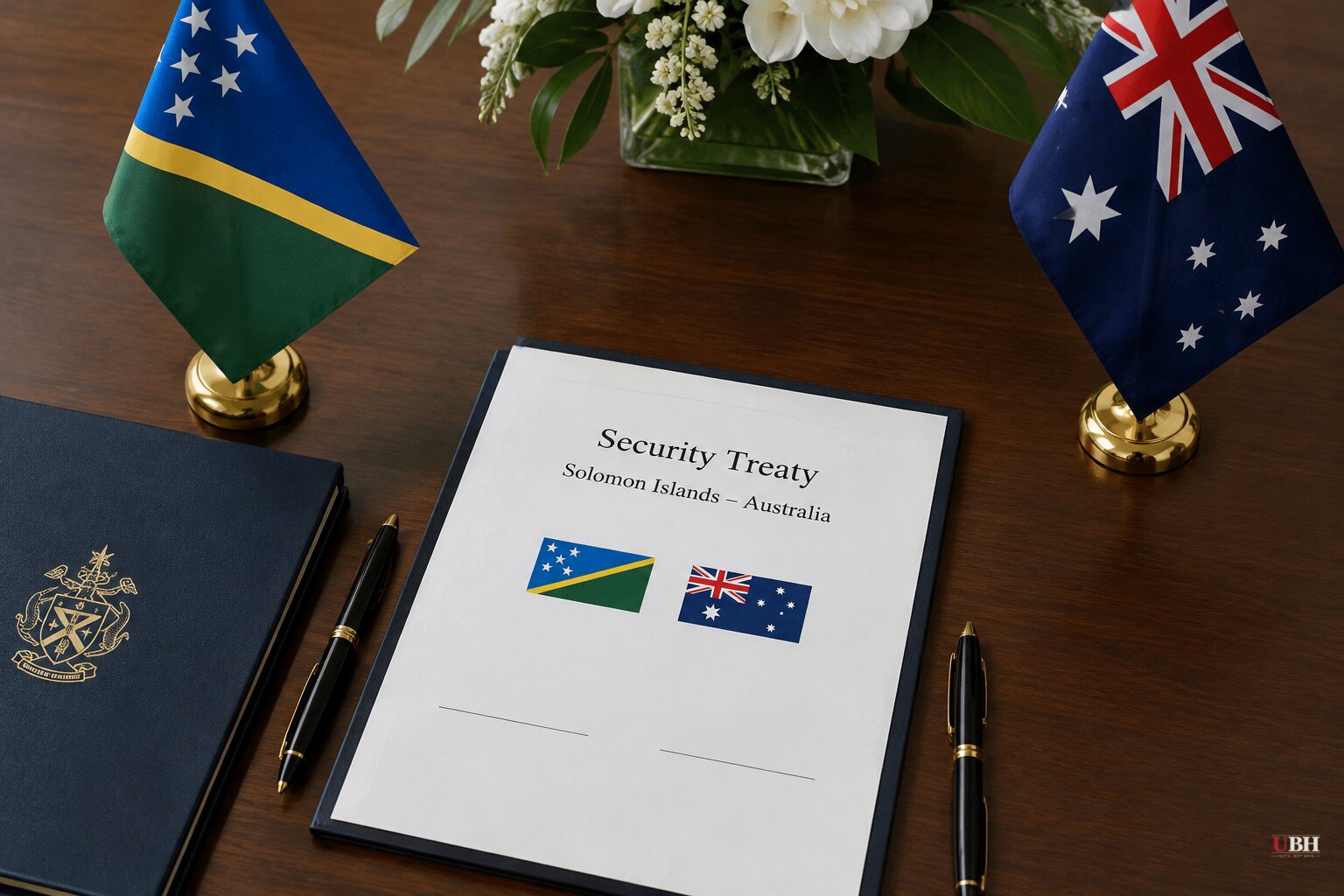
The Solomon Islands signed a security treaty with Australia in Canberra on Wednesday, Nov. 25, and promised never to allow a foreign military base on its soil.
Prime Minister Matthew Wale signed with Australian Prime Minister Anthony Albanese, then was applauded by federal politicians on the floor of Parliament.
"With this treaty, Australia becomes the Solomon Islands' primary security partner," Albanese said.
What the treaty does
The leaders' joint statement says Honiara will deny any request from a foreign power to establish military or security bases on its territory. It also commits the Solomons to keep its critical infrastructure free from "militarisation and unauthorised access."
Honiara must consult Australia on the development of critical infrastructure. Australia, for its part, will support the expansion of the Solomons' police and border force. The deal also includes Australian funding for infrastructure and education, plus improved visa arrangements for Solomon Islanders.
The text was posted online by Australia's foreign affairs department.
The China question
The Solomons signed a secretive security pact with China in 2022. Western analysts feared it could lead to Chinese warships docking in the islands and, eventually, a base threatening sea links between Australia and the United States in a Pacific conflict. Beijing has denied it is seeking a base.
A day before the signing, it emerged that Wale's government told Beijing last month it would not renew that five-year pact when it expires in April.
Wale would not confirm it. "Unfortunately, there is a non-disclosure clause in the treaty with China, the security pact and the policing agreement," he told reporters. "We have ongoing discussions with China, but of course, today is about our relationship with Australia."
So the headline commitment, no foreign bases, is on the record. The fate of the China pact is not, at least from Wale's own mouth.
Beijing's position
China's foreign ministry did not immediately respond to a request for comment on the signing. Earlier this week a ministry spokesman said Beijing's Pacific diplomacy was "not for geopolitical contest" and criticized efforts to thwart China's regional engagement.
"The international community should help Pacific Island countries achieve sustainable development, respect their independence, put development first, and stick to openness and inclusiveness," the spokesman said.
A notable turn for Wale
Wale is a long-time China critic who took office in May. He had condemned the 2022 pact, saying it would upset regional security and jeopardize existing partnerships.
But in 2025 he led a delegation to Beijing, where he praised China's economic development and said his party supported the one-China principle. That made his stance look softer.
"Solomon Islands has been for a number of years a source of uncertainty and doubt in the region," Wale said Wednesday. "Those days are done."
He said he would seek legislation to "bed down the treaty," a step meant to make it harder for any pro-China successor to back out.
Connor Graham, a research fellow in the Pacific Islands program at the Lowy Institute in Sydney, said the deal, together with signs the China pact will lapse, "goes beyond the success of the previous deals" Australia has struck in the region. "It is a blow to Chinese security ambitions in the Pacific certainly," he said.
Canberra's Pacific string of deals
The Solomons treaty is the latest in a run. Last year Australia signed a mutual-defense treaty with Papua New Guinea, its first military alliance since the 1951 ANZUS treaty with New Zealand and the United States. Pacts with Vanuatu and Fiji followed in June and July.
"Across the Pacific, we are taking our partnerships to a new level," Albanese said.
The Solomons has more than 800,000 people spread across about 1,000 islands northeast of Australia. The islands were important battlegrounds in the Allied victory over Japan in World War II.
The Solomons agreement is not described as a mutual-defense treaty in the leaders' statement. It centers on policing, border security, infrastructure and a ban on foreign bases.
The wider push against Beijing
Albanese is also working the Quad track. After talks in Manila with President Donald Trump, India's Narendra Modi and Japan's Sanae Takaichi, Albanese said Australia would deploy P-8A Poseidon and P-3C Orion maritime patrol aircraft in new Quad exercises in early 2027.
Asked what he would tell Chinese leader Xi Jinping about the plan, Albanese said military exercises were common and the aim was peace and security in the region.
A Chinese reaction to the Solomons treaty has not yet come. The next test is April, when the 2022 China pact reaches its five-year expiry, and whether Wale's legislation passes and binds his successors.
Sources used for this briefing
6 links from 6 independent newsrooms (syndicated copies of the same report count once)
These are the sources it draws on, linked so you can verify.


