
Unbiased headlines. Facts, not spin.
Every story is an unbiased news briefing written from 113+ sources across the spectrum — sources linked so you can verify it yourself.
 defense
Breaking / Critical (9/10)
Event date: September 23, 2026
defense
Breaking / Critical (9/10)
Event date: September 23, 2026
Trump Threatens to 'Annihilate' Iran at the UN, Then Sends Envoys Into Surprise Talks as GOP Support Cracks
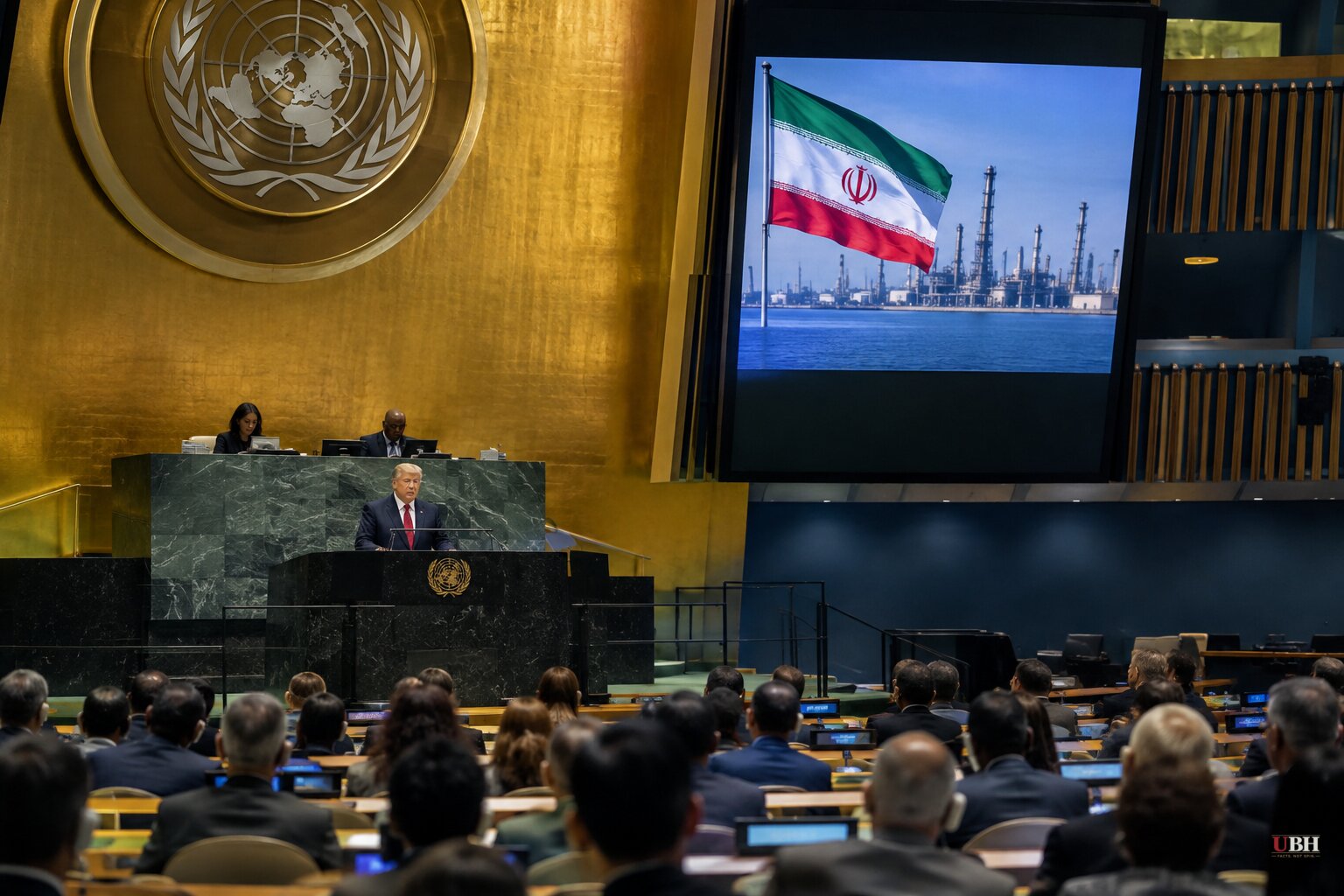
President Trump used his address to the United Nations General Assembly this week to lay out what the New York Times described as a "winner-takes-all vision of U.S. power," including a fresh threat aimed at Iran. He said he would soon decide whether to "annihilate the Islamic Republic" or help turn it into "one of the great countries of the Middle East," according to the Guardian.
Hours later, his envoys Steve Witkoff and Jared Kushner sat down with Iran's foreign minister, Abbas Araghchi, for three hours of talks at UN headquarters in New York, mediated by Qatar. Trump called the session "very productive." Witkoff called it "encouraging, constructive and successful," per the Guardian. Brent crude fell below $100 a barrel for the first time in two weeks after Trump's comments.
Iran's government did not confirm any change in position. Foreign ministry spokesman Esmail Baghaei said the talks were aimed at "conveying Iran's conditions, including the end of the war in all its dimensions, the cessation of American aggressive actions, the naval siege, and the economic war, the release of Iranian assets and so on." Iran has laid out seven preconditions and, in a new wrinkle over the past two days, signaled the Strait of Hormuz could reopen within a week if those conditions are met. The Guardian reports that any deal would likely require the U.S. and Gulf states to accept a shipping lane running mainly through Iranian waters, under Iranian rather than Omani control, a concession American negotiators have not yet embraced.
The war is costing Republicans at home
The war, nearly seven months old according to TIME, has become a liability inside Trump's own party as the midterms approach. TIME reports that a growing number of GOP candidates, including some in competitive Senate races, are now calling for it to end. The latest war powers resolution in the House picked up fresh Republican votes, and polling shows Trump's approval on the war among Republican voters has dropped by double digits.
Republican strategist Brian Darling, a former counsel to Sen. Rand Paul, told TIME the shift is straightforwardly electoral. "It's all about getting reelected," he said. "It's all about making sure that they can signal to their constituents that they have the same concerns about the Iran war." Darling traces most of the discontent to inflation. A Congressional Budget Office report released last week found the war added 2.3 percentage points to an annualized inflation rate of 5.3% in the second quarter of 2026, driven mainly by disruptions to shipping through the Strait of Hormuz, according to TIME. Regular gasoline is up roughly 52% since the war began, to around $4.48 a gallon, per U.S. Energy Information Administration figures cited by TIME.
Republican critics of the war point to a conflict Trump once said would last weeks now approaching seven months, hitting voters at the pump and in grocery bills, with no announced exit plan. The counterpoint, which Trump himself made at the UN and to reporters afterward, is that he's simultaneously pursuing an end to it. "It's to their advantage to make a deal, and we can do that," he said Tuesday, according to TIME, and he has predicted the conflict will wind down after the midterms. The talks in New York suggest the diplomatic track is still alive.
Lula uses the same stage to knock American power
Brazil's Luiz Inácio Lula da Silva, opening the General Assembly under the tradition that gives Brazil the first speaking slot, used his address to criticize U.S. tariffs and military presence in Latin America without naming Trump directly, according to Breitbart. "Brazil doesn't fit in anyone's backyard," Lula said, adding his country doesn't need "aircraft carriers patrolling our waters." He called U.N. credibility "never so low" and pushed for Security Council reform, particularly around veto power.
Breitbart's headline frames the speech as Lula having "trashed" U.S. power, but its own reporting shows a more even-handed address than that framing suggests. On Gaza, Lula accused the Netanyahu government of genocide against Palestinians, but in the same breath said Israeli civilians "paid the price for the radicalism and intolerance of Hamas terrorist acts" — criticism aimed at both sides, not a one-sided broadside.
Separately, the Atlantic's coverage of Trump's UN week, referenced on The Politics Lab podcast, noted the president settled for "something much less" than his earlier vow to "own" Greenland. This pattern of grand UN rhetoric followed by scaled-back outcomes now shows up again in the Iran standoff: a threat to annihilate a nation followed, within hours, by three hours of quiet negotiation. Whether that negotiation produces an actual reopening of the Strait of Hormuz or another stalled round like the one that collapsed over the summer remains unresolved.
Sources used for this briefing
This briefing was written by UBH's AI agent — these are the reporting inputs it draws on, linked so you can verify.


