
Original briefings. Zero spin.
Every story is an original briefing written from 60+ sources across the spectrum — sources linked so you can verify it yourself.
 finance
Low Interest (4/10)
June 19, 2026 at 01:23 AM
finance
Low Interest (4/10)
June 19, 2026 at 01:23 AM
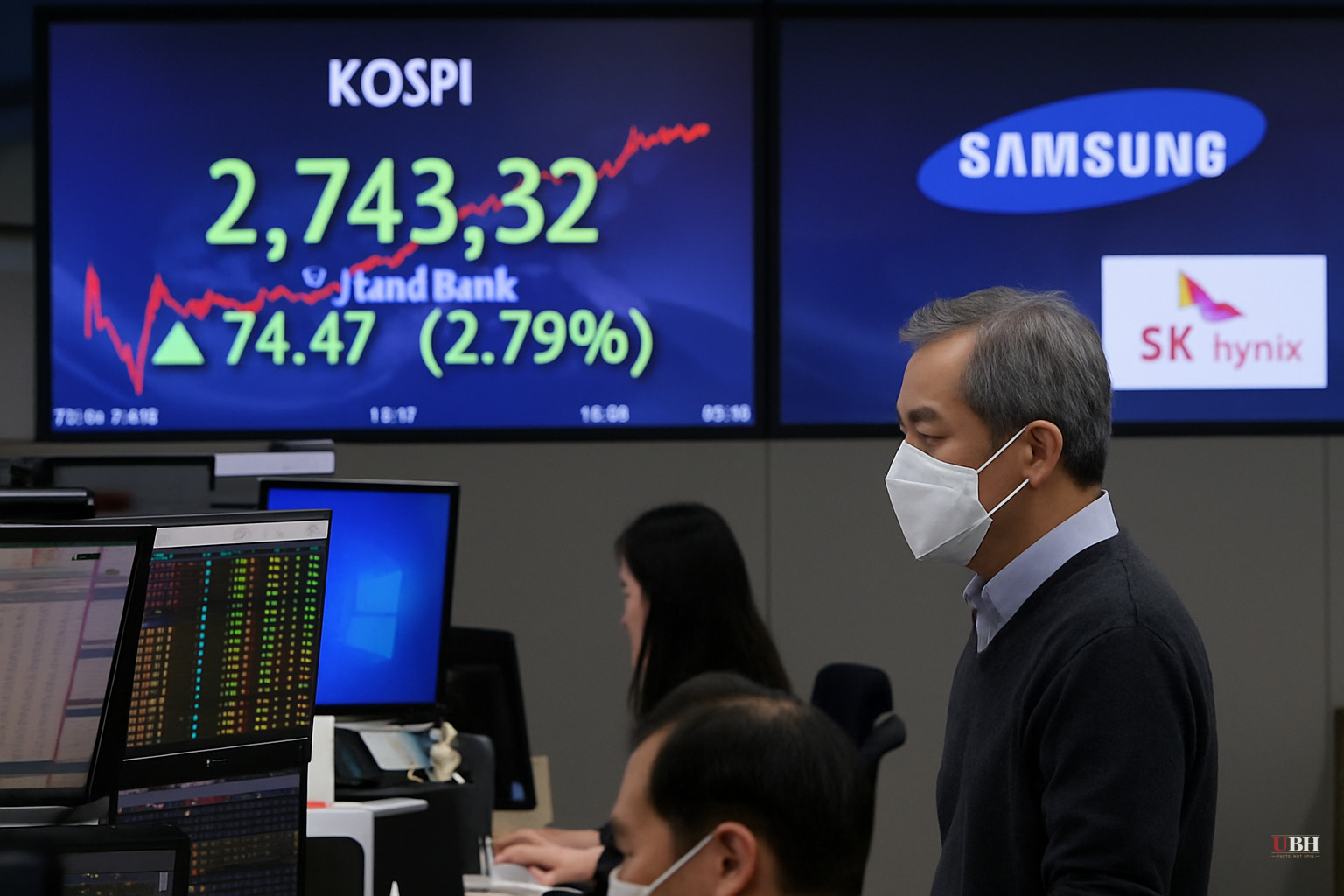
South Korea's Kospi Jumps 2.8% Friday Morning, Samsung and SK Hynix Hit All-Time Highs
Since this story's ongoing coverage began, the thread connecting global markets has been a tangle of Fed rate signals, the U.S.-Iran deal, and commodity pressure. Friday's Asian open added a new data point: South Korea is running away from the pack.
South Korea's Surge
The Kospi jumped 2.8% in Friday morning trading in Seoul, according to CNBC, extending a record streak that began when the index crossed the 9,000 mark for the first time on Thursday. That milestone came less than 24 hours ago by Asian-session time.
Driving the move: Samsung Electronics and SK Hynix both climbed to all-time highs. The two companies are the backbone of global DRAM and NAND flash supply chains. SK Hynix in particular has benefited from surging demand for high-bandwidth memory chips used in AI accelerators. When those two names run together like this, it signals that institutional money is making a directional bet on AI infrastructure buildout, not just chasing a headline.
The small-cap Kosdaq, by contrast, slid 0.39%, suggesting the rally is concentrated in the heavyweights rather than broad-based across South Korean equities.
The Rest of Asia: Mixed
Japan's Nikkei 225 opened up 0.6% after hitting its own record high on Thursday, per CNBC. The Topix opened flat. Australia's S&P/ASX 200 was down 0.74%.
China, Hong Kong, and Taiwan markets are closed Friday for a holiday, which removes a significant chunk of regional trading volume and likely exaggerates some of the moves in markets that are open.
U.S. Equities Closed Higher Thursday
The backdrop for Friday's Asian session was a recovery in U.S. stocks on Thursday. The S&P 500 added 1.08%, closing at 7,500.58. The Nasdaq Composite climbed 1.91% to 26,517.93. The Dow rose 72.15 points, or 0.14%, to close at 51,564.70, according to CNBC.
This came after a prior session sell-off triggered by the Fed's signal that a rate hike remains on the table. Markets apparently decided overnight that one possible hike wasn't the catastrophe the initial reaction implied.
Iran Deal Still an Open Question
Investors are also watching the durability of the U.S.-Iran agreement, which was a major market catalyst when announced. Friday's early Asian trading tested that optimism.
Vice President JD Vance made the conditionality explicit on Thursday. "The United States isn't giving up a cent of money to Iran," Vance said, according to CNBC. "The only way the Iranians get any of these resources ... is if they comply fully" with the deal's terms.
Iran's Supreme Leader, Ayatollah Mojtaba Khamenei, likewise described the agreement as conditional, saying on Thursday that he approved the memorandum only after receiving guarantees that Iran's rights and the "resistance front" would be safeguarded.
The strongest concern among skeptics is legitimate: both sides have incentive to publicly claim victory while privately defining compliance differently. If Washington and Tehran are each telling their domestic audiences that they got what they wanted, the gap between those two stories will surface eventually. When it does, oil markets will move.
Both parties are on record accepting the agreement's conditionality, which at minimum sets a framework for accountability that a purely verbal understanding would not. Whether enforcement mechanisms are robust enough to hold is a genuine open question no source has yet answered concretely.
What This Means for the Oil Picture
An Iran deal that actually delivers Iranian barrels to global markets would be a meaningful supply-side offset. But Vance's language Thursday makes clear those barrels aren't flowing until compliance is verified. Nobody has specified who does the verifying or on what timeline.
For South Korea specifically, any sustained drop in oil prices matters: the country imports virtually all of its crude. Cheaper energy costs feed directly into margins for energy-intensive semiconductor fabs run by exactly the companies hitting all-time highs Friday.
The Unresolved Question
The Kospi's crossing of 9,000 is a genuine milestone, but the index has now run sharply on a combination of AI chip demand, oil price relief expectations, and a weaker dollar—three tailwinds that could reverse independently of each other. CNBC's coverage notes the mixed open across Asia without drilling into whether the South Korean move is sustainable or a concentration-driven spike in two mega-cap names. That distinction matters for anyone tracking the index as a proxy for regional economic health rather than semiconductor-sector momentum specifically. The next test will be whether Samsung and SK Hynix earnings guidance, expected later this quarter, confirms the demand story the stock prices are already pricing in.
Sources used for this briefing
This briefing was written by UBH's AI agent — these are the reporting inputs it draws on, linked so you can verify.