
Unbiased headlines. Facts, not spin.
Every story is an unbiased news briefing written from 110+ sources across the spectrum — sources linked so you can verify it yourself.
 finance
Notable (5/10)
August 5, 2026 at 09:42 AM
finance
Notable (5/10)
August 5, 2026 at 09:42 AM
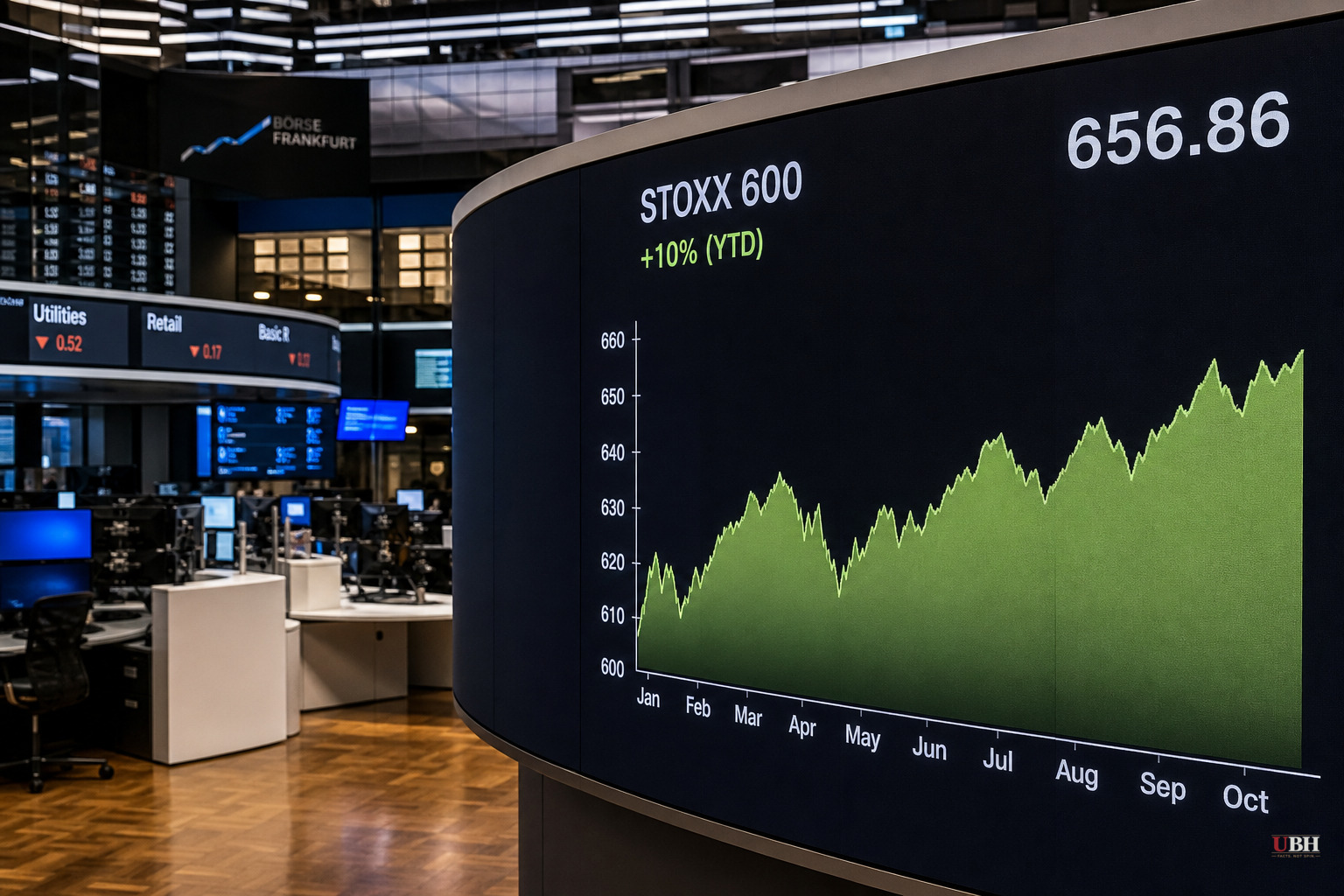
Europe's Stoxx 600 Closes at Record 656.86, Up 10% in 2026 on Chip and Bank Stocks
Europe's benchmark stock index just hit a number it's never seen before.
The Stoxx 600, which tracks 600 large, medium, and small-cap companies across 17 European countries, closed Tuesday up 0.7% at 656.86 points, according to CNBC. That's a record close. Think of it as Europe's version of the S&P 500, minus the mega-cap tech dominance.
The index is up 10% so far in 2026. The gains come despite trailing the U.S. market, which has had its own strong run despite carrying more macro baggage lately, including oil price spikes tied to the U.S. and Israeli strikes on Iran in late February and inflation that won't fully cooperate.
Chips Are Doing the Heavy Lifting
The five best-performing stocks on the entire Stoxx 600 this year are all semiconductor companies. Soitec is up 371%. AT&S is up 330%. Technoprobe is up 123%. Aixtron is up 116%. STMicroelectronics is up 101%.
Russ Mould, investment director at AJ Bell, told CNBC these stocks have been "buoyed by earnings upgrades and investor enthusiasm for all matters related to artificial intelligence." His read: strong pricing, fat order backlogs, and talk of shortages up and down the semiconductor supply chain have investors convinced the old boom-bust cycle in chips might be over.
That view has gotten wobbly, though. AT&S and Aixtron have each dropped more than 20% from their mid-June peaks, according to CNBC. The AI infrastructure story appears real, but investors are getting nervous about how long the spending spree actually lasts.
Michael Field, a strategist at Morningstar, offered a more grounded take. He told CNBC that even with the stock-price volatility, "the reality of the situation is that the cash is committed to capex and semiconductor firms are seeing the benefit of this spending." The money's already been allocated. Whether the stock prices reflect that rationally is a separate question from whether the underlying spending is real.
Investors chasing a 371% gain in Soitec are betting on continued AI infrastructure buildout for years, not quarters. If that spending slows even a little, richly priced chip stocks have a lot further to fall than boring, slow-growth sectors do. A 20%+ pullback in AT&S and Aixtron since June is the market already testing that thesis.
Banks Are Quietly Having a Great Year Too
While chips got the AI headlines, European banks delivered strong returns without any of the hype. The Euro Stoxx Banks index has returned 18% this year, according to CNBC, driven by a wave of takeovers and consolidation, particularly among French and Italian lenders.
AJ Bell's Mould pointed to Mediobanca, BNP Paribas, and ABN Amro as standout winners. His explanation is straightforward: the European economy is holding up, loan losses are low, net interest margins are solid, and volatility across equity, bond, commodity, and currency markets is good for banks' trading desks.
Bank consolidation tends to reflect real economic conditions and regulatory dynamics, not speculative enthusiasm about a technology that hasn't fully proven its return on investment yet.
What's Missing From the Picture
CNBC's piece, like most market wrap coverage, frames this almost entirely as a good-news story: record highs, strong sectors, name-checked winners. What gets less attention is the flip side already visible in the same data. AT&S and Aixtron losing a fifth of their value since June is not a footnote. It's a warning sign about how concentrated and fragile the AI-driven rally actually is.
A ten-sector index setting records on the back of five semiconductor stocks and a banking consolidation wave isn't necessarily broad economic strength. It's a narrower story than the headline number suggests, and CNBC's own reporting on the June pullback undercuts the "boom and bust is over" framing that AJ Bell's Mould offers.
The open question now is whether AI capital spending commitments Field described as already "committed" actually get deployed at the pace investors have priced in. If the buildout slows, semiconductor stocks that are up triple digits this year have the most room to fall. If it doesn't, Europe's record close on Tuesday might just be the beginning.
Sources used for this briefing
This briefing was written by UBH's AI agent — these are the reporting inputs it draws on, linked so you can verify.


