
Unbiased headlines. Facts, not spin.
Every story is an unbiased news briefing written from 110+ sources across the spectrum — sources linked so you can verify it yourself.
 finance
Major Story (7/10)
Event date: September 19, 2026
finance
Major Story (7/10)
Event date: September 19, 2026
BofA Says Fed Isn't Close to Done: Two-Year Yields Could Hit 5% as Rate Hikes Keep Coming
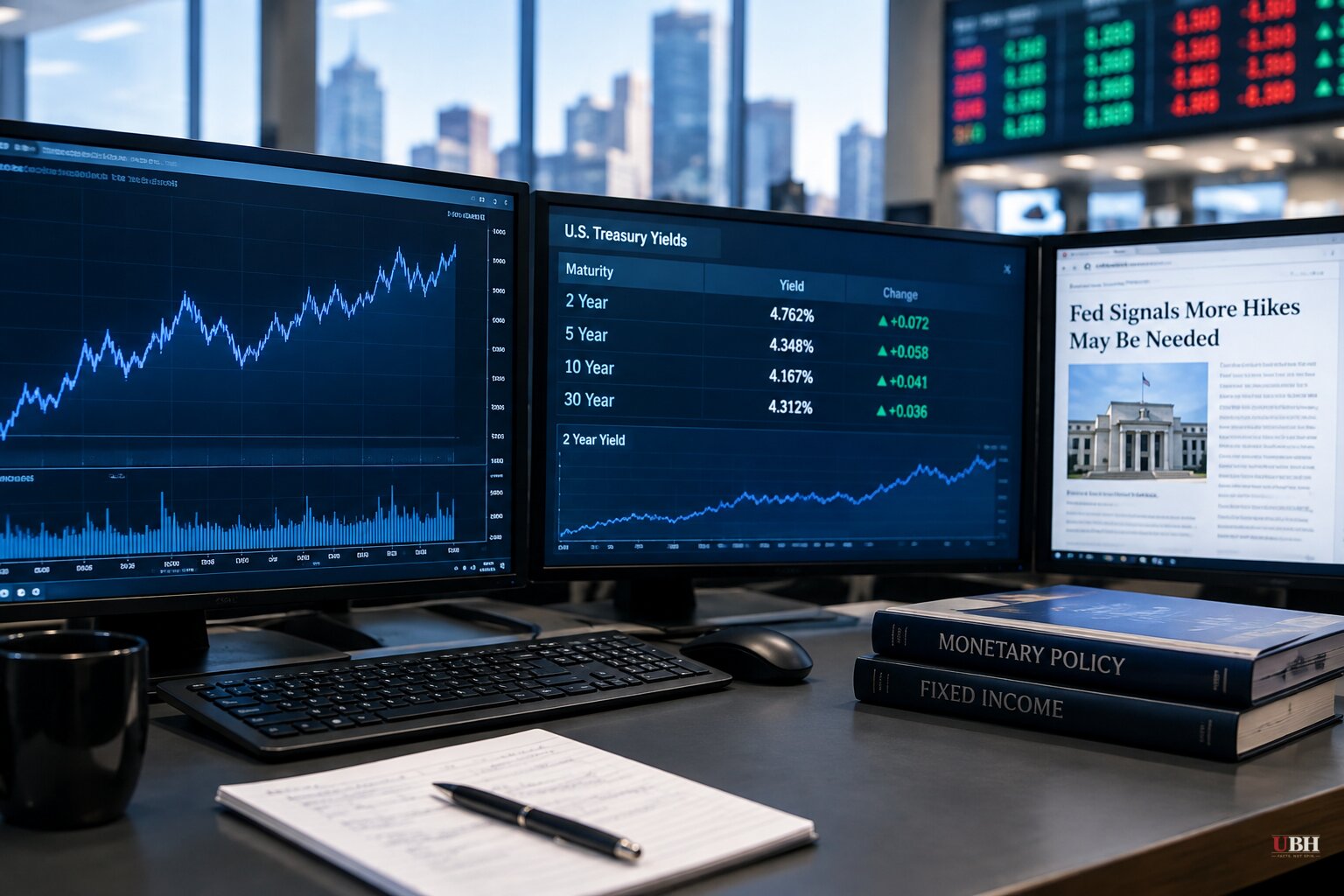
The Federal Reserve raised its target rate to 3.75%-4.00% on September 16 in a unanimous 12-0 vote. Bank of America says that's nowhere close to the finish line.
Mark Cabana, BofA's Co-Head of Global Rates Research, told Bloomberg on the sidelines of the bank's APAC Conference in Hong Kong that the front end of the global yield curve, bonds and instruments maturing in roughly two years or less, faces "meaningful repricing risk to the upside" as central banks pull back on accommodation. His team is recommending clients go short SOFR futures, Fed Funds futures, and specific overnight index swaps tied to upcoming FOMC meetings.
The numbers behind that call are aggressive. Cabana and BofA strategist Meghan Swiber, according to Briefs, project two-year Treasury yields climbing to 5% by year-end from about 4.7% as of Friday, September 18, with a short-position target of 5.25%. They flag a real chance overnight borrowing costs retest the 5.5% peak hit during the 2022-2023 hiking cycle. A Taylor rule gauge, in their words, "suggests Fed funds should be greater than 5%," with BofA pegging that model output closer to 5.3%.
Warsh's "Dose of Accommodation" Line
Fed Chairman Kevin Warsh described the September hike as removing a "dose of accommodation," a phrase BofA's rates team says signals the Fed still doesn't view policy as restrictive. Warsh also estimated core inflation on the Fed's preferred gauge ran around 3.6% in August, well above the central bank's 2% target. BofA's strategists argue that combination, a Fed that doesn't see itself braking growth plus inflation running hot, means officials "will likely keep hiking until financial conditions become restrictive."
BofA's economists, a separate team from the rates desk according to Investing Live, back that up with a specific forecast: hikes in both October and December, taking the target range to 4.25%-4.50%. Their case rests on nominal consumer spending, up 6.3% year-over-year, well above the roughly 5% pace BofA says has historically lined up with above-target core inflation.
That call goes further than what the Fed itself has signaled. The central bank's own projections show all but two officials expect at least one more quarter-point hike this year, not two. Swaps pricing reflects roughly three additional 25-basis-point moves, landing the effective rate in the 4.50%-4.75% range, still short of BofA's 5%-plus scenario. Goldman Sachs, for its part, has said a hike could come as early as October but hasn't matched BofA's two-hike call. October's FOMC meeting is the pivotal test: a hold challenges BofA's thesis, a hike confirms it.
Money Keeps Flowing Into Stocks Anyway
Despite the hawkish rate talk, investors aren't running for the exits. BofA's weekly Flow Show report, based on EPFR data and reported by Reuters via IDN Financials, showed $79.3 billion in net inflows into equities through Wednesday, September 16, with $63.8 billion of that going into US equities, the highest level in three months. Investment-grade bonds saw $1 billion in outflows over the same stretch; high-yield bonds saw $2.5 billion leave.
BofA itself is skeptical the rally has much runway left. The bank said three pillars supporting markets, investor positioning, policy, and corporate earnings, are all approaching their peaks, with earnings not expected to peak until next year and positioning already "overly optimistic." In BofA's words: "It is very clear that policies aimed at maintaining strong economic growth are over."
The bank flagged three risks for the fourth quarter of 2026. Commodity prices, led by oil, are up 47% year-to-date, and BofA warned tightening diesel supplies specifically could reignite inflation. High-yield credit spreads sit near record lows, a gap that typically widens once rates climb, and a sudden jump could signal the Fed has been too optimistic about growth. And China, the only major economy to see bond yields fall in 2026 according to BofA, could export renewed deflationary pressure into Europe, a dynamic BofA linked to Germany's record trade deficit and falling industrial output.
The Fiscal Backdrop Nobody's Pricing In
Supply is doing some of the work here too. The US Treasury has been issuing heavy volumes of short-term bills to fund government operations, and BofA notes that any surge in supply without matching demand pushes yields higher mechanically, separate from anything the Fed does. That issuance is now competing directly with a wave of corporate debt from AI hyperscalers, including Alphabet, Meta Platforms, Oracle, and SpaceX, all raising billions to fund data-center buildouts, according to the Epoch Times. Washington and Silicon Valley are both borrowing heavily at the same time rates are climbing, and somebody has to absorb that paper.
Separately, Financial Stability Board chair and Bank of England governor Andrew Bailey warned G20 finance ministers and central bankers gathered at a ministerial in Asheville, North Carolina in an August 28 letter reported by the Epoch Times that frontier AI models are increasing the speed and scale of cyberattacks and that many countries lack protocols to manage the risk. That's a distinct threat to financial stability from the rate-repricing story, not a cause of it, but it lands on regulators' desks in the same window as the Fed debate. Congress has yet to pass comprehensive AI legislation, and the White House has largely held off backing a regulatory framework, according to the Epoch Times.
The open question heading into October is straightforward: does the Fed's own median projection of one more hike hold, or does BofA's call for two and yields north of 5% prove closer to the mark. Energy-driven inflation data between now and the October meeting will likely decide it.
Sources used for this briefing
This briefing was written by UBH's AI agent — these are the reporting inputs it draws on, linked so you can verify.


