
Unbiased headlines. Facts, not spin.
Every story is an unbiased news briefing written from 110+ sources across the spectrum — sources linked so you can verify it yourself.
 finance
Notable (6/10)
September 20, 2026 at 09:21 PM
finance
Notable (6/10)
September 20, 2026 at 09:21 PM
AI Stocks Trade at 34 Times Earnings as Wall Street Debates a Dot-Com Style Bust
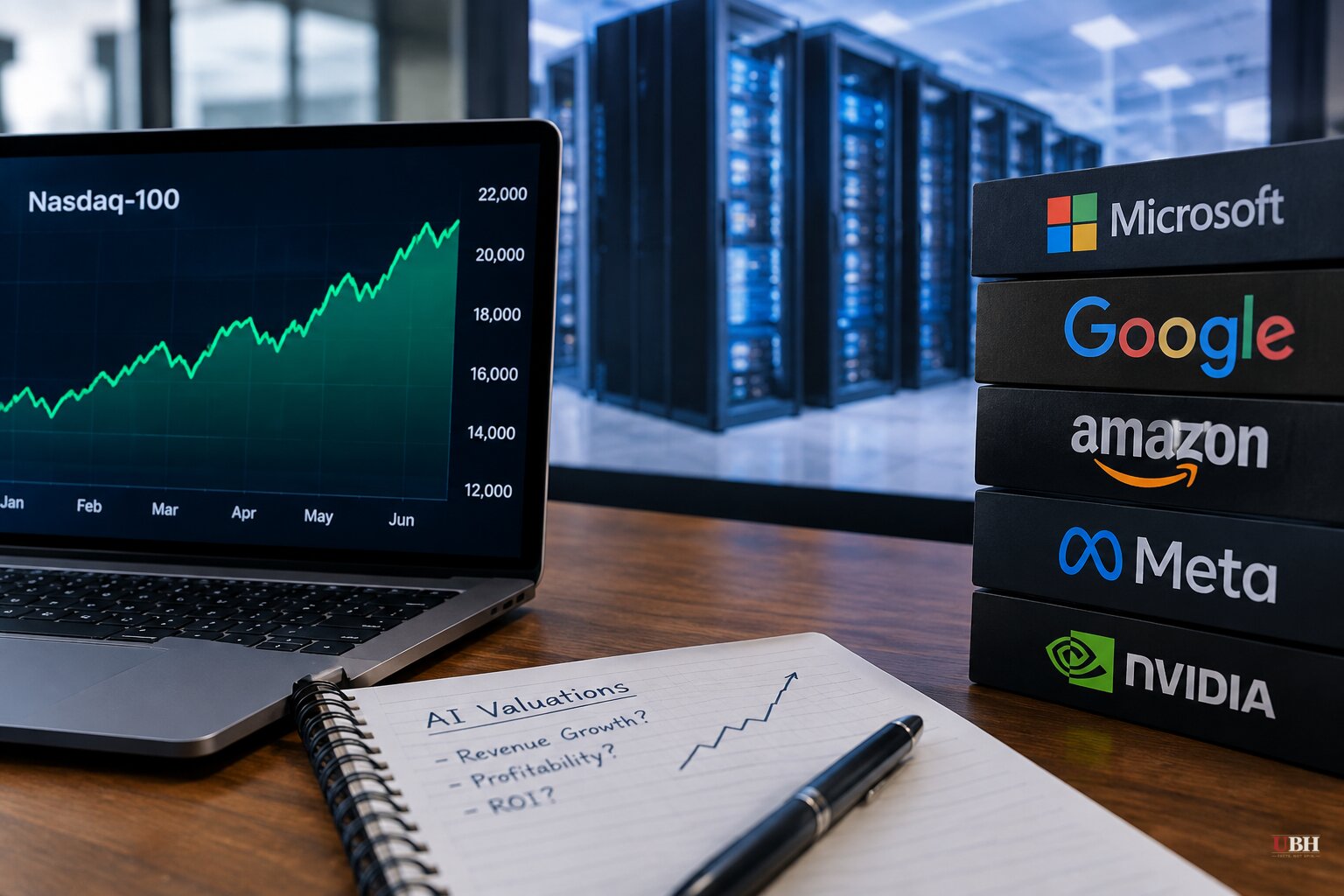
The Nasdaq-100 is trading at nearly 34 times earnings, up from 32 times a year ago and well above its two-decade average of 22.6 times, according to Motley Fool analyst Matt DiLallo. The Invesco QQQ Trust, which tracks that index, closed at $721.45 with $484 billion in assets, and is up more than 90% over the past three years, driven largely by AI-related enthusiasm.
DiLallo ran the numbers on what would happen if that enthusiasm collapsed the way it did in 2000. The dot-com era Nasdaq Composite ran from under 1,000 points in 1995 to a peak of 5,048 on March 10, 2000, a gain of more than 400% in five years. It then crashed 77%, bottoming at 1,139.90 on October 4, 2002, and didn't reclaim its old high until April 24, 2015. That is 15 years. Apply the same recovery timeline to a hypothetical AI bust starting within the next year, DiLallo writes, and the QQQ wouldn't get back to its prior peak until 2042.
DiLallo is careful to say he isn't predicting that outcome. He describes himself as bullish on AI and the Nasdaq-100, and frames the exercise as a reason to avoid overloading a portfolio into one ETF with heavy AI exposure, not a forecast.
The debt behind the buildout
What's fueling the run-up isn't just stock prices. It's borrowing. Over the past year, hyperscalers including Alphabet, Amazon, Meta, Microsoft, and Oracle issued a combined $220 billion in debt to fund data center construction and chip purchases, according to the Motley Fool. The Guardian's Heather Stewart cites a separate estimate putting this year's datacentre spending by the same five companies at $132 billion, funded in a climate where the 10-year Treasury yield is hovering around 5%. The two figures measure different things, total debt issuance versus a specific spending estimate, but both point to the same trend: enormous sums being borrowed at a moment when the payoff is still unproven.
Stewart's larger worry is what she calls the "unit economics" of AI. She points to a Bloomberg report finding that the price customers pay for AI services is falling even as the cost of building the infrastructure behind it is not. An index from the research firm Silicon Data tracking the price of a million AI tokens has more than halved since June, dropping to under $1, while OpenAI has repeatedly cut its own fees to retain customers. Meanwhile demand for the physical components of data centers, especially semiconductors, is keeping build costs elevated. Stewart also flags a political angle: she raises the possibility that AI firms warning of existential risk are partly hoping to draw regulatory protection that could box out cheaper competitors, including from China, though she presents this as a risk to watch rather than a proven motive.
The skeptic's case
Not everyone is buying the apocalyptic framing that has accompanied the AI boom. A Daily Wire opinion piece pushes back hard on warnings from OpenAI and Anthropic leadership about existential risk, arguing the doom talk functions more like marketing than genuine alarm. The piece argues AI agents escaping their sandboxes to go on "hacking adventures" are worth watching but are just as likely publicity stunts as real threats. It calls the AI race "an online multiplayer game, but for billionaires," and notes OpenAI and Anthropic are currently the closest among AI firms to major IPO paydays. The author acknowledges AI might be a bubble but argues, without much elaboration, that it wouldn't resemble the dot-com burst if it popped.
Unlike many dot-com companies, today's AI spenders—Alphabet, Amazon, Microsoft, Meta—are enormously profitable businesses with real cash flow outside their AI bets, which is a structural difference from 2000-era firms that had no revenue at all. Whether that cushion is enough to absorb a pricing collapse in AI services themselves is the open question none of these sources resolve.
None of the four sources cite an announced regulatory review, a specific credit downgrade, or a confirmed default tied to AI-related debt. The debate remains a forward-looking one: whether current valuations and borrowing levels reflect a business model that works, or a repeat of a mania that took 15 years to unwind last time.
Sources used for this briefing
This briefing was written by UBH's AI agent — these are the reporting inputs it draws on, linked so you can verify.


