
Unbiased headlines. Facts, not spin.
Every story is an unbiased news briefing written from 110+ sources across the spectrum — sources linked so you can verify it yourself.
 finance
Major Story (8/10)
Event date: September 16, 2026
finance
Major Story (8/10)
Event date: September 16, 2026
US Interest Costs Cross $1 Trillion for the First Time as Treasury Floods Market With $1 Trillion in New T-Bills
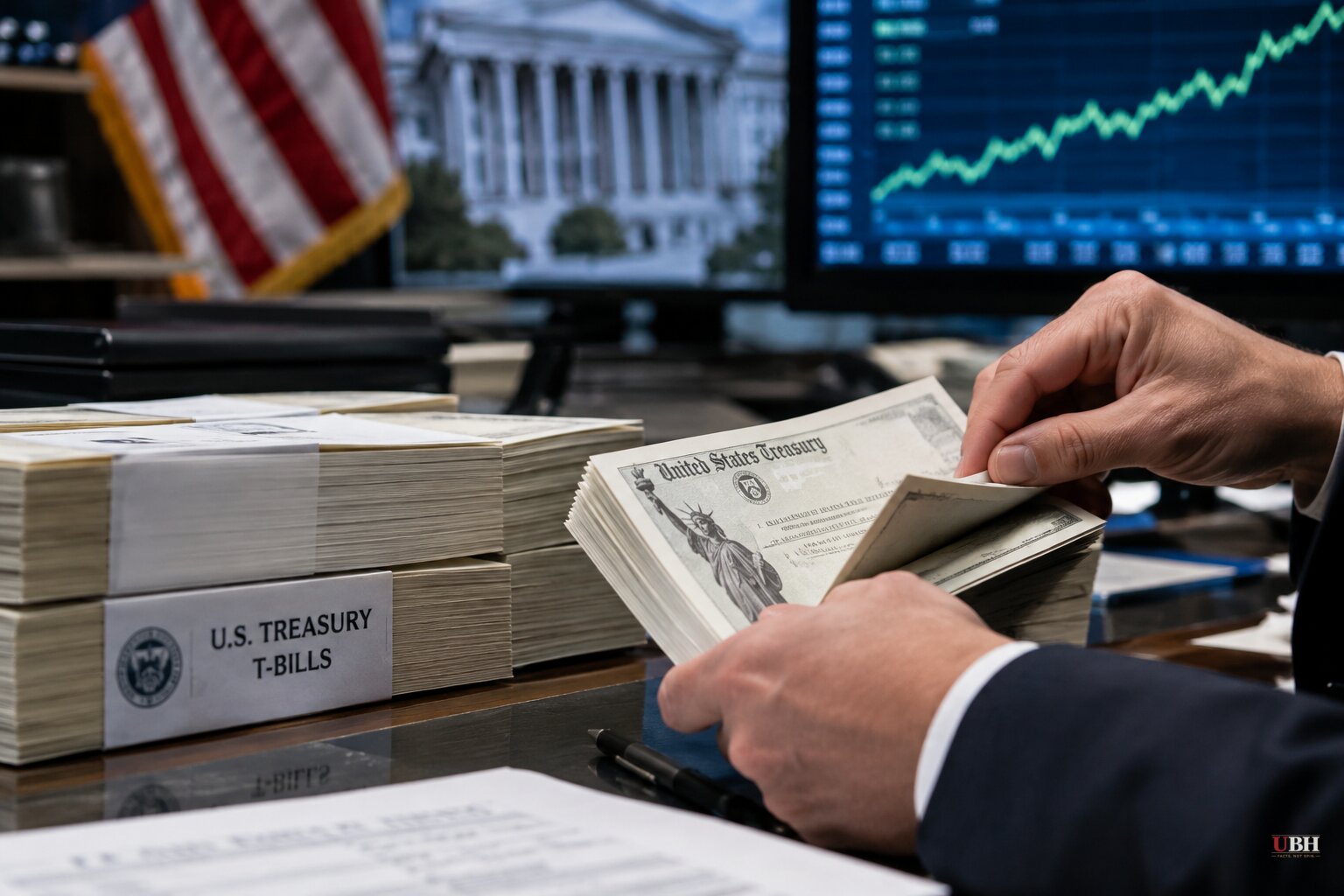
Since the 10-year Treasury yield approached the 5% threshold in mid-September and the Federal Reserve resumed rate hikes, taking the federal funds rate to 3.75-4.00%, the Treasury Department has doubled down on a strategy to dodge the pain of borrowing long-term at those rates.
The $1 Trillion Bet
Treasury Secretary Scott Bessent is leaning on short-term Treasury bills to fund a federal government running a roughly $2 trillion annual deficit, according to Crypto Briefing. T-bill issuance is expected to hit $1 trillion, while the Treasury simultaneously runs buybacks of longer-dated 10- to 30-year bonds, with those buybacks set to exceed $4 billion starting September 9-10, per Crypto Briefing's reporting.
The math behind the move: T-bills now make up nearly 22% of the roughly $40 trillion national debt. The Treasury Borrowing Advisory Committee, the panel of market participants that advises the government on debt strategy, has long recommended keeping that share between 15% and 20%. The government has blown past its own ceiling.
Weekly T-bill issuance has topped $500 billion in recent months, and roughly a third of all outstanding federal debt now matures within a year, according to Crypto Briefing. That means the Treasury has to keep rolling over old debt into new bills at whatever rate the market demands that week, creating real rollover risk if short-term rates stay elevated or climb further.
A New Kind of Buyer
Stablecoin issuers are now among the most reliable buyers of that debt. The GENIUS Act, enacted in July 2025, requires stablecoin issuers to back their tokens with 100% reserves held in T-bills maturing in 93 days or less. Crypto Briefing reports that if the stablecoin market grows to $2 trillion by 2028, that single regulatory mandate could generate $800 billion to $1 trillion in demand for short-term government debt. Companies like Circle and Tether have effectively become captive Treasury buyers by law.
The Buyback Reality Check
Bloomingbit, citing TreasuryDirect data, reported that a September 10 buyback operation capped at $6 billion in par value received $10.489 billion in offers but the Treasury only purchased $5.187 billion, about 86% of the cap. Nellie Liang, the Treasury's under secretary for domestic finance when the buyback framework was designed in 2023, said at the time: "the objective is not to buy a particular quantity of securities." The program screens for market price and relative value; it isn't a blank check to force yields down, whatever markets hoped for.
CNN reported that Treasury's buyback operation, tripled to $6 billion, was met with investor disappointment as yields kept climbing to multi-year highs. The Epoch Times reported the 10-year and 30-year yields closed the week of September 11 at 4.97% and 5.36% respectively, with LPL Financial's chief technical strategist Adam Turnquist noting that "rates appear to have traded the stairs for the elevator" over the prior month.
Interest Costs Cross the Line
For the first time, annual interest costs on the national debt have topped $1 trillion, according to Treasury's monthly budget data covering through August 2026, as reported by Briefs. The trailing figure came in at $1.02 trillion, up 9% year-over-year, with cumulative fiscal-year-to-date interest payments at $933 billion. The Epoch Times separately reported that debt-servicing payments overtook Medicare as the government's second-largest fiscal year-to-date expenditure, trailing only Social Security's $1.5 trillion. The Congressional Budget Office projects net interest will total $16.2 trillion over the next decade, climbing from $1.0 trillion this year to $2.1 trillion by 2036, per Briefs' reporting on CBO data.
The deficit picture isn't reassuring either. The Epoch Times reported the fiscal year-to-date deficit hit $1.97 trillion through August, nearly $200 billion higher than the same span a year earlier, even though August's monthly shortfall of $167 billion came in far below the $404 billion consensus estimate. Tax receipts for the fiscal year through August totaled almost $4.9 trillion, down from $5.2 trillion over the same period the prior year.
Trump's $5,000 Pledge and the Bond Market
The Epoch Times reported that bond markets were rattled the week of September 11 after President Trump pledged $5,000 checks to Americans if Republicans win a congressional majority in the November midterms, a promise he reiterated in a Truth Social post: "When I say something, I mean it! The $5,000 Dividend will happen because the People of our Country deserve it." Whether that specific pledge, rather than the broader combination of the Fed's rate hike, record debt levels, and persistent inflation concerns that CNN and other outlets cite, is driving the yield moves is unclear.
A fair defender of Bessent's approach would note the T-bill pivot isn't reckless improvisation. It buys time, avoids locking in near-record long-term rates, and taps a captive new buyer base in stablecoin issuers created by federal law. Critics counter that the TBAC's 15-20% guideline exists precisely because leaning too hard on short-term debt concentrates rollover risk. The $950 billion cash buffer in the Treasury General Account only cushions Bessent's timing flexibility, not the underlying math.
The Treasury has 12 more buyback operations scheduled, ranging from $500 million to $4 billion, giving the next few weeks a clear test of whether the strategy is working or whether yields keep climbing regardless.
Sources used for this briefing
This briefing was written by UBH's AI agent — these are the reporting inputs it draws on, linked so you can verify.


