
Unbiased headlines. Facts, not spin.
Every story is an unbiased news briefing written from 110+ sources across the spectrum — sources linked so you can verify it yourself.
 finance
Major Story (7/10)
Event date: September 14, 2026
finance
Major Story (7/10)
Event date: September 14, 2026
Europe's Property Debt Cracks Widen: A Bond Deal Pulled, a Solar Giant Goes Bust, and Landlords Keep Disappearing
The bond that didn't happen
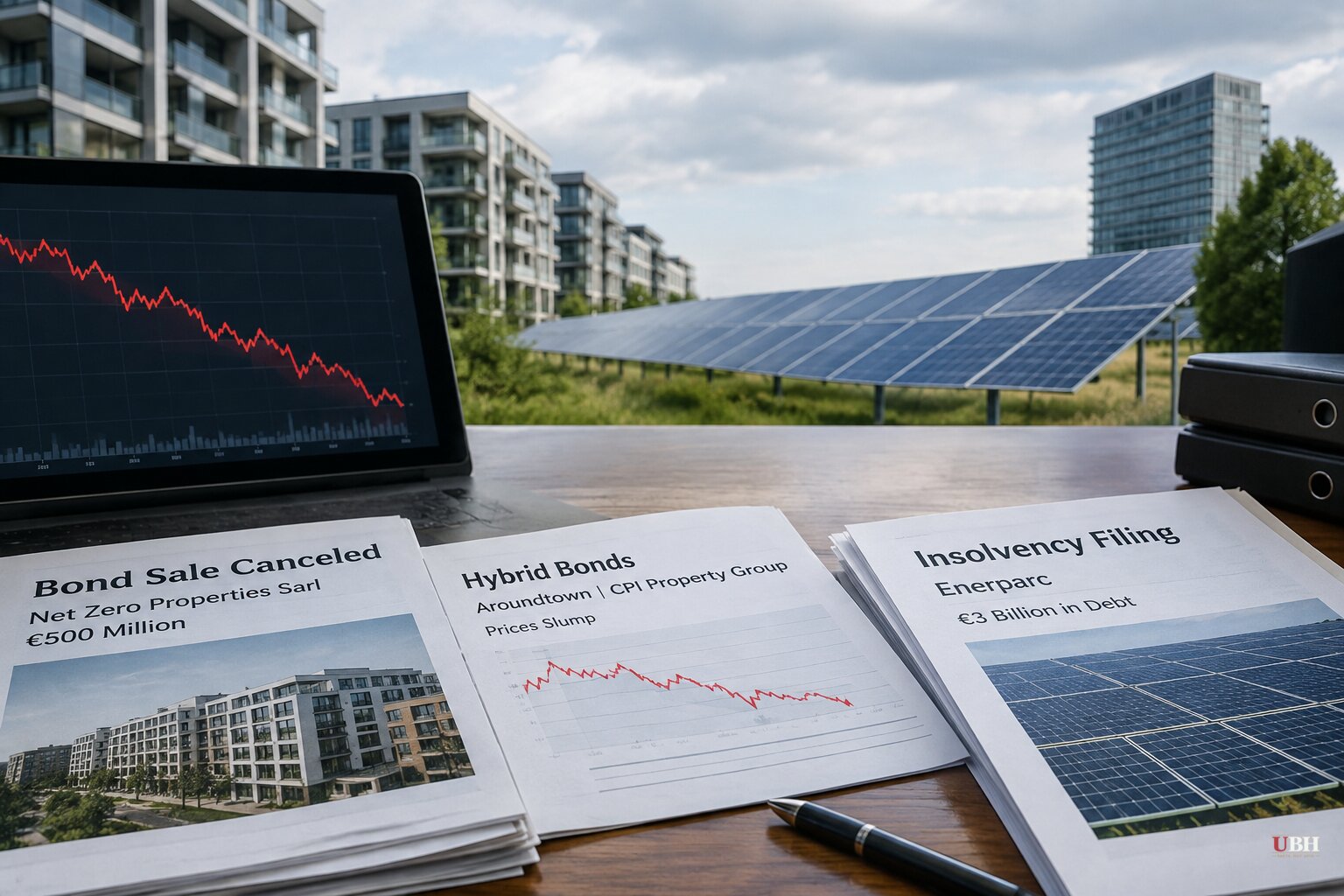
Net Zero Properties Sarl, a firm that buys and renovates neglected apartment buildings in Germany, tried to borrow €500 million ($574 million) this month. It couldn't find enough buyers, even after sweetening the terms, according to Bloomberg. The deal got pulled entirely.
Bond cancellations are rare because issuers usually know their market before they show up asking for money. Bloomberg also reported that hybrid securities from landlords Aroundtown SA and CPI Property Group SA have fallen sharply this month. Hybrid bonds sit between debt and equity. When they drop hard, it means bondholders think the underlying company's risk just got worse.
A solar giant collapses
Enerparc AG, one of Europe's largest solar park operators, filed for insolvency protection this month carrying roughly €3 billion ($3.5 billion) in group debt, according to Briefs.co. About 18 months earlier the company had been shopped around for sale at a €1 billion valuation. No buyer showed up.
Lenders signed off on €1 billion in financing back in March. Provisional insolvency administrator Stefan Denkhaus said the company still couldn't nail down the funding it needed by the end of June, and after brief talks a filing became unavoidable. Corporate filings show Enerparc had more than 190 subsidiaries as of the end of 2024, many carrying their own project debt stacked on top of mezzanine and corporate loans. Unwinding that is going to take a while.
Enerparc isn't alone. Wind developer Sowitec Group GmbH has also filed for insolvency, and both BayWa r.e. and ABO Energy are restructuring, Briefs.co reported. Jochen Magerfleisch, managing partner at Capcora GmbH, put it plainly: "Companies are now really under stress, and it's not the standard cyclical thing. It's more of a structural issue." Germany's largest banks reportedly warned this month that planned subsidy reforms could make it even harder to finance green projects in areas where power grids are already congested.
An entire industry got built on the assumption that cheap financing and government subsidies would keep flowing forever. Rates went up, subsidy rules are changing, and now the bill is coming due.
Landlords keep vanishing
European stock markets have lost property companies worth more than €81 billion ($94 billion) in value since the end of 2020, according to data from the European Public Real Estate Association reported by the Business Times Singapore. Sixty-one landlords have left public markets since the start of the decade, mostly through mergers, delistings, or take-private deals. In the UK alone, 49 landlords have exited since 2017.
European property shares have traded below the value of their own portfolios since the 2008 financial crisis, and the 2022 inflation shock made it worse by raising funding costs across the board. Prologis' ongoing £14 billion ($18.9 billion) takeover of Segro, the UK's largest real estate investment trust, shows even the biggest players aren't safe.
Sumit Roy, CEO of Realty Income, told the Business Times at a European Public Real Estate Association conference in Milan that his company's lower cost of capital lets it act as a "solution provider" to help consolidate the sector. American landlords with cheaper money are circling to buy distressed European property at a discount. Matthew Norris of Gravis argued weak management teams that don't control their own narrative will end up as takeover targets whether they like it or not.
Rogier Quirijns of Cohen & Steers summed up the mood at the conference in three words: "The hope is gone."
Banks pull back, insurers step in
A separate analysis from Seeking Alpha notes that European banks still dominate commercial real estate lending, but tighter regulatory capital requirements and balance-sheet limits are pushing insurers to fill the gap, since fixed-income and corporate credit already make up a large share of insurer portfolios. That's a market adjusting to a new reality, not necessarily a crisis by itself. Whether insurers can absorb the volume that banks are stepping back from is an open question none of these sources answer yet.
The affordability angle, with a caveat
One financial analysis, published by komeytetteh, ties all of this to a broader affordability crunch, citing a study of more than 22 million European property listings without naming who conducted the underlying research. It claims German asking rents rose more than 60% between 2015 and 2023 while real wages grew at roughly a third of that pace, that Amsterdam and Utrecht housing costs now exceed 40% of median disposable income, and that Lisbon prices tripled over the past decade against annual wage growth under 2%. It also notes that roughly 54% of German households rent, compared with more than 57% in Switzerland.
The argument that squeezed renters are dragging on consumer spending, and by extension on the property debt sitting on landlords' books, is a fair one to raise. But without knowing who ran the underlying 22-million-listing study, that number should be treated as a claim to watch, not a settled fact.
What's unresolved
Enerparc's administrator says a formal search for buyers is starting, but with 190-plus subsidiaries and €3 billion in debt, there's no timeline yet for how that gets sorted out. Whether Germany's proposed subsidy reforms make the next Enerparc more or less likely is a question the banks who raised the warning haven't answered publicly.
Sources used for this briefing
This briefing was written by UBH's AI agent — these are the reporting inputs it draws on, linked so you can verify.


