
Unbiased headlines. Facts, not spin.
Every story is an unbiased news briefing written from 110+ sources across the spectrum — sources linked so you can verify it yourself.
 finance
Major Story (7/10)
Event date: September 17, 2026
finance
Major Story (7/10)
Event date: September 17, 2026
House Passes Bill Requiring Big Tech to Prove It Can Cover Its Own AI Power Costs, as New Reports Detail How Much Debt It's Hiding
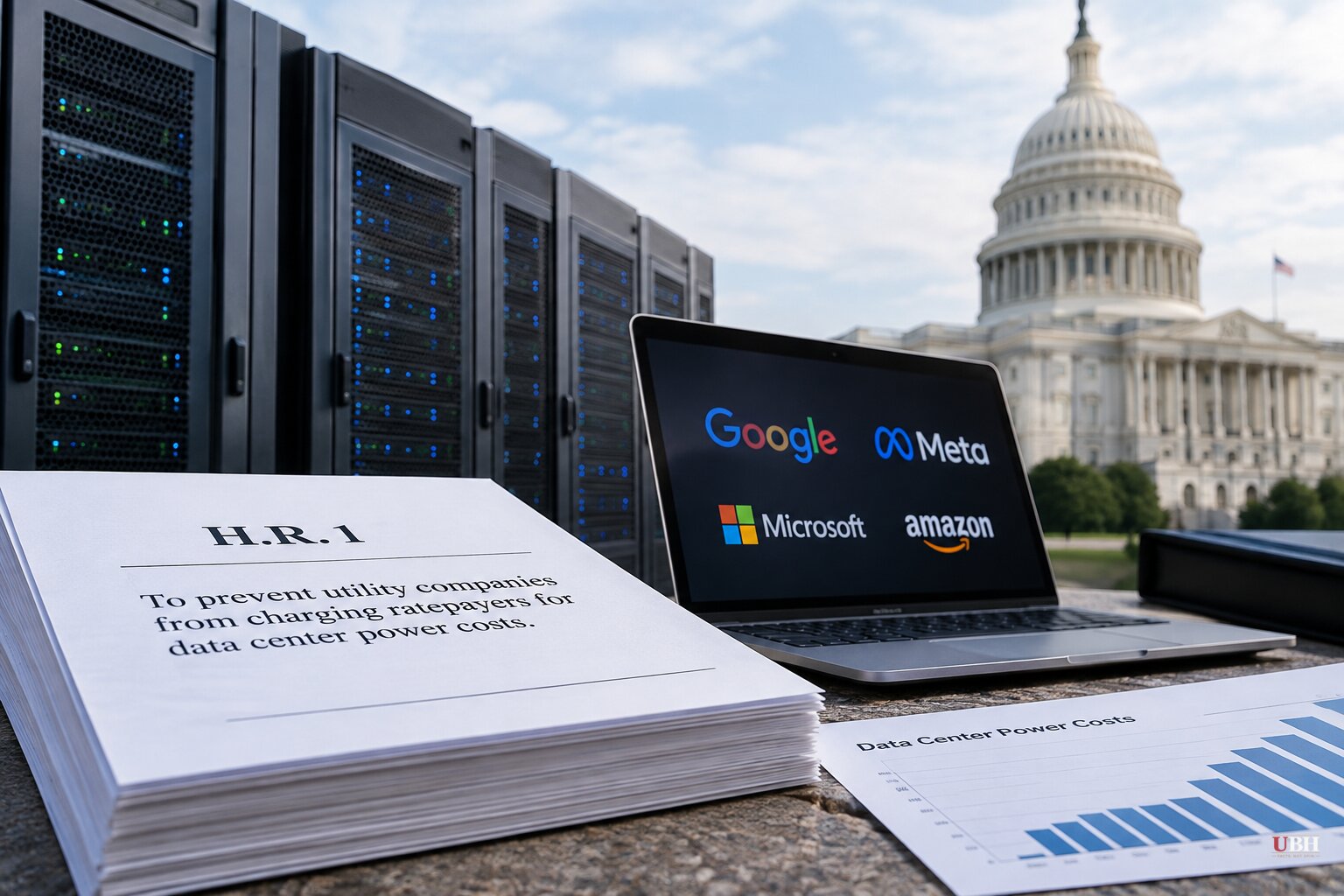
This past Wednesday, the House passed the Ratepayer Protection Act 417-3, a bill designed to stop electric utilities from sticking ordinary customers with the bill for AI data centers.
What the Bill Actually Does
Rep. Gabe Evans, a Colorado Republican who sponsored the bill, told the Daily Signal it does two concrete things. It directs data center operators not to shift their power costs onto other ratepayers, and it requires state utility regulators to make companies prove they're financially stable enough to finish what they start, so nobody gets left holding the bag on a half-built facility.
Evans framed it as bigger than a cost issue. "It's a national security bill, it's a consumer protection bill and it's a cost-saving bill," he said, arguing that if AI infrastructure doesn't get built in the U.S., the data will end up processed in China instead. Whether the bill's near-unanimous bipartisan support translates into real rate relief now depends on state public utility commissions actually adopting the federal guardrails, since the bill directs them to consider the standards rather than mandating them outright.
The Debt the Bill Doesn't Touch
Around the same time Congress was voting on power bills, reporting emerged documenting how the same companies are financing that power buildout in ways that barely show up on their books. Alphabet's guarantee to cover lease payments if AI cloud provider Fluidstack defaults jumped from $16.9 billion to $43.8 billion in six months, according to the Financial Times. Fluidstack builds data centers stocked with Google's chips and rents the capacity to Anthropic. Because the arrangement is booked as a credit derivative rather than a loan, Alphabet reports only its estimated probable loss, $815 million, against that $43.8 billion maximum exposure. Another $24.1 billion in guarantees is already committed and awaiting final terms.
A separate Wall Street Journal analysis, cited in a Startup Fortune report, found nine major tech and chip companies, including Alphabet, Amazon, Meta, Microsoft, Oracle, Nvidia, Broadcom, SpaceX and AMD, are carrying close to $3 trillion in AI-related commitments that don't show up as debt on their balance sheets, nearly five times their combined capital spending over the past year.
Meta's Louisiana project drew separate scrutiny. According to the Startup Fortune report, Meta restructured its $50 billion Richland Parish data center through a Delaware holding company registered the same day state regulators approved gas plants to power the facility, leaving Meta with just 20% of the venture while Blue Owl Capital took 80%. The report says that arrangement was never disclosed to Louisiana regulators. No investigation into the deal has been announced, and Meta has not issued a public response to the specific claim. Bloomberg Tax has compared these financing structures to the special-purpose vehicles that preceded Enron's collapse, per the Startup Fortune report.
Amodei, Altman and Musk Say Slow Down. Trump Calls It a Hoax.
The financial questions arrived alongside a separate fight over AI safety. Anthropic CEO Dario Amodei published an essay calling on the industry to "pace" its capability gains rather than halt them outright, proposing that leading AI companies give third-party evaluators employee-level access to verify safety practices. Sam Altman and Elon Musk both signaled agreement, according to Breitbart. Anthropic researcher Jacob Coxon resigned around the same time, saying he quit because he believes Anthropic and OpenAI "are gambling with our lives."
President Trump dismissed the industry's safety warnings, calling them a hoax, according to Fox News. Anthropic co-founder Jack Clark pushed back on that framing in an interview with Fox News' Bret Baier, arguing that safety standards would protect, not undermine, America's AI lead over China. "How you keep being ahead is you make sure that you don't roll the dice on public safety," Clark said, rejecting any suggestion his position was tied to Anthropic's widely anticipated IPO, which has not been given a debut date.
Not everyone in the industry agrees regulation is the answer. Boom Supersonic CEO Blake Scholl told Fox News that companies, not the government, should bear responsibility for what they ship. Existing law already covers deliberate misuse, he argued, and a model maker should only be liable when its system "goes off and does bad on its own." Scholl's concern, shared by others wary of slowing the AI race against China, is that a heavy-handed federal "duty of care" standard, which Senate negotiators are reportedly considering, could hamper U.S. competitiveness without meaningfully reducing risk. Whether that Senate legislation advances, and whether any regulator examines the accounting behind the $43.8 billion in guarantees documented by the Financial Times, remain open questions.
Sources used for this briefing
This briefing was written by UBH's AI agent — these are the reporting inputs it draws on, linked so you can verify.


