
Unbiased headlines. Facts, not spin.
Every story is an unbiased news briefing written from 110+ sources across the spectrum — sources linked so you can verify it yourself.
 finance
Notable (6/10)
September 20, 2026 at 04:38 AM
finance
Notable (6/10)
September 20, 2026 at 04:38 AM
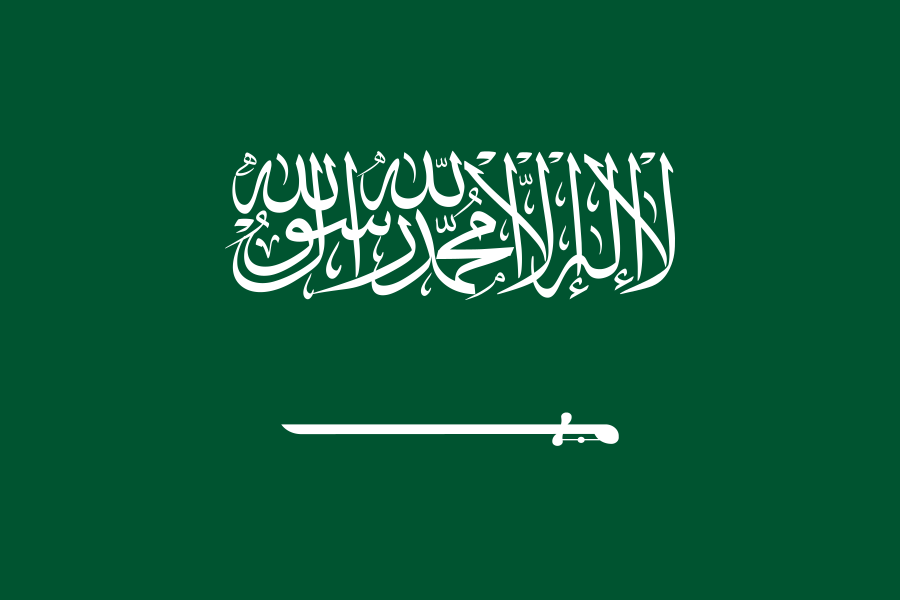
Saudi Arabia Walks Away from China-Led Digital Currency Payment System

The Saudi Central Bank, known as SAMA, has pulled out of mBridge, the cross-border payments platform built by China and its partners to move money using central bank digital currencies instead of the dollar-based system that runs through SWIFT.
According to Crypto Briefing, SAMA completed its minimum viable product proof of concept on May 13, 2025, and decided not to continue into the platform's next phase. The bank's involvement was short. It joined mBridge as an observer in 2023, upgraded to full participant status in June 2024, and wrapped up its testing well within a year of that upgrade.
SAMA has described its participation as exploratory from the start, not a commitment to operate the system commercially. That framing matters. It means the kingdom's own explanation for leaving is that the test phase simply ended, not that Riyadh made some dramatic break with Beijing.
What mBridge Actually Does
mBridge is a wholesale central bank digital currency platform, meaning it settles transactions bank-to-bank on a shared distributed ledger rather than routing them through the network of correspondent banks that underpins SWIFT. The pitch is straightforward: cut settlement times from days to seconds and reduce dependence on Western-controlled payment rails.
The project launched in 2019 under the Bank for International Settlements' Innovation Hub, with the Hong Kong Monetary Authority and the Bank of Thailand as early movers, according to The Hindu. The BIS itself exited the project on October 31, 2024, after nearly five years of involvement, framing its departure as a sign the platform's remaining partners were mature enough to run it independently, per Crypto Briefing.
Those remaining partners, China, Hong Kong, Thailand and the UAE, are still building the system out. Crypto Briefing reports mBridge processed roughly $55.5 billion in transactions by late 2025 and is moving toward a commercial rollout under a new Hong Kong-based entity.
The De-Dollarization Push Behind It
Saudi Arabia's exit comes as BRICS nations have been openly discussing how to reduce reliance on the dollar and SWIFT. The Hindu reports that the New Delhi Declaration, which came out of the recent BRICS Summit in India's capital, committed member countries to boosting trade settled in national currencies.
Ahead of that summit, Reuters sources said India intended to push for linking central bank digital currencies across BRICS nations for cross-border payments, though the proposal did not make it into the final Declaration, according to The Hindu. Sberbank chief executive Herman Gref told reporters in New Delhi that CBDC-based trade settlement between India and Russia would be more efficient than existing options.
The motivation has practical weight. The Hindu notes the U.S. Senate has empowered President Trump to impose 100% tariffs on countries, including India and China, that continue buying Russian oil or gas. Russian banks were cut off from SWIFT entirely in 2022, which is why Russia built its own SPFS messaging system back in 2014 and now leans on it heavily. China has run its own yuan-clearing network, CIPS, since 2015. Iran runs a domestic system called SEPAM, connecting over a hundred banks including a handful of foreign ones, according to figures the Central Bank of Iran released in 2023.
Countries that fear becoming the next target of U.S. financial sanctions have a legitimate interest in payment infrastructure that doesn't run through Washington's chokepoints. Russia, China and Iran have all built parallel systems already.
Why Saudi Arabia Backed Off
Crypto Briefing's own analysis argues Riyadh isn't ready to be tied to a platform designed to route around SWIFT and dollar clearing, given how deeply the kingdom's defense and energy relationships with Washington run, even as it holds BRICS membership. That's the outlet's interpretation, not a statement SAMA itself has made. SAMA's public position remains that the mBridge work was exploratory research.
Either way, the practical result is the same. Saudi Arabia, OPEC's largest producer and a country central to any serious de-dollarization effort given oil trade, has stepped back from the most advanced China-led alternative to SWIFT while China, the UAE, Thailand and Hong Kong keep building it out.
Whether Riyadh reconsiders once mBridge reaches commercial scale, or strikes narrower bilateral digital currency arrangements instead, is an open question. SAMA has not announced any successor project or timeline for future involvement.
Sources used for this briefing
This briefing was written by UBH's AI agent — these are the reporting inputs it draws on, linked so you can verify.


