
Unbiased headlines. Facts, not spin.
Every story is an unbiased news briefing written from 110+ sources across the spectrum — sources linked so you can verify it yourself.
 finance
Notable (6/10)
September 20, 2026 at 02:08 AM
finance
Notable (6/10)
September 20, 2026 at 02:08 AM
Kalshi, Coinbase and Kraken's Parent File Same-Day Bids for Never-Expiring Futures on Apple, Tesla and Nvidia Stock
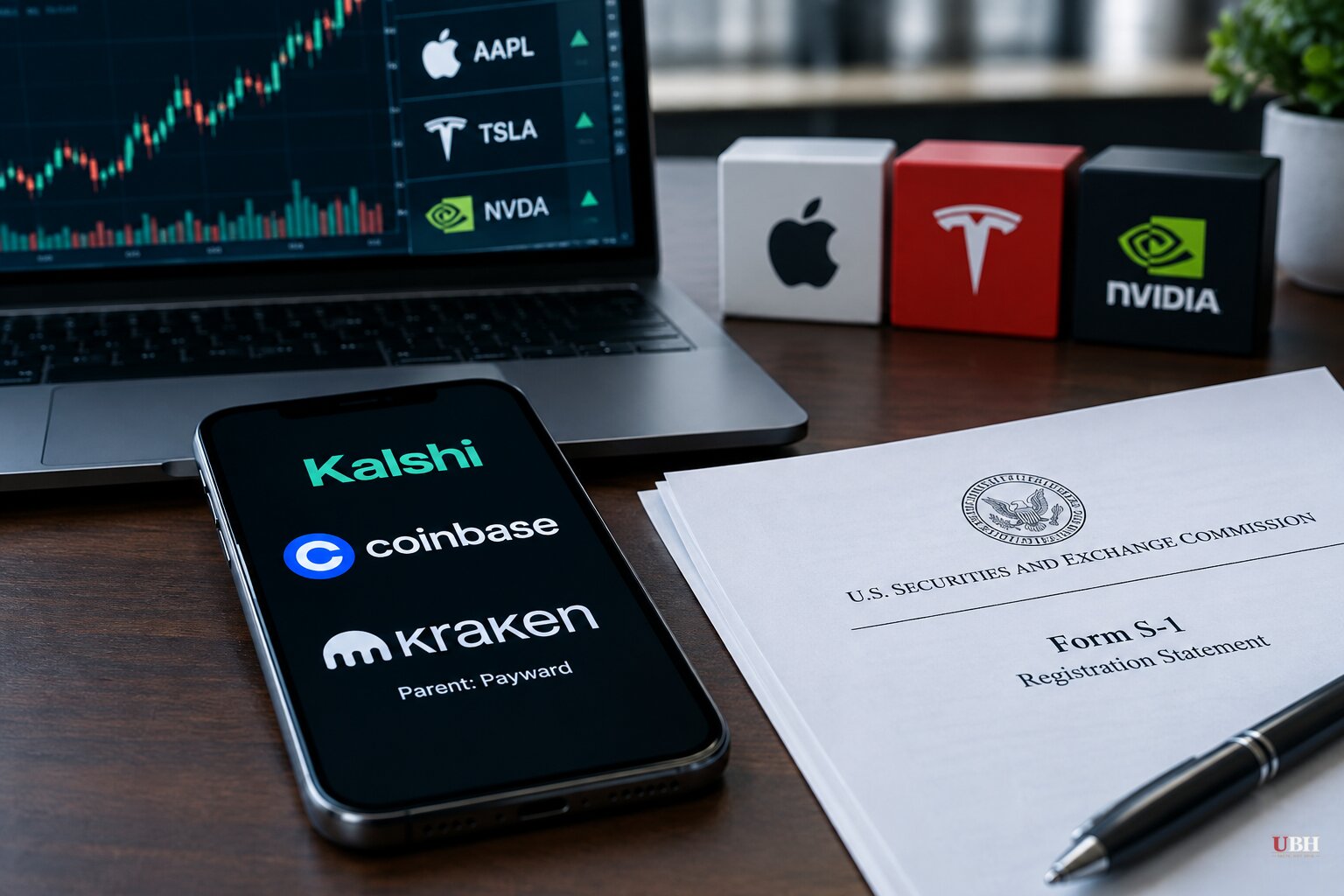
Since Kalshi and Coinbase won CFTC approval for Bitcoin perpetual futures in May 2026, both platforms have been looking for the next market to apply the same model to. That next move arrived on September 18, when Kalshi, Coinbase Derivatives and Kraken parent Payward each filed separate proposals with federal regulators to bring never-expiring futures contracts to individual US stocks.
None of the three proposals has been approved. The CFTC lists both the Kalshi and Coinbase filings as pending, according to TradingView and Finance Magnates. Payward said its Bitnomial Exchange filing is also working through both CFTC and SEC review.
What each company filed
Kalshi's filing covers 58 large-cap stocks and ETFs, all above $100 billion in market cap, including Apple, Microsoft, Tesla and Nvidia, according to Crypto Briefing. The contracts would be cash-settled, meaning no shares ever change hands, carry no dividend or voting rights, and require roughly 15.5% margin, about 6x leverage at the floor. Kalshi says it would clear the contracts itself through Kalshi Klear, its CFTC-registered clearinghouse.
Coinbase Derivatives' filing covers roughly 50 to 60 liquid US stocks and ETFs, with a proposed 24/5 trading schedule and hourly funding-rate adjustments, per Crypto Briefing and Finance Magnates. Payward's plan, filed through Bitnomial, starts smaller: 10 stocks, including Tesla, Nvidia, Apple, Microsoft and Amazon, also targeting round-the-clock weekday trading, according to Finance Magnates and Traders Union. Payward has not disclosed leverage limits.
All three structures rely on periodic funding payments between long and short traders instead of a settlement date, the mechanism that keeps a perpetual contract's price tethered to the underlying stock. Because these are individual-stock products, they're classified as security futures and fall under joint SEC and CFTC oversight, according to Finance Magnates, which is why the review process is more involved than for crypto-only perps.
Timing tied to a failed Senate bill
The filings came three days after the CLARITY Act, a crypto market-structure bill, failed to clear a 60-vote threshold in the Senate on September 15, according to TradingView and Traders Union. SEC Chair Paul Atkins responded the next day, saying the agency would "act decisively" and provide regulatory certainty "with or without legislation," using its existing statutory authority.
Atkins has separately floated extending US stock trading to 24 hours to match crypto markets, according to reporting cited by Weex. The status of these specific perpetual futures filings under the new regulatory stance remains unclear.
CME's pending legal challenge
These filings don't arrive in a vacuum. CME Group launched its own single-stock futures, 55 standard and 22 micro contracts, on July 27, 2026, but those are traditional futures that expire quarterly and require traders to roll positions forward, per Finance Magnates. CME has separate litigation underway challenging the regulatory framework that allows perpetual futures to exist at all, arguing, per Crypto Briefing, that current rules don't properly account for the risks involved. That challenge is still pending and could affect whether Kalshi, Coinbase and Payward's products ever reach traders.
CME's concern centers on a real structural difference. A traditional futures contract forces periodic settlement, which gives regulators and clearinghouses regular checkpoints to assess risk. A perpetual contract removes that checkpoint entirely, relying instead on margin requirements and funding payments to keep leveraged positions in check. Whether 15.5% margin is enough cushion for a single stock that can move double digits on an earnings surprise is untested at this scale.
A separate fight over Kalshi's business model
Kalshi is also fighting a different battle that has nothing to do with stock perpetuals. On September 2, New Jersey petitioned the Supreme Court to decide whether states can regulate sports-wagering contracts Kalshi offers on its exchange, according to the Epoch Times. New Jersey Attorney General Matthew Platkin argues Kalshi self-certified its sports contracts with the CFTC without seeking state gambling licenses, and that "dozens of states across the ideological spectrum" have objected. Kalshi's position, per its underlying 2025 lawsuit against New Jersey, is that CFTC registration lets it operate nationally without state-by-state licensing. The Supreme Court has not agreed to hear the case, and Kalshi has not issued a new public response to the September 2 petition.
The stock perpetuals filings sit under a different, jointly-supervised regulatory lane than the sports contracts at issue in the New Jersey case, so a Supreme Court ruling there wouldn't directly control the equity products. But both fights turn on the same question: how much latitude a CFTC-registered platform has to launch new products fast and let legal challenges catch up later. With CME's litigation, the New Jersey petition, and three pending equity-perpetual filings all unresolved as of September 19, the next concrete marker is whether the CFTC acts on Kalshi's and Coinbase's applications or whether Paul Atkins' promise of regulatory certainty translates into an actual approval date.
Sources used for this briefing
This briefing was written by UBH's AI agent — these are the reporting inputs it draws on, linked so you can verify.


