
Unbiased headlines. Facts, not spin.
Every story is an unbiased news briefing written from 110+ sources across the spectrum — sources linked so you can verify it yourself.
 finance
Notable (6/10)
Event date: September 16, 2026
finance
Notable (6/10)
Event date: September 16, 2026
BofA Survey: Fund Managers Call Long Semiconductors the Most Crowded Trade, and AI Capex the Top Credit Risk
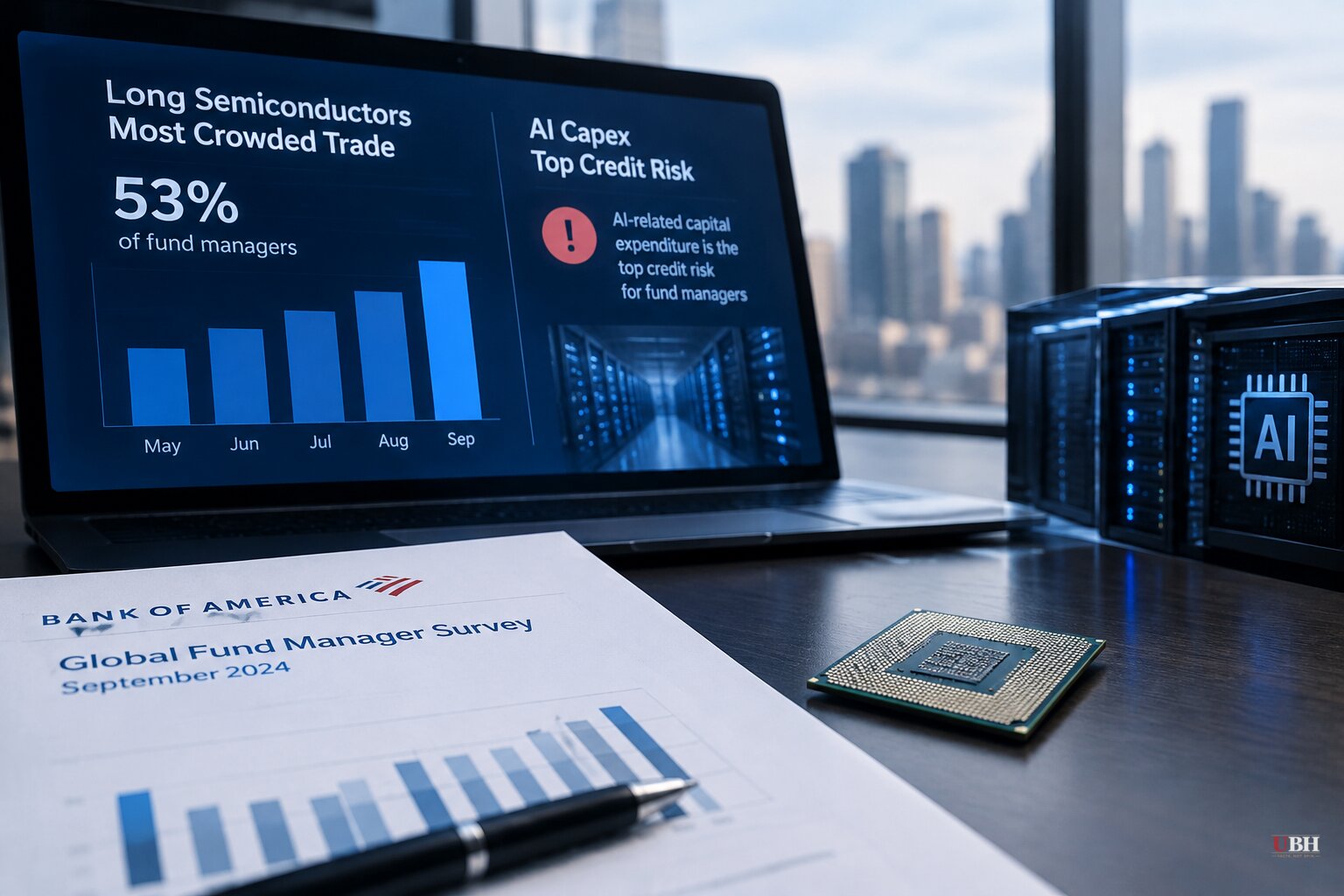
Bank of America surveyed 190 fund managers overseeing $512 billion in assets between September 4 and 10. The results show a market that has not stopped believing in AI, but has started hedging against it.
The crowded trade, cooling but not breaking
53% of respondents named going long global semiconductors the most crowded trade in the market, according to BofA's September Global Fund Manager Survey. That figure has now held the top spot for four consecutive months, unchanged from August.
But the trend line matters more than the snapshot. The reading was 25% in April, jumped to 73% in May, hit 80% in June, and peaked at 82% in July, according to data reported by Crypto Briefing. It has since fallen to 53% and stayed there. BofA analysts have described the resulting posture as "frozen bulls": managers who think valuations are stretched but are not willing to actually sell.
For comparison, "shorting government bonds" moved into second place for the first time at 18%, according to Chain Catcher. Long positioning in the Magnificent Seven, once the market's default consensus trade for 23 straight months from 2023 through 2025 and a 70% reading in June 2024, has fallen to just 7%.
The same money is now the top credit fear
In the same survey, 42% of managers named AI infrastructure spending the most likely source of a systemic credit event, up from 38% in August, according to Benzinga. Government debt ranked second at 25%, and private credit came in third at 19%.
BofA strategist Michael Hartnett wrote that "AI hyperscaler capex continues to be seen as the most likely source of a systemic credit event." A record net 33% of respondents said companies are overinvesting, per both Benzinga and NDTV Profit, the highest reading BofA has recorded on that question.
The numbers behind the worry are large. Amazon, Alphabet, Meta, Microsoft and Oracle are on track for roughly $700 billion in combined capital expenditures in 2026, and analysts at BofA and Evercore project that figure passes $1 trillion in 2027, according to Benzinga.
Oracle is the clearest example of the strain. The company reported $28.5 billion in capital spending in a single quarter and negative free cash flow of $5.4 billion, a gap partly covered by a $20 billion at-the-market equity sale. Full-year capex guidance sits at $90 billion to $95 billion, and Oracle's management gave no timeline for returning to positive free cash flow, per Benzinga's reporting.
Apollo chief economist Torsten Slok pointed to credit markets as further evidence: investors are paying more to insure against hyperscaler defaults through credit default swaps, even as the cost of protection on bank debt has stayed flat, Benzinga reported.
The case for staying long
The bull case is not baseless. Nvidia's data center revenue hit $89 billion in the second quarter of its fiscal 2027, up 117% from a year earlier, and the company forecast $108 billion in total revenue for the following quarter, according to Benzinga. A full 79% of survey respondents expect no AI infrastructure spender to announce a spending cut this year, up from 71% in August. For chip and equipment suppliers, that reads as a demand signal, not a bubble signal.
Managers surveyed by BofA are also broadly optimistic on the wider economy. A net 8% expect global growth to accelerate, and 55% now foresee a "no landing" scenario where growth simply does not slow, versus 38% expecting a soft landing and just 2% a hard landing, according to NDTV Profit. Expectations for double-digit earnings growth over the next 12 months are at their highest level since August 2021.
Strong current demand and rising fear about who eventually pays for it are both true at the same time. The same 42% who flag AI capex as the top credit risk are largely the same crowd still long semiconductors.
What actually shifted this month
The newest and biggest move in the survey was not about AI at all. "Disorderly rise in bond yields" became the top tail risk cited by 33% of managers, up from 27% in August, overtaking AI bubble fears, which had spiked from 28% in June to 45% in July before fading from the top spot, according to NDTV Profit and Crypto Briefing. Cash allocations rose to 3.9% from 3.5%, and BofA strategists said it would be safe to add risk once cash returns to a 4-5% neutral range. Only 16% of respondents believe Treasury Secretary Scott Bessent's bond-buyback program will meaningfully reduce yields.
BofA runs this survey monthly. The October edition will show whether the crowded-trade reading keeps drifting down from 53%, whether the 42% credit-event number keeps climbing, and whether Oracle's free cash flow trajectory has changed by the time it next reports.
Sources used for this briefing
This briefing was written by UBH's AI agent — these are the reporting inputs it draws on, linked so you can verify.


