
Unbiased headlines. Facts, not spin.
Every story is an unbiased news briefing written from 110+ sources across the spectrum — sources linked so you can verify it yourself.
 finance
Major Story (7/10)
Event date: September 16, 2026
finance
Major Story (7/10)
Event date: September 16, 2026
10-Year Treasury Yield Holds Near 5% for a Second Week as Debt Skeptics Turn Alarmists
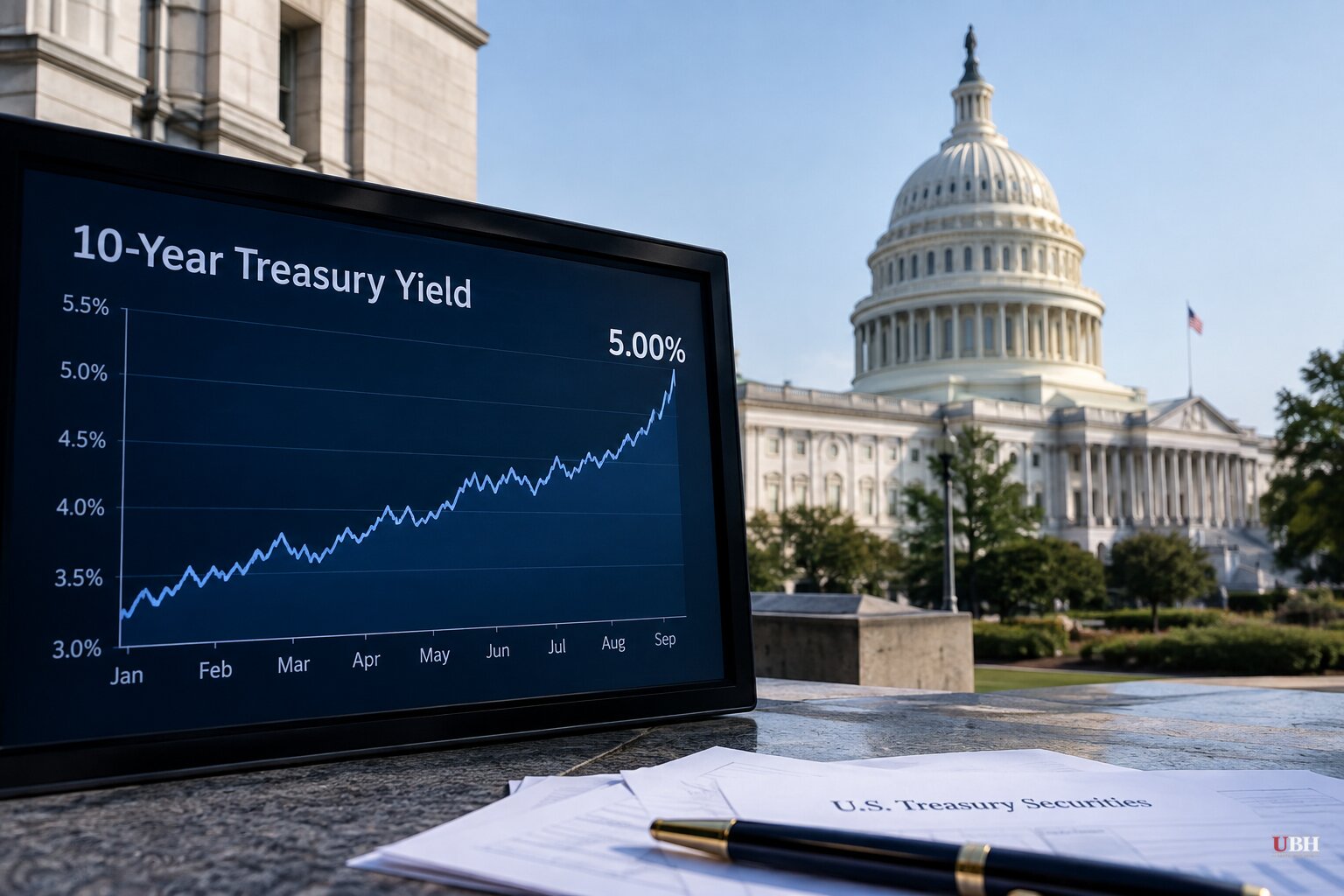
Since the 10-year Treasury yield first broke above 5% on September 10, it has stayed stuck near that level for more than a week, a threshold the market hasn't touched since 2007, according to Fortune. The 30-year yield climbed even higher, moving above 5.3%, according to STL.News, which cited Federal Reserve data showing the 10-year constant-maturity yield at 4.95% on September 10.
By Friday, September 18, the picture had softened only slightly. Yahoo Finance reported the 10-year was back to "almost precisely 5%" at midday, having briefly poked above that level earlier in the month before retreating modestly.
Why Yields Blew Past Every Forecast
The Congressional Budget Office's most recent long-term outlook, issued in February, projected the 10-year yield at just 4.1% this year and 4.2% in 2027, drifting up to 4.4% by the mid-2030s, according to Fortune. That forecast predates the Iran war, the oil price spike, and the September inflation scare. Reality has already blown past it by roughly a full percentage point.
Multiple forces are pushing in the same direction at once. The Saudi Ministry of Energy said on social media that its East-West Pipeline came under attack on September 10, causing injuries and rattling oil markets, according to Epoch Times. ING commodities strategists Warren Patterson and Ewa Manthey said Brent crude jumped nearly 3% in response.
That fed straight into inflation. August consumer prices rose 0.4%, with gasoline up 3.9% and energy overall up 16.3% year over year, according to Epoch Times. That's a sharp turn from July's 0.1% monthly increase.
The inflation jump reshaped rate expectations in an unusual direction. As of September 11, the CME Group's FedWatch tool assigned a 90.3% probability to a 25-basis-point rate hike at the Fed's upcoming meeting, up from 59.4% a week earlier, according to Epoch Times. That's notable because the Fed had held its target range at 3.5% to 3.75% since a 9-3 vote at the end of July, and Epoch Times separately reported that President Trump has been pressing the Fed to cut rates, not raise them, ahead of that meeting. The market is currently pricing the opposite of what the White House wants.
Vikram Kumar, an economics professor at Davidson College, told the college's Martin Institute for Public Good that the surge reflects an unusually tangled mix of forces rather than a single culprit: inflation expectations, a rising term premium, and heavy private debt issuance by AI hyperscalers like Meta competing with the Treasury for the same pool of investor capital. He also noted the U.S. isn't alone. The U.K., Japan and France have all seen record jumps in borrowing costs over the past month, he said, calling it "a signal to policymakers and to politicians to fix their fiscal houses."
The Numbers Behind the Alarm
The federal deficit has already reached roughly $1.97 trillion through the first 11 months of fiscal 2026, exceeding the entire fiscal 2025 deficit of about $1.775 trillion, according to Treasury data cited by STL.News. Interest costs alone are up $143 billion, or 13%, year over year for the same period.
CBO's 2026 baseline projects the deficit hitting $3.1 trillion by 2036, with debt held by the public rising from about 101% of GDP this year to 120% by 2036, which STL.News notes would exceed the post-World War II record. Net federal interest costs are projected to climb from roughly $1 trillion this year to $2.1 trillion by 2036, nearly the size of all projected discretionary spending that year.
The Committee for a Responsible Federal Budget estimates that if yields stay more than 80 basis points above baseline projections, annual interest payments will hit $2.7 trillion by the end of the decade, more than Medicare or Social Security retirement benefits, according to Fortune. "The real threat is the debt spiral," CRFB president Maya MacGuineas said. "If interest begets debt, and debt begets interest, eventually debt will spin out of control. A fiscal crisis, once unthinkable, is now a distinct possibility."
Not Everyone Is Panicking, Yet
The fairest pushback against the doom framing comes from Ed Yardeni, the market veteran who coined the term "bond vigilantes." For years he argued 4% to 5% yields represent a normal range for a healthy economy running hot with a tight labor market, not a warning sign. Kumar echoed a version of that view, telling Davidson's Martin Institute he remains "generally bullish" on the U.S. economy even while conceding "as a consumer, I worry a little bit."
Robin Brooks, a senior fellow at the Brookings Institution, offered a more pointed version of the concern in a Substack post reported by International Business Times. He noted that yields kept rising even as some recent economic data came in weaker than expected, which historically would push yields down, not up. He called the disconnect a sign investors are focused on the deficit itself rather than growth. IBT was careful to note that this is "an interpretation of market movements, not proof that a debt crisis is imminent."
Brooks also pointed to a structural shift: foreign central banks have traditionally been steady Treasury buyers, but Norges Bank Investment Management, the world's largest sovereign wealth fund, has proposed shifting some holdings away from Treasuries, according to IBT. Hedge funds, which are more sensitive to price swings, have taken on a bigger role instead.
On the more alarmist end, economist Peter Schiff wrote on September 14 that "don't be fooled into thinking this is the top. It's more likely just a launching pad to 6 percent and beyond," according to Epoch Times, which also noted Schiff has long warned of a coming sovereign debt crisis and dollar collapse. Mohamed El-Erian described the move as "even more dramatic" in bonds like U.K. gilts. Capital Economics' John Higgins said some in the market view 5% as a threshold above which things could go into "meltdown," though he personally isn't convinced 5% is a magic number.
Epoch Times' headline described the 5% level as the "highest since 2023," while Fortune described it as the highest since 2007. The two outlets' body text doesn't resolve the discrepancy, and neither cites a third-party historical yield database to settle it.
Yardeni's own tone has shifted. "We will worry about a debt crisis when the bond market worries about a debt crisis," he wrote Tuesday, according to Fortune. That line reads less like reassurance now than an admission the bond market might be getting there.
The next data point to watch is the Fed's upcoming rate decision, where futures markets are now betting on a hike rather than the cut the White House wants. Whether that decision cools yields or adds fresh fuel to them will be the first real test of who's right, Yardeni or Schiff.
Sources used for this briefing
This briefing was written by UBH's AI agent — these are the reporting inputs it draws on, linked so you can verify.


