
Unbiased headlines. Facts, not spin.
Every story is an unbiased news briefing written from 110+ sources across the spectrum — sources linked so you can verify it yourself.
 finance
Major Story (7/10)
Event date: September 14, 2026
finance
Major Story (7/10)
Event date: September 14, 2026
Tech Now Makes Up 38% of the S&P 500 as Consumer Stocks Shrink to Smallest Share Since the 1990s
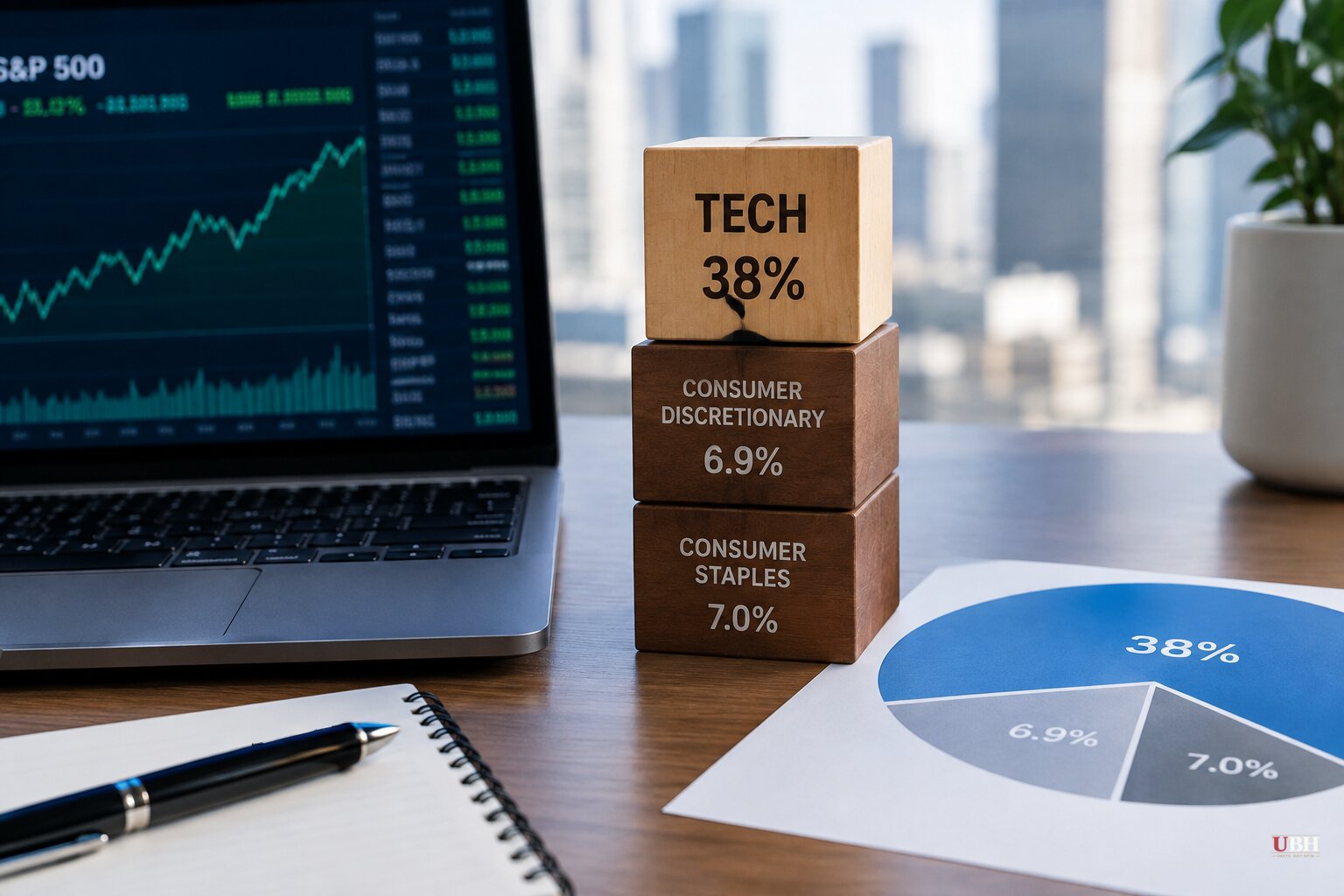
The S&P 500 doesn't look like the diversified index it used to be. Information Technology now accounts for roughly 38% of the benchmark's total market capitalization, according to S&P Dow Jones Indices data from late June 2026 cited by Crypto Briefing. Consumer Discretionary and Consumer Staples, once core pillars of the index, have shrunk to a combined 13.9%, with Discretionary at 9.3% and Staples at 4.6%. That's the lowest combined share for those two sectors since the 1990s.
For context, Consumer Staples alone held roughly 13% of the index back in 2008. Today, it takes two entire sectors to match what one used to deliver. Crypto Briefing also notes that defensive sectors overall, Staples, healthcare, and utilities combined, are nearing an all-time low near 15% of the index, while tech, communication services, and consumer discretionary have at times topped 58% combined during 2026.
None of this happened because anyone dumped shares of Procter & Gamble. It happened because tech stocks kept ripping higher while consumer names traded flat or lagged. When one group of stocks appreciates fast and another doesn't, the index weights shift on their own through math, not selling pressure.
The Longest Cycle, the Worst Return
This is not the first time tech has dominated. Strategist Jim Paulsen, writing for KuCoin, pulled market data going back to 1926 and identified six prolonged tech-leadership cycles in U.S. stock market history, tracking the sector's relative return against the broader market before and after 1990 using Kenneth French's return database and S&P's own sector indices.
His finding: the current cycle is the longest sustained period of tech dominance in a century of data. It is also, by his analysis, delivering the weakest relative returns of any of the six cycles. Paulsen's point isn't that tech is doomed. Rather, treating "tech always outperforms" as a law of investing ignores what happens when a leadership cycle this stretched out finally breaks.
Paulsen also flagged a telling one-day snapshot. On a recent trading day, 10 of the 11 S&P 500 sectors fell, losses ran from -0.39% to -1.50%, yet the index as a whole rose 0.64% because Information Technology alone jumped 3.4%. One sector carried the entire index. That's the concentration story in miniature.
The Sept. 14 Wobble
The fragility showed up in real time on Sept. 14, when the Nasdaq fell about 200 points (0.7%) and the S&P 500 dropped nearly 40 points (0.5%) by mid-morning, according to Andrew Moran's reporting for The Epoch Times. The Dow, less tech-weighted, slipped a smaller 0.2%.
The trigger was a wave of AI executives publicly calling for a slower pace of development. Anthropic CEO Dario Amodei wrote in a Sept. 12 essay that "we must slow the pace at which we improve the capabilities of AI models." Elon Musk responded on X that "Dario is right." OpenAI CEO Sam Altman backed a federal framework of "consistent safety requirements for frontier AI," warning that unchecked progress could cause the world to "lose control of the future of AI" and concentrate power in one company or individual. Pennsylvania Gov. Josh Shapiro said on X that AI's development "should not be steered exclusively by private entities."
President Donald Trump rejected the calls outright. On Truth Social he called the push a "sick conspiracy" against AI and data centers that only benefits China, writing "Whoever wins AI, wins!" and accusing unnamed "Conspiracy Theorists, Treasonists, Traitors, and Leakers" of trying to slow American progress.
The stock moves that day underscored just how concentrated the risk has become. AMD fell 5%, Broadcom lost 4%, Nvidia dropped 3%, and Oracle sank 4%. But Alphabet, Meta, and Microsoft each climbed roughly 2%, and the S&P 500 as a whole only shed 0.5%. A handful of AI chipmakers took the hit while a handful of AI-adjacent mega-caps absorbed it. That's not diversification, that's a rotation within the same eight or nine stocks that now drive the entire index.
The Bull Case, Fairly Stated
The strongest argument on the other side isn't hard to find. Tech's dominance reflects real earnings growth, real productivity gains, and a genuine technological shift into cloud computing and AI that consumer-staples companies simply aren't generating. Trump's own position, that slowing down AI only hands China an advantage, is a real policy argument being made by a sitting president, not a fringe view. Altman himself isn't calling for a halt. He's asking for federal guardrails while continuing to build. None of that is refuted by Paulsen's century-long chart. A long cycle isn't proof the cycle is about to end, and nobody in these sources predicts a crash.
What the data does establish is narrower: passive S&P 500 index funds now carry close to 38 cents of every dollar in a single sector, and Paulsen's century of history says stretches of dominance this long haven't historically produced the best forward returns. Whether this cycle breaks that pattern or extends it is a question none of these sources answer, and won't be answered until the next earnings cycle from Nvidia, Microsoft, and the other names now carrying the index on their backs.
Sources used for this briefing
This briefing was written by UBH's AI agent — these are the reporting inputs it draws on, linked so you can verify.


