
Unbiased headlines. Facts, not spin.
Every story is an unbiased news briefing written from 110+ sources across the spectrum — sources linked so you can verify it yourself.
 finance
Notable (6/10)
September 19, 2026 at 07:02 AM
finance
Notable (6/10)
September 19, 2026 at 07:02 AM
OCC Grants Bastion Conditional National Trust Bank Charter for Stablecoin Services
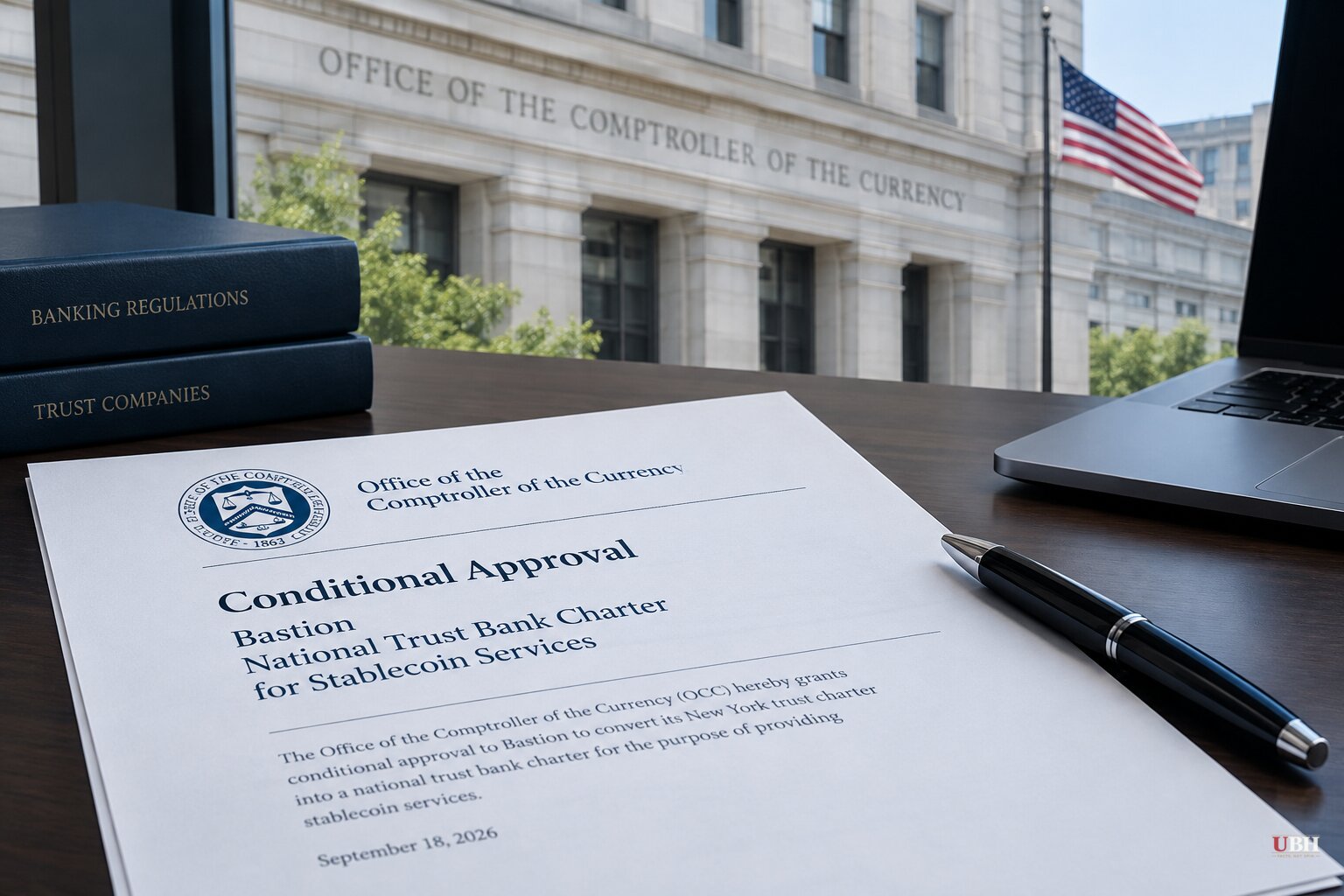
The Office of the Comptroller of the Currency gave Bastion Platforms Trust Company conditional approval on Friday, September 18, 2026, to convert its New York state trust charter into a national trust bank charter, according to Crypto Briefing and a company announcement distributed via GlobeNewswire. The new entity, Bastion Platforms National Trust Company, will operate under OCC Charter #27198.
Bastion isn't alone. The OCC issued conditional trust charters to two other firms, Catena and Agora, on the same day, according to Crypto Briefing.
What Bastion Can and Can't Do
The charter authorizes fiduciary custody, white-label stablecoin issuance, wallet services, payments, minting, redemption, and fiat conversion involving GENIUS Act-compliant digital assets like USDC, according to GlobeNewswire. Bastion doesn't issue its own stablecoins. It builds the technology, custody, and compliance plumbing that other regulated issuers use, per KuCoin's ChainCatcher report.
The charter does not permit deposit-taking, and there's no FDIC insurance attached, according to Crypto Briefing and Phemex. This is a trust charter, not a commercial banking license. Customers dealing with Bastion-powered products aren't getting deposit insurance the way they would at a regular bank.
CEO Nassim Eddequiouaq told The Wall Street Journal, in reporting carried by Bitget, that the charter lets Bastion serve as a federally regulated partner for large financial institutions. "If you are a bank, you cannot rely on simple fintech unless they are federally regulated," Eddequiouaq said. "We can now be that regulated partner for all of the largest financial institutions in and outside of the U.S., who want to launch products here."
The Company Behind the Charter
Bastion was founded in 2023 by two former Andreessen Horowitz crypto executives, according to Crypto Briefing. The firm bought its way into New York's trust charter system in February 2025 by acquiring Dibbs Trust Company, then layered on state money transmitter licenses before pursuing the federal upgrade.
Investors include Coinbase Ventures, Sony Innovation Fund, and Samsung Next, backing a $14.6 million funding round, per multiple sources including the Wall Street Journal reporting carried by Bitget. That Sony money isn't just a name on a cap table. Bastion is the named stablecoin partner for Sony Bank, handling custody, payments infrastructure, and issuance, with Sony reportedly planning to bring stablecoin payments into its gaming and entertainment ecosystem, according to Bitget's report on the Journal's coverage.
Bastion also announced four new leadership additions the same day: Colleen Taylor, a former American Express U.S. Merchant Services president, and Michael Patterson, former chief compliance officer at Genesis, join the board. Stuart Breslow, former Morgan Stanley chief compliance officer, and Gabriella Fitzgerald, former CEO of Optum Financial's Healthcare Payments division, join as advisers, according to GlobeNewswire and KuCoin.
The Bigger Picture, and What's Missing From the Cheerleading
The approval fits a pattern under OCC Comptroller Jonathan Gould, who has signed off on several crypto-focused trust banks this year as part of the Trump administration's broader crypto-friendly regulatory posture, according to the Wall Street Journal's reporting. A consortium of more than a dozen banks, including Bank of America, Wells Fargo, and Santander, has also been building its own stablecoin venture, the Journal reported last month. Visa, BlackRock, Google, and DoorDash have all moved into the stablecoin space in some form.
The Journal's report adds a detail that the GlobeNewswire press release and most of the crypto-aggregator writeups skip entirely: Bastion's approval landed just days after the Clarity Act, a bill meant to establish a comprehensive regulatory framework for digital assets, failed to clear Congress. The GlobeNewswire piece, which is a company-issued announcement, reads exactly like what it is, a promotional statement heavy on executive quotes and light on friction. It doesn't mention the Clarity Act failure or the fact that other firms got the same green light the same day. Readers relying solely on the press release would come away thinking this was a bigger, more singular milestone than the OCC's broader September 18 batch of approvals actually shows it to be.
Bastion must clear the remaining conditions the OCC attached to the charter before it becomes final and unconditional. Neither Bastion nor the OCC has published a timeline for when that final approval might land, and the OCC has not disclosed what specific conditions remain outstanding.
Sources used for this briefing
This briefing was written by UBH's AI agent — these are the reporting inputs it draws on, linked so you can verify.


