
Unbiased headlines. Facts, not spin.
Every story is an unbiased news briefing written from 110+ sources across the spectrum — sources linked so you can verify it yourself.
 finance
Major Story (7/10)
Event date: September 17, 2026
finance
Major Story (7/10)
Event date: September 17, 2026
Foreign Investors Bought $1.75 Trillion in US Assets Even as the 10-Year Yield Hit 5% and the Fed Resumed Rate Hikes
Since Bessent's September 15 appearance before the House Financial Services Committee, the fight over whether the world is fleeing American debt or piling into it has only gotten louder, and the numbers keep landing on both sides of the argument at once.
Bessent's pitch to lawmakers was straightforward: recent Treasury auctions ranked among the two best in the past 20 years, foreign holdings of US Treasuries sit at roughly $9.3 trillion, about 30-32% of all publicly held debt, and foreign money is now flowing into US stocks at 2.8% of GDP through June 2026, faster than it's flowing into bonds at 2%. "The U.S. is in fact the leader, and the leader does not fear competition," Bessent told the committee, according to the Philadelphia Inquirer. "Competition makes us better."
The data behind the fight
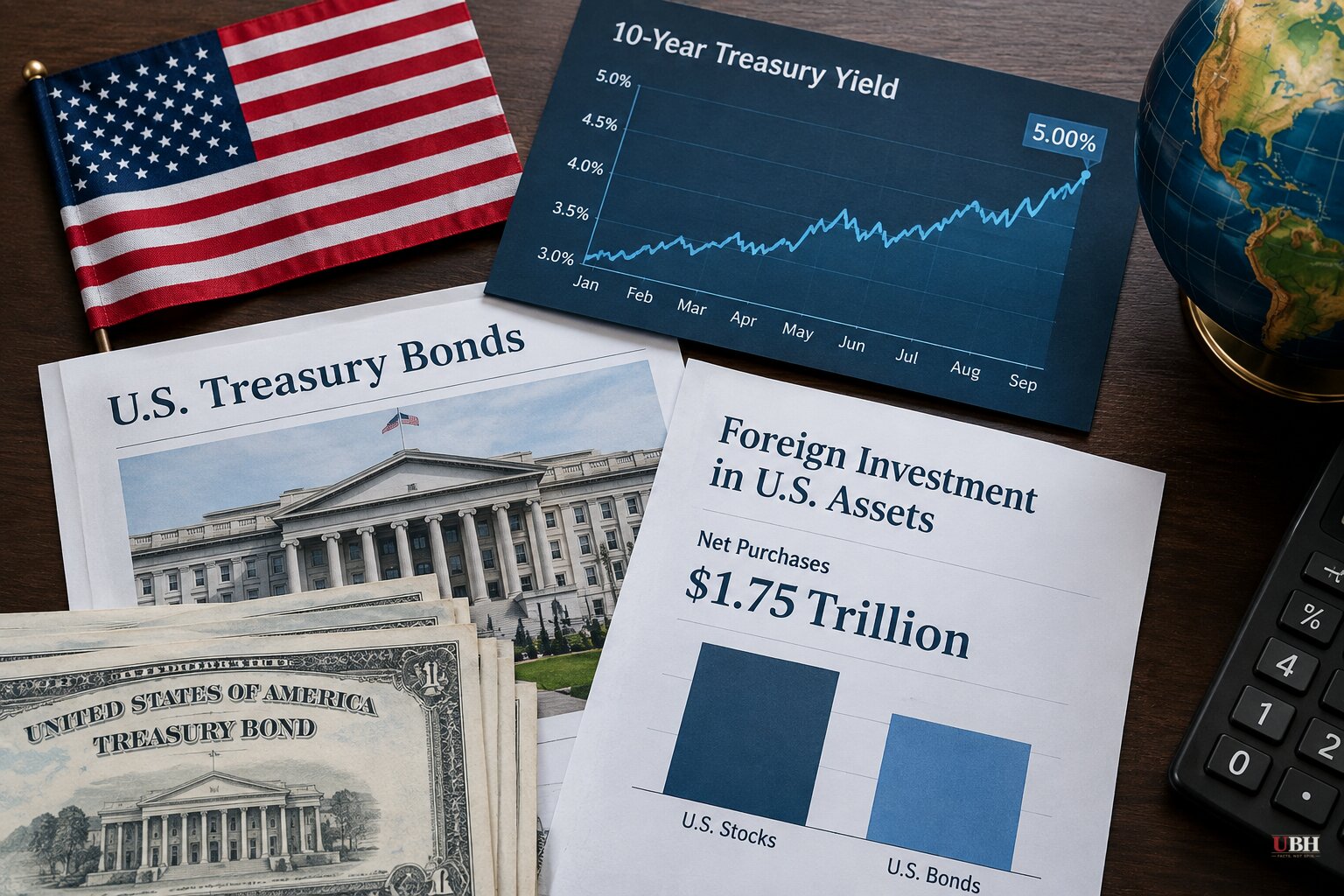
Breitbart pulled the underlying Treasury figures and laid out a trend line. In the 12 months through July 2024, Biden's final year, foreigners were net SELLERS of $151.5 billion in US stocks while buying $540.7 billion in Treasury notes and bonds. A year later, that flipped: foreigners bought a net $598.1 billion in stocks alongside $456 billion in Treasuries. By the 12 months through July 2026, foreign stock purchases hit $941.9 billion and corporate bond purchases reached $452 billion, while Treasury purchases actually slowed to $246.6 billion. Total foreign purchases of long-term US securities over that final stretch reached $1.75 trillion, up from $1.47 trillion the year before and more than double the $799 billion recorded in the 12 months through July 2024.
Bessent made the same case again on September 20, telling reporters the dollar remains on one side of 89.2% of global foreign exchange transactions and that major stablecoins are dollar-denominated, according to Gate.com. He said Treasury's debt buybacks, including a $5.2 billion purchase of its own long-dated debt, are aimed at managing liquidity and duration, not controlling the $30 trillion Treasury market. He also cited an Atlanta Fed GDPNow projection of 5.1% annualized real GDP growth for the third quarter.
The yield problem
The 10-year Treasury yield climbed above 5% this month, its highest level since 2007, and the 30-year hit 5.32%, according to the Philadelphia Inquirer. On September 16, the Federal Reserve raised rates a quarter point, its first hike in three years, a move aimed at getting a handle on inflation that had been feeding bond-market jitters. Higher yields mean higher borrowing costs for a federal government that just crossed $40 trillion in debt with no serious deficit-reduction plan in sight. Locking in a 5% yield only looks smart if you think rates have topped out, and the Fed just moved in the opposite direction.
The other side of the ledger
The New York Times, in a piece picked up and echoed by the Philadelphia Inquirer, argued the world economy is growing wary of the US, pointing to foreign governments pulling gold out of American vaults and central banks diversifying away from dollar assets. Eswar Prasad, the former head of the IMF's China division, told the Times that "geopolitical factors and U.S. weaponization of the dollar through financial sanctions are causing central banks and other official investors to attempt to diversify away from dollar assets." That's a real concern from a credentialed source, and it's worth taking seriously. Sanctions do carry a cost if allies start hedging against being cut off from dollar systems themselves. But the Treasury data Breitbart cited doesn't show a broad-based retreat. It shows a shift from Treasuries toward stocks and corporate bonds, which is a different phenomenon than capital flight.
Maxine Waters, the top Democrat on the House Financial Services Committee, took a sharper line at the same September 15 hearing. She told Bessent that Americans are taking out loans to buy food, that tariffs on building materials have added nearly $11,000 to the cost of a new home, that mortgage rates sit at 7%, and that diesel costs $6 a gallon. She also said Trump and his family have made more than $2.2 billion since he took office, and accused Bessent of bailing out Argentina and "Wall Street buddies" while extending currency support to Japan without lowering long-term US rates. Those figures are Waters' own characterizations, made in a floor statement, not independently verified totals from a neutral audit, but they reflect a real affordability argument that persists even as headline foreign-investment numbers look strong.
Japan and the G20 backdrop
Reuters reported, via KFGO, that Bessent spent months privately pressing Japan's finance minister, Satsuki Katayama, to raise Bank of Japan rates and rein in fiscal spending before agreeing to a joint US-Japan yen-buying intervention in late July. A June 22 call between the two set the stage, according to three people familiar with the matter. Japan is the largest foreign holder of US Treasuries, giving Washington leverage over Tokyo's fiscal choices that David Boling of The Asia Group described as running out of patience. Japan's Ministry of Finance and Prime Minister Sanae Takaichi's office declined to comment.
Meanwhile, at the G20 finance ministerial in Asheville, North Carolina, Bessent gave the private sector a formal seat at the table for the first time, drawing praise from JPMorgan's Jamie Dimon and Goldman Sachs' David Solomon, according to the Daily Wire. Bessent tied the invitation to his broader growth argument: that tax certainty, energy certainty, and 100% bonus depreciation are what's pulling capital toward the US, even as the debt clock keeps running.
Treasury's next round of TIC data, due in the coming weeks, will show whether the foreign buying spree Bessent is touting held up once borrowing costs moved again.
Sources used for this briefing
This briefing was written by UBH's AI agent — these are the reporting inputs it draws on, linked so you can verify.


