
Unbiased headlines. Facts, not spin.
Every story is an unbiased news briefing written from 110+ sources across the spectrum — sources linked so you can verify it yourself.
 finance
Major Story (7/10)
Event date: September 18, 2026
finance
Major Story (7/10)
Event date: September 18, 2026
Fed and Bank of England Use Jane Street's $15 Billion Trading Loss to Review Bank Ties to Trading Firms
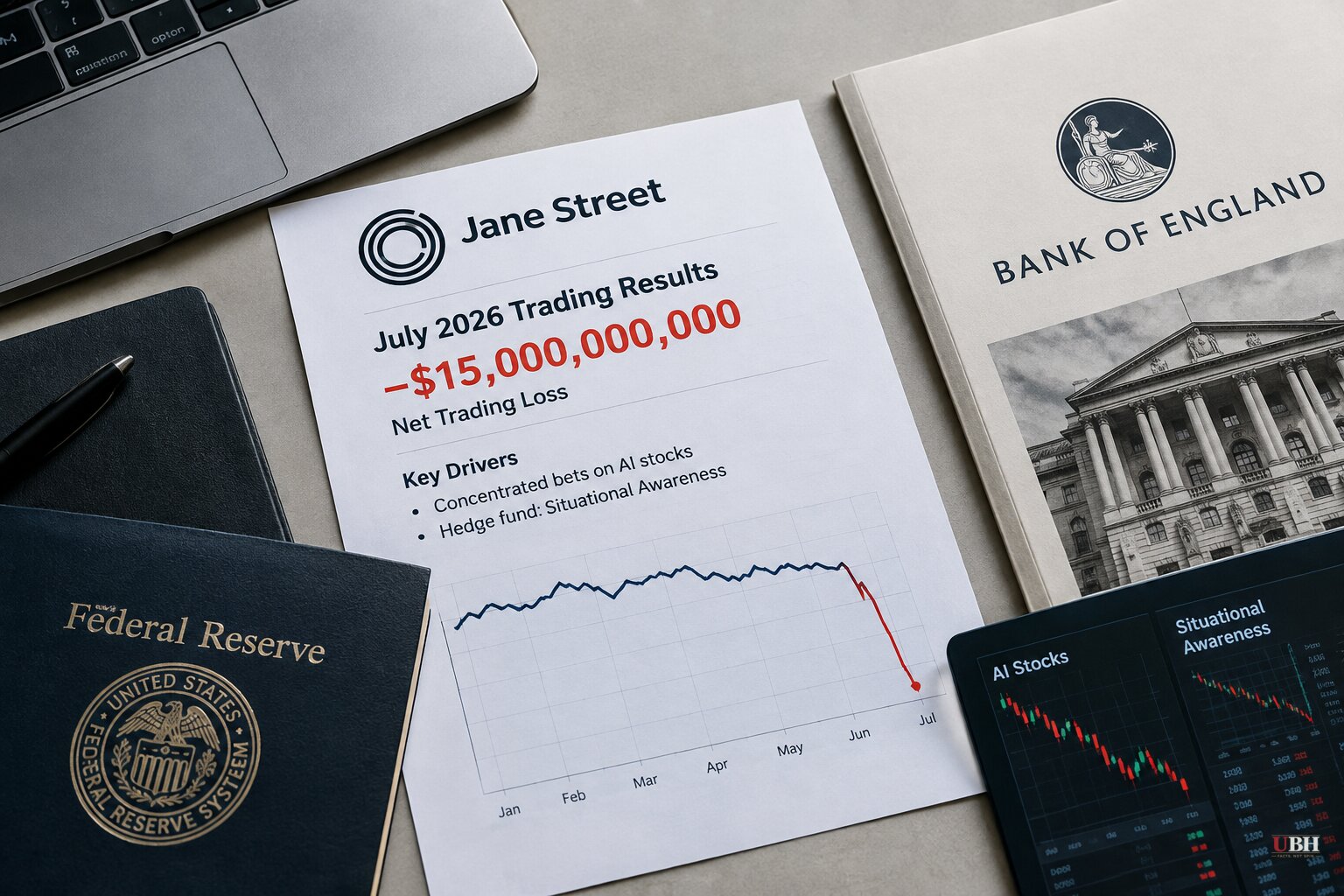
Jane Street, one of Wall Street's most profitable quantitative trading firms, lost roughly $15 billion in July 2026. That's its first month of negative trading revenue since 2016, according to Crypto Briefing.
The loss wasn't a near-death experience. By mid-August 2026, Jane Street had racked up more than $40 billion in net trading revenue for the year, already topping its full 2025 total of approximately $39.6 billion, per Crypto Briefing. This is a firm that got hit hard and kept making money anyway.
What caused the hit? Concentration risk in artificial intelligence bets. A large piece of the July losses traced back to positions tied to Situational Awareness, an AI-focused hedge fund, plus direct exposure to AI-related equities that got crushed in a broader tech selloff. Memory and semiconductor stocks were among the hardest hit, with parts of that sector falling nearly 50%, according to Crypto Briefing.
Regulators Move In
The Federal Reserve and the Bank of England are now using Jane Street's bad month as the reason to dig into how exposed banks are to trading firms like it, according to the Financial Times, as reported by Gate.com and Chain Catcher.
This isn't coming out of nowhere. The Bank of England was already sounding alarms in April 2026, when officials pushed back on proposals to loosen capital requirements for trading firms, warning that easing those rules could threaten financial stability, per Crypto Briefing.
The BoE's July 2026 Financial Stability Report went further, flagging what it called significant vulnerabilities in banks' interlinkages to non-bank financial institutions, a bucket that includes hedge funds and trading firms operating outside the traditional banking perimeter but tied to it through lending, clearing, and counterparty relationships.
S&P Global Ratings put numbers behind the concern. The ratings agency warned that banks carry trillions of dollars in aggregate exposure to hedge funds and trading firms, and described the setup as carrying inherent fragility driven by leverage and concentration risk, according to Crypto Briefing.
The Fed, for its part, is now running its own parallel review of how U.S. banks manage counterparty risk from major trading firms. The central bank is currently under the leadership of Chairman Kevin Warsh, who has been providing regular updates on interest rates and the broader economic outlook.
The Case Nobody's Making Loudly Enough
The trading industry would argue that Jane Street lost $15 billion and nobody had to bail it out. No emergency Fed facility. No taxpayer backstop. The firm absorbed the hit, kept operating, and still finished the stretch through mid-August up over $40 billion for the year. That's the system working the way it's supposed to, a private firm eating its own losses.
From that view, piling new capital rules or deeper bank oversight onto trading firms punishes success and pushes risk into less transparent corners of the market instead of eliminating it. Regulators reaching for more scrutiny every time a hedge fund or trading shop has a bad month risks becoming reflexive rather than evidence-based.
But the regulators' counterpoint isn't really about Jane Street surviving. It's about the banks standing behind firms like Jane Street through lending, clearing, and prime brokerage relationships. If a firm ten times more leveraged than Jane Street took a similar concentrated AI bet and it went the other way, the losses wouldn't stay contained to one balance sheet. That's the interconnection the BoE's Financial Stability Report is pointing at, and it's a fair question regardless of how this particular firm fared.
What's Actually Unresolved
No new capital rule has been finalized on either side of the Atlantic. The Fed's review is described as ongoing, not concluded, and no specific regulatory proposal has been announced as a result of it, according to the available reporting.
The open question is whether Warsh's Fed and the Bank of England end up tightening capital or counterparty exposure rules on banks that lend to and clear for trading firms, or whether this review ends the way plenty of regulatory reviews do, with a report and no binding change. S&P Global's trillion-dollar exposure warning gives the review teeth. Whether it produces an actual rule is the thing to watch next.
Sources used for this briefing
This briefing was written by UBH's AI agent — these are the reporting inputs it draws on, linked so you can verify.


